
As an Amazon Associate I earn from qualifying purchases and sometimes recommend products from other sellers at no extra cost you. For more details see my disclosure policy and privacy policy.
If you already know how to play Eldritch Horror, you know the mechanics well enough to lose anyway. Most losses do not come from a bad die roll on a single encounter. They come from misreading the two systems that actually decide whether your table wins or watches an Ancient One wake up: the Doom Track and the Mythos deck.
This guide skips the rules refresher (our Eldritch Horror Board Game Rules guide already covers that ground) and goes straight into how strong players actually manage those two systems across a full game.
The Doom Track Is the Real Clock
New players track their progress by mysteries solved. Experienced players track it by Doom remaining, and the difference in mindset changes almost every decision at the table.
The Doom Track measures how close the Ancient One is to waking. Every Mythos card that advances the Omen track eventually pushes the Doom token down, and once it hits zero, the game ends in a Final Mystery you may not be ready for. Mystery progress matters, but it is a means to an end. The Doom Track is the actual scoreboard.
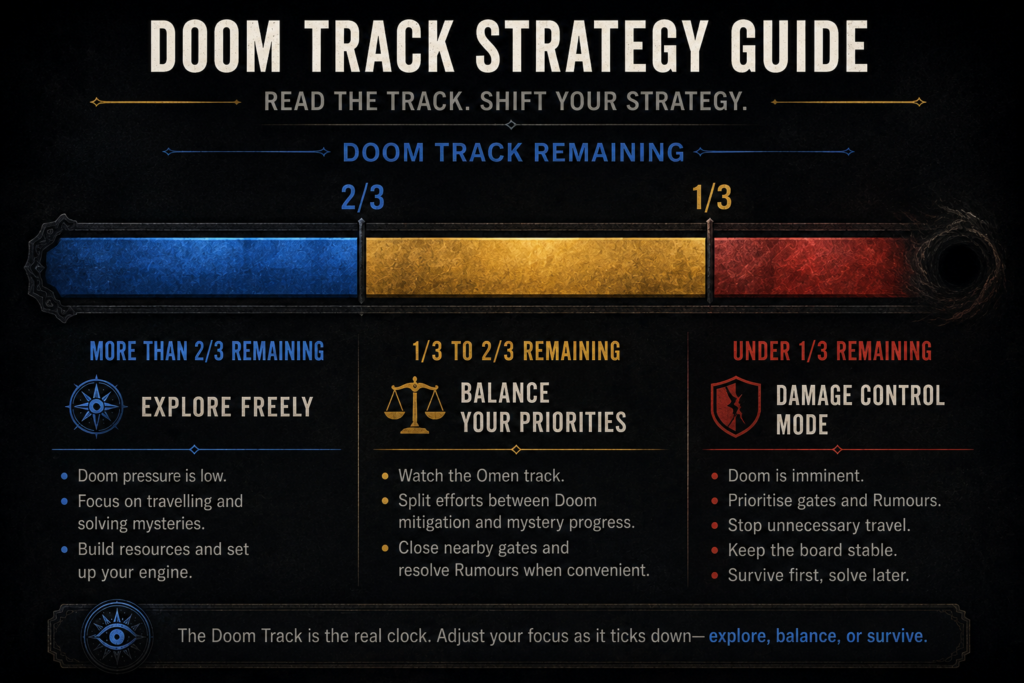
This reframing changes how you evaluate a turn. A turn that solves a mystery but ignores a mounting Reckoning that is about to spike Doom is not automatically a good turn. Ask what a turn does to the Doom Track first, and what it does for mysteries second.
Reading the Mythos Deck: Omens, Reckonings, and Rumours
The Mythos deck is not a random event generator. It is a structured deck with three card colours, and each colour tells you something different about what is coming.
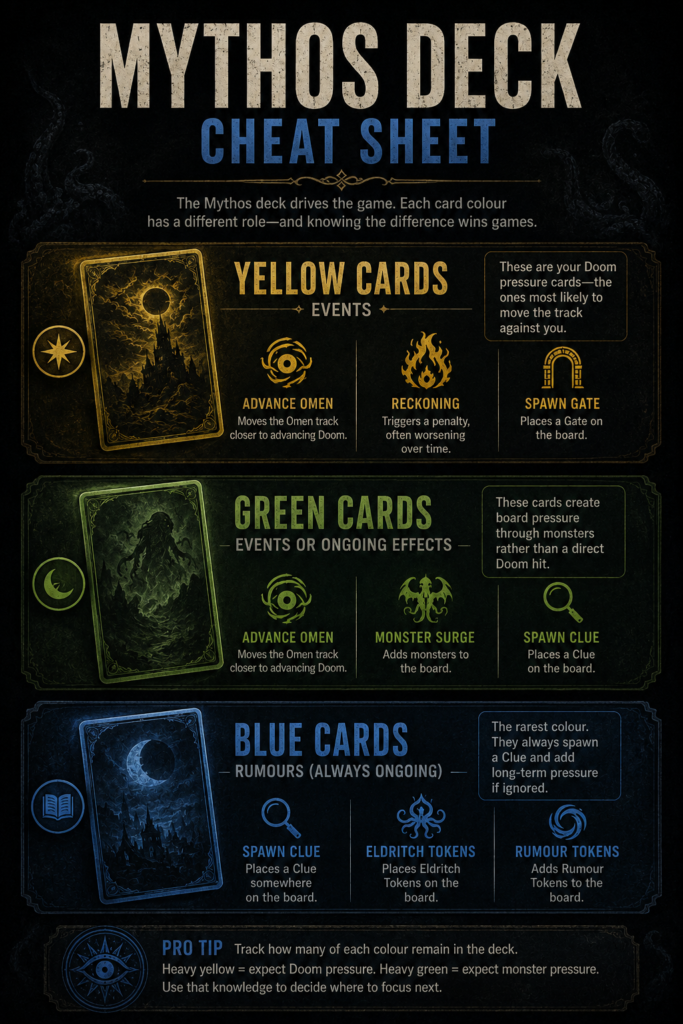
Yellow cards are Events, and they typically carry Advance Omen, Reckoning, and Spawn Gate effects. These are your Doom pressure cards, and they are the ones most likely to move the track against you.
Green cards can be Events or Ongoing effects, carrying Advance Omen, Monster Surge, and Spawn Clue effects. These cards create board pressure through monsters rather than a direct Doom hit, though they still often advance the Omen track along the way.
Blue cards are Rumours, and they are the least common colour in the deck. A Rumour is always Ongoing, and it will always spawn a Clue somewhere on the board. Rumours also tend to place Eldritch tokens or additional Rumour tokens, which quietly compound pressure over several turns if left unresolved.
Because the deck composition is fixed, you can track roughly how many yellow, green, and blue cards remain as the game progresses. A deck that is running heavy on yellow cards late in the game is a signal to prioritise Doom mitigation over exploration for the next few turns.
Balancing Doom Mitigation Against Mystery Progress
Every turn spent travelling toward a distant mystery is a turn not spent closing gates, calming a Rumour, or otherwise slowing the Omen track. Strong play is not about maximising one at the expense of the other. It is about reading which lever the current board state actually needs.
A useful gut check: if the Omen track is more than halfway to triggering its next Doom advance, treat gate-closing and Rumour resolution as your priority over chasing a new mystery clue. If the Omen track has plenty of room and a mystery is genuinely close to solved, push for the solve.
This is where reading the Mythos deck composition pays off directly. If you can see that yellow cards are thinning out and green cards dominate the remaining draws, you can afford to lean back toward mystery progress, since the immediate Doom pressure is easing even as monster pressure rises.
Splitting Roles in Multiplayer: Doom Control vs Mystery Solvers
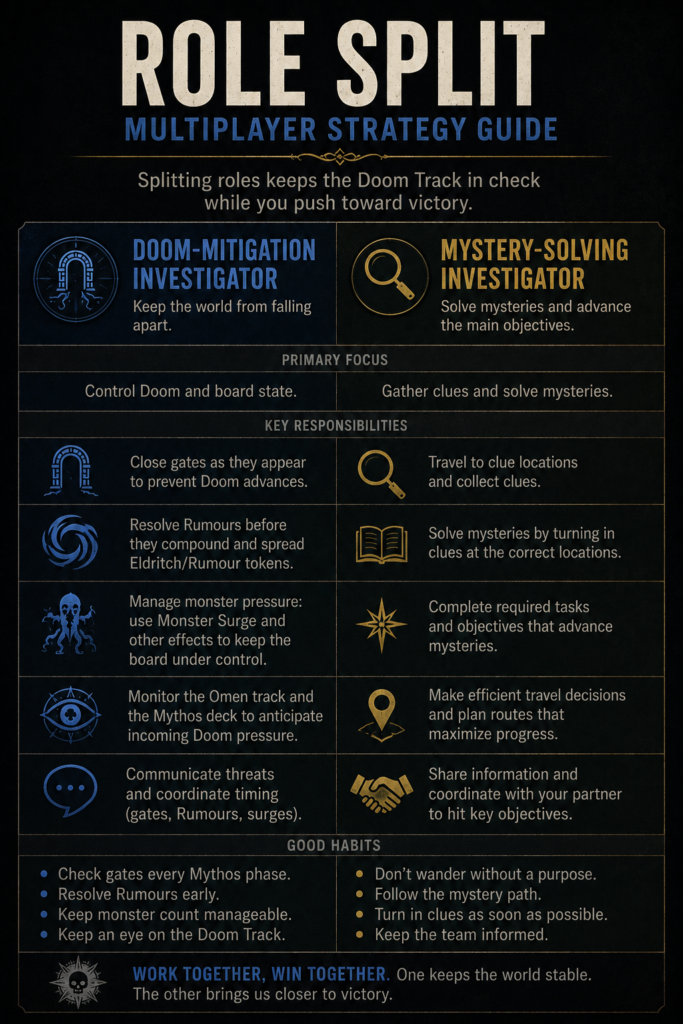
In a multiplayer game, trying to have every investigator do everything is a common way to burn actions without making real progress on either front. Splitting the party into rough roles, even loosely, tends to outperform everyone chasing the nearest clue.
One or two investigators can specialise in Doom mitigation: closing gates, resolving Rumours before they compound, and keeping the board’s monster count from spiralling. The rest can push mystery objectives, travelling to clue locations and pursuing the actual win condition.
This does not need to be rigid. A Doom-focused investigator who happens to pass through a mystery location should still pick up an easy clue. The point is that someone at the table is watching the Doom Track as their primary job, so it never falls through the cracks while everyone is focused on the mystery ahead.
Common Misplays That Burn Doom for Nothing
A few mistakes account for a disproportionate share of early Doom losses, and most of them are avoidable once you know to watch for them.
- Mismanaging the Reckoning. Ignoring a building Reckoning effect because it seems minor early on often means eating a much larger Doom or monster penalty a few turns later, once it has had time to compound.
- Ignoring monster surges. Leaving Monster Surge effects unresolved lets the board fill with monsters that block travel and encounters, which slows your mystery-solving investigators just as much as it threatens Doom directly.
- Chasing a distant mystery clue while a nearby gate sits open. An open gate is a standing Doom threat every Mythos phase it remains unclosed. Closing it is almost always worth the detour.
- Treating every Rumour as low priority. Because Rumours are the rarest card colour, it is tempting to treat them as a minor inconvenience. Left unresolved, they quietly stack additional tokens and effects that get harder to unwind the longer they sit.
Knowing When to Pivot from Exploration to Damage Control
Every game of Eldritch Horror eventually reaches a point where the correct strategy flips from expansion to damage control, and recognising that pivot early is one of the clearest markers of an experienced table.
Watch for these signals that the pivot has arrived: the Doom Track has less than a third of its space remaining, multiple gates are open at once, or the Mythos deck’s remaining cards are visibly yellow-heavy. Any one of these on its own is a warning. Two or more together mean it is time to stop chasing new mysteries and start closing what is already open.
Once you are in damage control mode, the priority order simplifies considerably: close gates before anything else, resolve Rumours next, and only push mystery progress with investigators who are already positioned to do so without a detour. This is not the position you want to be in for an entire game, but recognising it quickly, rather than a few turns too late, is often the difference between recovering and watching the Ancient One wake up.
If you are weighing Eldritch Horror against its Fantasy Flight stablemates for your next campaign, Arkham Horror vs. Eldritch Horror vs. Mansions of Madness breaks down how the Doom-Track-driven pacing here compares to the other two systems.