
As an Amazon Associate I earn from qualifying purchases and sometimes recommend products from other sellers at no extra cost you. For more details see my disclosure policy and privacy policy.
If you’ve played paper Pioneer for a while and finally decided to try it on MTG Arena, you’ve probably already hit a moment of confusion: you go looking for “Explorer” in the format list and it just isn’t there. That’s not a bug, and it’s not you misremembering the name. Explorer, as a distinct format name, hasn’t existed on Arena since May 2025, and understanding what actually happened matters more than most overview articles let on.
For the full rundown of every Arena format and how they compare, our overview of which Arena format to play is the right starting point. This piece goes deep on just one of those formats, specifically for players coming from paper Pioneer who want the real story rather than a surface-level comparison.
🕰️ What Explorer Was, and Why It Existed
Explorer launched on Arena in 2022 as Wizards of the Coast’s answer to a real problem: Pioneer, the popular non-rotating paper format built on cards printed from 2012 onward, simply wasn’t fully represented in Arena’s digital card pool. Rather than wait years to digitise every Pioneer-legal card before offering anything, Wizards shipped Explorer as a “true to tabletop” format built from whichever Pioneer-legal cards already existed on Arena at the time.
For roughly three years, that meant Explorer and Pioneer were related but not identical. The strategic shape was similar, but a meaningful slice of niche cards, old sideboard tech, and narrow synergy pieces simply weren’t available, and the two formats occasionally diverged on banned cards too.
🔄 The Rename You Might Have Missed: Explorer Became Pioneer in 2025
On May 10, 2025, Wizards officially renamed Explorer to Pioneer on Arena. This wasn’t a cosmetic label change, it was Wizards declaring the digitisation project essentially finished. After three Explorer Anthology releases, seven Historic Anthology sets, and the draftable Pioneer Masters set, the card pool gap had closed enough that Wizards felt comfortable calling the Arena format what it actually was: Pioneer.
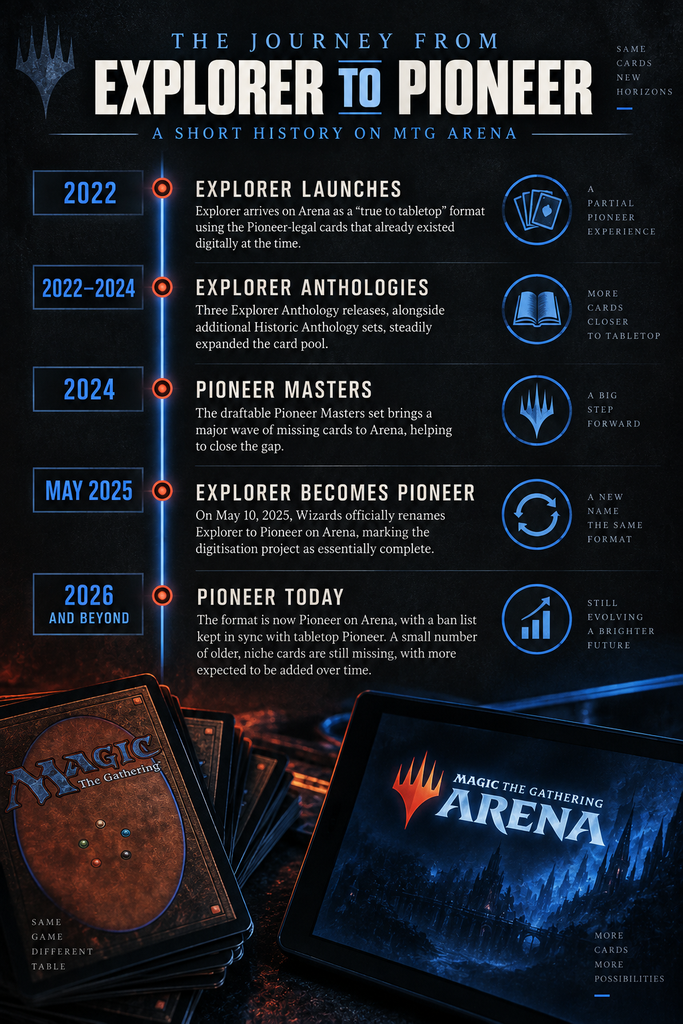
So, to directly answer the question that probably brought you here: is Explorer the same as Pioneer? Today, yes, they’re the same format under the same name, played with a ban list synced to tabletop Pioneer. Historically, no, Explorer was a narrower approximation of Pioneer for about three years. If you’re seeing “Explorer” referenced in older articles, videos, or community habit, that’s a leftover from before the rename rather than a sign of an ongoing separate format.
🗂️ The Card Pool Gap: What’s Actually Missing, and Why
The honest answer is that a card pool gap still exists, but it’s smaller and far less relevant than it sounds. Independent tracking around the time of the rename put the number of Pioneer-legal cards missing from Arena at over 2,000 individual cards, which sounds alarming until you understand what those cards actually are.
Wizards’ own data from the rename announcement is more useful here. Out of 411 distinct competitive Magic Online decklists played in the month before the switch, Explorer was missing just seven cards that appeared in those lists. The gap is concentrated almost entirely in older, low-impact, or highly niche cards, mostly from sets that predate Arena’s 2019 launch, rather than anything that shapes the competitive metagame.
This is a digitisation backlog, not a power-level decision. Cards aren’t withheld from Arena because they’re judged too strong or too weak for the format, they’re withheld because Wizards hasn’t got around to adding them yet. Wizards has committed to continuing to add newly-relevant cards at what it describes as a sustainable cadence, expected to land around once or twice a year as the competitive Pioneer metagame shifts.
🚫 Ban List Differences Between Arena Pioneer and Tabletop Pioneer
Since the 2025 rename, Arena’s Pioneer ban list is deliberately kept in sync with tabletop Pioneer’s official Banned and Restricted list, which currently sits at roughly 30 banned cards and updates on Wizards’ regular B&R announcement schedule. When tabletop Pioneer gets a new ban, Arena’s Pioneer format gets the same one; when a card gets unbanned on the tabletop list, as happened with Tibalt’s Trickery at the time of the rename, Arena follows.
There’s one genuine, current exception worth flagging if you’re used to tabletop rules. Tibalt’s Trickery is banned specifically in Best-of-One Pioneer on Arena, while it remains legal in Best-of-Three Pioneer and in tabletop Pioneer generally. Without a sideboard to bring in an answer, Bo1’s single-game structure made the card’s early combo lines too oppressive to leave unaddressed, so Wizards carved out an Arena-specific, mode-specific ban rather than touching the shared list.
Beyond that one carve-out, don’t assume Arena and tabletop Pioneer will keep diverging the way Explorer and Pioneer used to. Ban list parity, aside from the Bo1 Tibalt’s Trickery exception, is the current default state, not something you need to double-check before every deck build.
⚔️ Which Pioneer Archetypes Translate Cleanly (And Which Don’t)
Because Arena’s Pioneer card pool now tracks the competitive Magic Online and paper metagame so closely, established tier-one and tier-two archetypes translate almost without friction. If a deck is winning real Pioneer events, the odds are extremely high that every meaningful card in its 75 is already on Arena, since that’s specifically the standard Wizards used to judge the format ready for the rename.
Where things get rougher is homebrew and rogue territory. Decks built around older, narrower synergy pieces, especially cards from sets that predate Arena itself, are more likely to hit a wall of missing cards. Sideboard plans leaning on obscure utility lands or old hate cards can also be thinner on Arena than in a paper sideboard box, simply because those cards haven’t been prioritised for digitisation yet.
The practical takeaway is simple. If you’re bringing over a known, tournament-proven Pioneer list, expect it to build cleanly. If you’re bringing over a personal brew with unusual card choices, check each card individually before committing wildcards, since that’s where the residual gap actually lives.
💎 Migrating Your First Deck: Wildcards and What to Expect
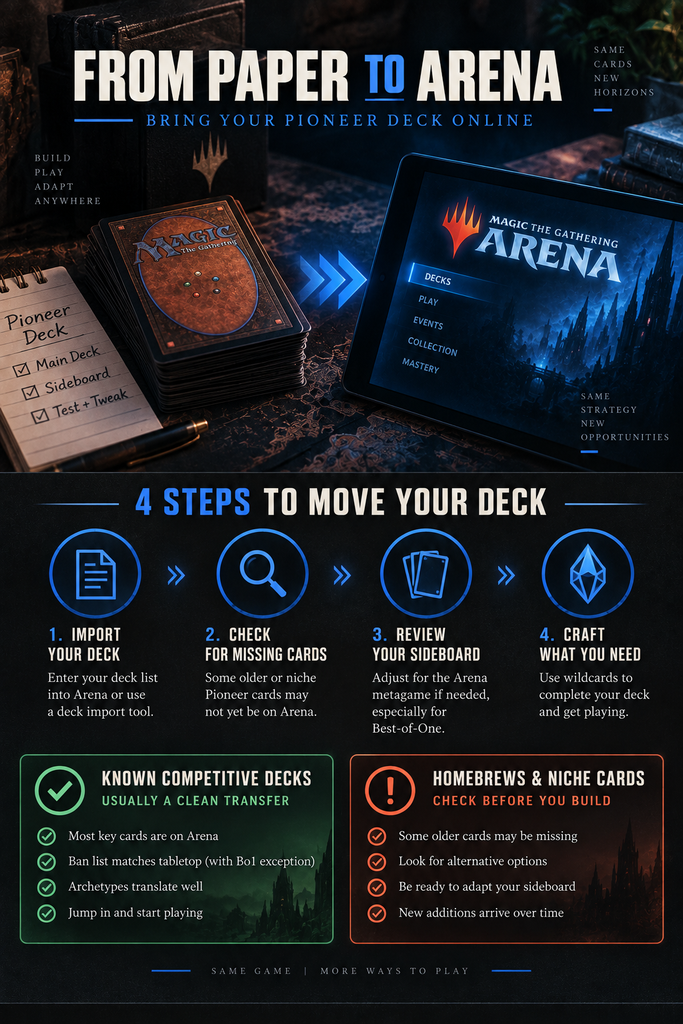
If you’re a paper Pioneer player building your first Arena deck, the process is more predictable than people assume. Search for your exact decklist, ideally a recent, tournament-verified one, and Arena’s deck import and wildcard-cost tools will show you exactly what you own versus what you need before you spend anything.
A few practical notes for the migration:
- Budget your wildcards around rares and mythics first, since commons and uncommons are cheap enough in gold that they rarely bottleneck a build.
- Expect the occasional gap on very old or very niche cards, particularly one-of sideboard pieces, and have a substitute in mind before you start crafting.
- Don’t assume your paper sideboard plan transfers directly. Check each sideboard card individually, since sideboard tech is disproportionately where older, less-digitised cards tend to cluster.
- If wildcard budgeting in general is unfamiliar territory, the same budget-conscious approach used in 5 Budget Standard Decks for MTG Arena applies just as well here: build toward proven lists rather than speculative brews until your collection is established.
Pioneer is also a non-rotating format on Arena, which is worth knowing if your experience so far has been Standard-only. Once you’ve built a deck, that investment doesn’t age out the way a Standard deck does after rotation, so wildcards spent here tend to hold their value longer. For a deeper look at how gold, gems, and wildcards actually work together, our guide to the Arena wildcard economy is worth reading before you commit a season’s worth of resources to one deck.
🏆 Where Pioneer Sits in Arena’s Competitive Ecosystem
Pioneer has its own ranked ladder on Arena and is playable in both Best-of-One and Best-of-Three, but it’s honest to say it’s a secondary format rather than Arena’s competitive centrepiece. Play rates for Pioneer have stayed steady but comparatively small alongside Standard and Alchemy, more in line with Timeless and Standard Brawl than with the main ladder formats.
On the organised play side, dedicated Pioneer competitive events are still building momentum rather than headlining the calendar. Wizards has signalled plans to run Arena Championship and Qualifier events specifically featuring Pioneer starting in 2027, which suggests the format is being treated as a growing pillar rather than an afterthought, even if it isn’t yet on the same competitive footing as Standard.
For most paper Pioneer players, that’s actually good news. It means you can ladder, practise, and test paper lists digitally without the format’s queues drying up, while knowing its competitive presence on Arena is still on the way up rather than already past its peak.
Explorer didn’t disappear, it grew up and got renamed. If you’re coming from paper Pioneer, the Arena version is closer to your paper experience today than it has ever been, with a synced ban list and a card pool gap that’s mostly academic rather than practical. Bring a tournament-proven list, budget your wildcards sensibly, and you’ll be playing something that genuinely resembles the paper format you already know within a session or two.