
As an Amazon Associate I earn from qualifying purchases and sometimes recommend products from other sellers at no extra cost you. For more details see my disclosure policy and privacy policy.
Ask most players what they think of aggro, and you’ll hear the same thing: “You just play creatures and turn them sideways.” The implication is that fast decks are for players who want wins without thought — a shortcut through sheer speed rather than skill.
That impression is wrong, and it costs players games every single day.
Elite aggro players are making a stream of high-stakes micro-decisions every turn: when to trade, when to press damage, which threat to deploy first, how to sequence two spells on the same turn, and how to force opponents into situations where every choice is a losing one. Aggro is not about ignoring the game — it’s about compressing it into its most consequential moments before your opponent gets comfortable. The window for all of those decisions is just much tighter.
This guide is for players who want to actually master MTG Arena aggro in Standard, not just ride wins on a curve-out. Whether you’re on Mono-Red, Izzet Prowess, or any of the current archetypes, these principles will sharpen your play and help you squeeze more wins out of the same decklist.

| What You’ll Learn | Why It Matters |
|---|---|
| Resource denial and forcing decisions | The real mechanism behind aggro wins |
| Sequencing fundamentals | The skill that separates good and great players |
| Attack decisions | The most common mistake aggro players make |
| Bo1 vs Bo3 differences | Two completely different games on Arena |
| Current Standard archetypes | What each deck teaches about aggro strategy |
| Sideboard philosophy | How to not wreck your own deck between games |
The Real Strategic Layer: Resource Denial and Forcing Decisions
The conventional description of aggro — “reduce your opponent’s life total to zero before they can set up” — is technically accurate but misses the deeper mechanism entirely.
Aggro wins by creating a resource asymmetry. When you deploy threats that cost less mana than your opponent’s answers, you force them to spend their resources on your timetable, not theirs. A 1-mana creature that demands a 3-mana removal spell isn’t just a creature — it’s a tempo trade that puts your opponent structurally behind. While they’re answering your board, they’re not building their own engine.
This is the real heart of what aggro does: it denies the opponent the luxury of playing their game. The foundational 1999 article “Who’s the Beatdown?” captured this precisely — the beatdown player forces the opponent to deal with immediate threats while minimising the time and resources they can invest toward a longer game. Every creature you play, every burn spell you point at a blocker, is a decision your opponent has to respond to now.
Threat Density as Decision Pressure
Aggro decks maintain pressure through redundancy. Running four copies of your key one-drops isn’t just about consistency — it’s about ensuring that your opponent cannot “answer their way out” of trouble. If every card in your deck is a meaningful threat, your opponent runs out of answers before you run out of damage.
This is what players mean when they talk about aggro creating “virtual card advantage”: you win because your opponent exhausts meaningful choices before you exhaust meaningful threats. In the current Standard environment, Izzet Prowess illustrates this perfectly. The deck uses Stormchaser’s Talent, Slickshot Show-Off, and Elusive Otter alongside cheap cantrips — not to overwhelm on raw creature count, but to maintain a relentless stream of must-answer threats. The opponent keeps reacting until they’re dead.
If you want to understand how these archetypes fit into the broader format, the Standard metagame breakdown covers what’s actually putting up results at the competitive level right now.
Sequencing: Why the Order You Play Cards Matters Enormously
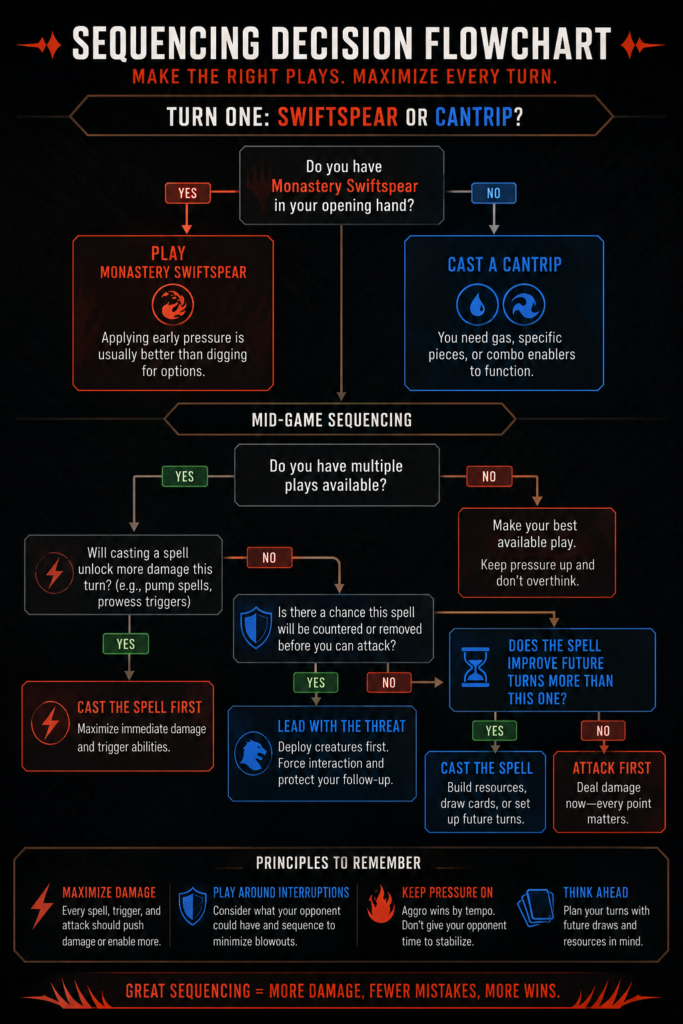
No skill separates beginning aggro players from advanced ones more clearly than sequencing. It’s the art of determining which card to play first when you have multiple options — and in most aggro decks, sequencing mistakes don’t just cost you efficiency. They cost you games.
Consider a hand with Monastery Swiftspear, a cantrip, and a burn spell on turn one. The “obvious” play is Swiftspear first, then cast the cantrip to trigger prowess immediately. That’s correct — but if you cast the cantrip first and then play Swiftspear, Swiftspear doesn’t get the prowess trigger. You’ve lost one damage and a larger attacker on turn one. Against a deck where every life point matters, that difference is not trivial.
The Prowess Puzzle
Scale that forward into a full Izzet Prowess turn where you’re casting two or three spells. The order of operations becomes extremely specific. Playing the card-draw spell before the pump spell means more cards in hand. Playing the pump spell last means it lands on a creature that has already grown from earlier triggers. Sequencing in prowess-style aggro is essentially a puzzle you solve fresh every single turn.
Mana efficiency is the other sequencing axis. Aggro decks want to spend all available mana every turn — leaving mana open generally means wasted pressure. But the order in which you spend that mana determines what your cards actually do.
A Practical Sequencing Rule
In Mono-Red, playing Razorkin Needlehead before your burn spell is often correct, because opponents drawing cards to answer your board will trigger Needlehead’s damage effect. Playing the burn spell first removes an immediate blocker, but if your opponent has something in hand, Needlehead enters a more dangerous board state. Reading the position and determining which sequence yields the best expected outcome is a constantly recurring micro-decision.
When in doubt: lead with your threat-establishing plays before your interaction. Your threats immediately start pressuring your opponent’s decisions while you hold interaction as leverage.
When to Attack — and When Not To
This is the aggro decision most players get wrong, and it’s deceptively simple to describe: not all attacks are good attacks.
New aggro players tend to swing with everything every turn because “more damage is always better.” Experienced players know this is a trap. Consider a turn where you have two 2/2 creatures and your opponent has a single 3/3 blocker. If you attack with both, you trade away a creature to deal three damage. If you attack with just one, you deal three damage and keep both bodies on board ready to swing next turn. Trading creatures is almost always a loss for aggro. Losing a body reduces your future damage output and makes your opponent’s sweepers more efficient.
Many times, holding back a creature preserves the threat of damage even without the actual damage itself — forcing your opponent to keep a blocker home, which is itself a tempo win.
The “Am I the Beatdown?” Question
One of the most important strategic lenses in any Magic game is recognising whether you’re the beatdown or the control in a given matchup. Against true control decks with slow starts, you’re almost always the aggressor — press the attack, use burn on face rather than creatures, and race their sweepers. Against midrange decks with large bodies, you may need to use burn on blockers, hold back smaller creatures, and find evasion rather than brute force.
In the aggro mirror, the player on the play is usually the beatdown. The on-the-draw player often needs to play slightly more reactively, trade creatures favourably, and look for a turn to swing the race.
Holding Back Against Sweepers
Against control decks, experienced aggro players sometimes slow down deliberately to avoid walking into a sweeper. Committing your entire board on turn three into a known Sunfall is how aggro players lose winnable games. The correct play is often to keep one or two threats in hand, apply steady pressure with your current board, and use burn spells to maintain momentum if the sweeper resolves.
Against blue-heavy control holding up countermagic, sequencing around potential interaction means thinking: “If they have a counterspell, what’s my best line?” Sometimes forcing out the counter on a small cantrip to clear the path for your real threat is the right move. That level of decision-making has nothing to do with “mindlessly” attacking every turn.
Bo1 vs Bo3: Two Completely Different Aggro Games
MTG Arena’s distinction between Best-of-One and Best-of-Three changes not just how you sideboard, but how you build your deck and approach every game. Understanding these differences is essential for any serious aggro player on Arena.
Hand smoothing applies in Bo1 Ranked and Bo1 Play modes only. It is not active in Traditional (Bo3) Ranked or any draft formats.
Bo1: Hand Smoothing and What It Actually Means
Bo1 on Arena uses a hand-smoothing algorithm: rather than dealing you one random opening hand, it evaluates two possible hands and provides the one whose land-to-spell ratio most closely matches your overall deck composition. This is a digital-only mechanic — it doesn’t exist in paper Magic and it doesn’t operate in Bo3 formats on Arena.
For aggro players, this is enormously significant. The hand smoother means you can reliably run 18–20 lands in a Bo1 aggro deck and still receive playable opening hands, where 18 lands in paper or Bo3 would create unacceptably high rates of mana screw. In Bo1, you can push your curve lower, reduce your land count, and squeeze in more threats without paying the statistical penalty you’d face elsewhere. Players who understand this have a structural edge over opponents building their Bo1 decks as though they were paper lists.
Bo1 also favours linear strategies by nature. Because there are no sideboards, opponents cannot specifically hate on your game plan between games. A hyper-focused Mono-Red deck that is weak to lifegain doesn’t have to face a board full of lifegain cards in game two — there is no game two. This is why aggro has historically dominated Bo1 ladder environments on Arena.
Bo3: Sideboard Awareness Changes Everything
In Bo3, the calculus shifts dramatically. Your opponent now has 15 sideboard cards specifically designed to stop you. After game one on Mono-Red, they’re bringing in Sunspine Lynx, Beza the Bounding Spring, cheap sweepers, and lifegain — all the tools that make fast aggro’s life miserable.
Select your expected matchups and get tailored sideboard recommendations.
Expected Matchups in Your Meta
Select the matchups you expect to face and your sideboard recommendations will appear here.
This changes both how you build the deck and how you play games two and three. Your main deck in Bo3 needs to be slightly more robust than a pure Bo1 list, because you’re playing against prepared opponents without the hand smoother safety net. You’ll often want 20–21 lands rather than 18–19.
Mulligan decisions are also different. In Bo1, you can be slightly greedier with opening hands because the algorithm reduces your chances of truly unplayable draws. In Bo3, you’re playing with true randomness — a one-lander might be the right keep if your low-end curve is powerful enough, but you have to make that call without any safety net. If you’re currently playing in Bo1 and considering a move to competitive ladder, our guide on choosing the right MTG Arena format covers the trade-offs in more depth.
The Current Aggro Options in Standard (May 2026)
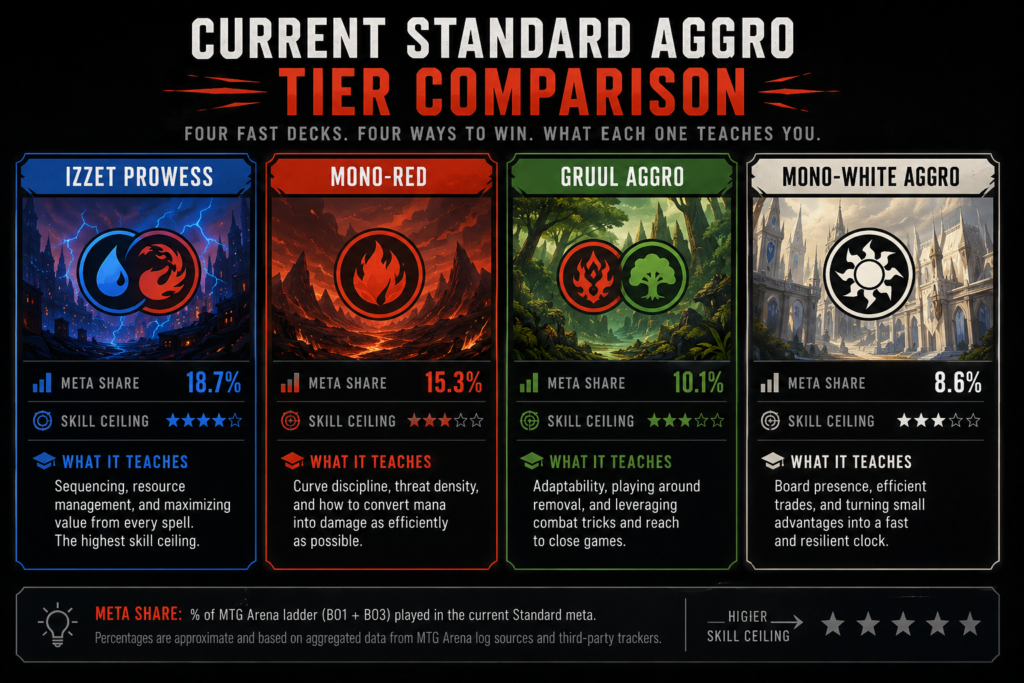
The Standard metagame is dominated by midrange and control shells right now, but several aggro archetypes are putting up real results. Each one teaches something distinct about what aggro means in this environment.
Izzet Prowess — The Skill-Intensive All-Star
Izzet Prowess is the highest-ceiling aggro deck in current Standard, sitting at roughly 21% of the competitive meta. Built around Stormchaser’s Talent, Slickshot Show-Off, and Elusive Otter, it combines creature pressure with a cantrip-heavy engine (Opt, Sleight of Hand) that makes every creature larger while filtering your draws. The sideboard typically includes Spell Snare, Spell Pierce, Ral, Crackling Wit, and targeted removal for specific problem matchups.
What it teaches: sequencing mastery. Every turn in Izzet Prowess is a puzzle of ordering spells to maximise prowess triggers and cantrip value. The deck rewards players who understand that the order in which you resolve your spells can be the difference between a 4/4 attacker and a 2/2. It also teaches how to make burn spells function as both removal and reach, depending on what the board demands.
Mono-Red Aggro — The Punisher
Mono-Red sits at roughly 1–2% of Arena tournament lists but has been a consistent performer across Standard rotations. Current competitive builds run Burnout Bashtronaut, Hired Claw, Scalding Viper, Razorkin Needlehead, and Ojer Axonil as the primary engine, with Burst Lightning and Lightning Strike as flexible removal or reach spells.
What it teaches: damage maths and resource management. Mono-Red is the format’s purest test of “how do I sequence my resources to kill my opponent on exactly the right turn?” Ojer Axonil changes the damage maths so completely that knowing when to deploy it versus holding it against removal is itself a complex decision. A misdeployed Axonil that gets immediately killed is wasted, but a held Axonil on a board where you could have ended the game a turn earlier is equally costly.
Gruul Aggro / Delirium — The Resilient Midrange-Aggro
Gruul Delirium sits between aggro and midrange — it runs cheap, efficient threats (Wildfire Wickerfolk, Fear of Missing Out, Patchwork Beastie) while using Seed of Hope and graveyard enablers to turn on delirium payoffs. The sideboard typically runs Cankerbloom for enchantment and artifact hate, Sunspine Lynx, Torch the Tower, and Abrade for creature matchups.
What it teaches: role recognition. Because Gruul sits between archetypes in its clock, pilots must constantly assess whether to press the attack or develop the board. Against control, you’re the aggressor. Against other aggro decks, you’re often the midrange player who trades favourably and takes over the mid-game. Correctly identifying your role each game — and adjusting your play — is the deck’s central skill challenge.
Mono-White Tokens — The Go-Wide Specialist
White aggro occupies a specific niche, going wide through token production and scaling damage through anthem effects and pump spells rather than individual threat quality. In Bo1, this is a particularly strong archetype because opponents cannot specifically sideboard against tokens without game knowledge.
What it teaches: board maths and attack pattern optimisation. Go-wide strategies require players to understand which combination of attacks maximises damage while preserving the board. Attacking with six tokens, keeping two back as blockers, and calculating exactly how an opponent can and cannot profitably block is a non-trivial exercise every turn.
If you’re still deciding where to start, the budget Standard decks guide covers accessible entry points across archetypes, including aggro lists that don’t require a full rare collection.
Sideboard Philosophy for Bo3 Aggro Players
Sideboarding with an aggro deck is one of the most misunderstood aspects of Bo3 play. Many players treat it as a defensive exercise — bringing in hate to survive. The better framework is to think of your sideboard as a set of tools to maintain your strategy’s core function while patching specific weak points.
The First Principle: Don’t Dilute Your Core
The cardinal sin of aggro sideboarding is over-sideboarding. If you bring in too many reactive cards, you stop being an aggro deck. You end up with a hybrid that is too slow to race and too inconsistent to control. After sideboarding, your deck should still feel like itself — just better tuned for the specific opponent in front of you.
A practical heuristic: for every powerful hate card you bring in, ask whether you’re also cutting one of your weaker main-deck cards for that matchup. You’re not just adding cards — you’re creating the best possible 60-card deck from your full 75 against this specific opponent.
Against Control: Remove the Sweeper or Bypass It
Against control decks, the aggro player’s main vulnerability is card exhaustion and sweepers. The tools that address this include discard spells like Duress — which you use before casting your key threat to force out the counter, then deploy the threat into a clear path. Resilient permanents like artifacts and enchantments that generate ongoing value are difficult for control decks to answer efficiently and keep pressure up even after a sweeper resolves.
Against control, cut expensive removal spells that have no targets and low-impact redundant threats that fold to sweepers anyway. You want cards that either prevent the sweeper from resolving or generate value through it.
Against Midrange: Shift the Dynamic
The midrange matchup is where aggro sideboards earn their keep. Midrange decks are generically positioned to beat aggro — larger creatures, removal, lifegain. Your sideboard needs to shift that dynamic.
Evasion threats with flying or menace that can’t be easily blocked break the midrange “trade favourably” strategy. Targeted hate like Magebane Lizard punishes midrange decks that rely heavily on spells and noncreature threats. Sunspine Lynx punishes the greedy multicolour manabases that midrange decks require. In the midrange matchup, burn spells that kill 3–4 toughness creatures are essential — cards like Witchstalker Frenzy or Obliterating Bolt clear the most threatening blockers efficiently.
Against Aggro: Tilt the Resource Exchange
In the aggro mirror, shift slightly toward the control role — bring in your cheapest removal to win combat maths battles, and take out your most fragile threats that fold to opposing removal. Cards like Torch the Tower (kills small creatures efficiently) or Tectonic Hazard (sweeps small token producers) let your threats connect while denying your opponent’s.
The most important principle for the aggro mirror: whoever navigates combat maths better wins. Don’t over-sideboard into a control deck. You’re trying to slightly tilt the resource exchange in your favour, not change the nature of the game.
A Practical Mono-Red Bo3 Sideboard
| Cards | Quantity | Purpose |
|---|---|---|
| Magebane Lizard | 4 | Punishes spell-heavy blue decks (Izzet Prowess, control) |
| Sunspine Lynx | 4 | Punishes greedy multi-colour manabases |
| Soul-Guide Lantern | 3 | Graveyard hate (reanimator, flashback strategies) |
| The Legend of Roku | 2 | Card advantage pivot vs. slow midrange/control |
| Iroh’s Demonstration | 2 | Flexible tempo removal / pseudo-sweeper |
Notice how this sideboard covers multiple angles without abandoning the core aggressive identity. You’re not adding lifegain or board wipes — you’re adding tools that let your strategy remain intact while patching specific gaps. The Secrets of Strixhaven set guide covers some of the newer additions that are showing up in sideboard slots right now.
The Strategic Depth You’ve Been Missing
Aggro on MTG Arena is not the thoughtless exercise its reputation suggests. Every game you play with a fast deck is a rapid succession of meaningful decisions: which threat to play first, whether to attack or hold back a body, how to sequence your spells, when to deploy your key cards, and how to construct your game plan around a specific opponent’s strategy.
The players winning consistently with aggro aren’t winning despite the archetype — they’re winning because they’ve mastered the compressed, high-stakes decision-making that separates a 52% win rate from a 60% win rate. They understand resource denial at a systems level. They have trained combat maths intuition. They know exactly which cards to bring in for each matchup and why.
If you’re a strategy-minded player who has avoided aggro because it seemed beneath the depth you’re looking for, reconsider. The clock is ticking — and the decisions you make inside that clock are some of the most consequential in the game.
Which aggro archetype are you most interested in trying, and what’s holding you back from making the switch? Let us know in the comments below.
Continue Your Journey
- MTG Arena Standard: What’s Winning Right Now — Full breakdown of the current meta including aggro’s place in it
- Which MTG Arena Format Is Right for You? — Bo1, Bo3, and everything in between
- Budget Standard Decks for MTG Arena — Competitive aggro lists without the full wildcard investment
- Secrets of Strixhaven on MTG Arena — The new set reshaping the Standard metagame
- Deck Building Games: Rules and Strategies — If the card game side is new to you, this covers the fundamentals
Want more MTG Arena strategy delivered straight to your inbox? Join the Everything Is A Game newsletter for weekly guides, format updates, and the plays that are actually moving the needle on the ranked ladder.