
As an Amazon Associate I earn from qualifying purchases and sometimes recommend products from other sellers at no extra cost you. For more details see my disclosure policy and privacy policy.
You did the homework. You took the advice from Testing Your Paper Deck on MTG Arena Before You Buy: A Practical Guide, built your list digitally, and ground out enough matches to trust it. The deck felt tuned. Then you sat down at your local shop, sleeved up the same sixty cards, and something felt wrong within the first three turns, even though nothing about the decklist changed.
That gap is not in your head, and it is not bad luck either. Arena and paper Magic are the same game on paper (literally), but they run on different physical and digital mechanics underneath. Once you know where those mechanics diverge, the “proven” list stops feeling like it betrayed you.
🔀 The Shuffle Isn’t What You Think It Is
Wizards of the Coast has been open about how Arena handles opening hands, and it is worth understanding in plain terms. Arena uses a system sometimes called hand smoothing, which draws several candidate hands and selects the one that best matches a target distribution of lands and spells for your deck. A true paper shuffle, whether overhand, riffle, or pile, has no such selection step. It is one randomisation, full stop.
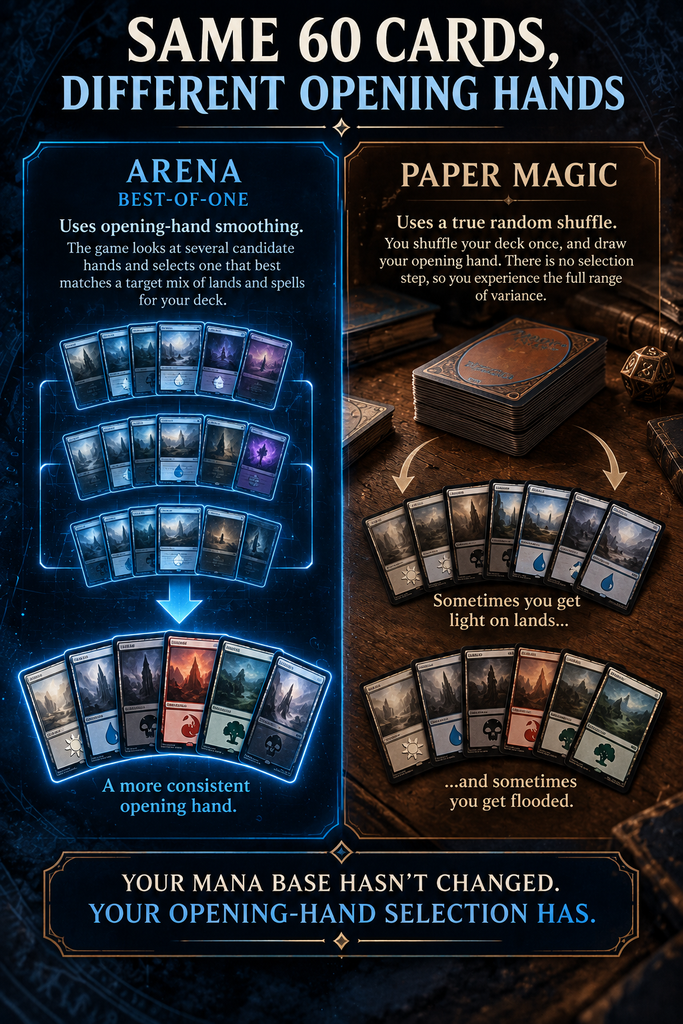
This is not a claim that Arena is rigged, and that framing misses the point anyway. It is a documented, deliberate difference in how the two platforms generate your opening seven. Arena is smoothing towards fewer disaster hands, while paper leaves you exposed to genuine variance on both ends of the curve.
Practically, this means a deck that felt consistent across fifty Arena games can still hand you a two-lander or a six-lander in paper that Arena would have quietly filtered out. Your mana base math has not changed. Your exposure to the tail ends of variance has.
⏱️ Tempo: The Clock in Your Head vs the Clock on Screen
On Arena, lands untap instantly, priority passes with a click, and triggers fire themselves whether you remember them or not. In paper, every one of those steps takes physical time and physical attention. Untapping seven permanents, checking your own upkeep triggers, and deciding whether to hold priority are all things you now do manually, under a real clock, in front of a real person.
This changes the actual skill test. A deck that looks smooth on Arena because the interface handles the bookkeeping can feel clunky in paper if it demands you track three triggered abilities and a delayed effect every turn. The card quality has not dropped, but the cognitive load per turn has gone up, and that is where paper reps most often expose a list Arena made look effortless.
If your deck leans on stacking triggers or holding up instant-speed interaction while tracking multiple game states, expect the first few paper rounds to feel slower and messier than your Arena win rate suggested.
🗂️ Sideboarding: Menu Click vs Kitchen Table
Arena’s Best-of-One queues do not have a sideboard at all, so any deck you tuned purely on ranked Bo1 was never tested against post-board adjustments in the first place. Best-of-Three on Arena does include sideboarding, but it happens through a calm menu screen with no visible clock and no one watching your face while you decide. For the full mechanical breakdown of how those two formats actually differ, Bo1 vs Bo3 on MTG Arena: How the Format You Choose Changes Everything covers it properly.
Paper Bo3 sideboarding is a different animal entirely. You are physically pulling cards from a box in a set amount of time, your opponent can watch your hands and your box, and any hesitation reads as information. A quick, well-rehearsed sideboard plan is a real paper skill, and it is one that Arena’s Bo3 menu never asks you to develop.
If your Arena testing was mostly Bo1, budget real practice time for building and executing sideboard plans before you take that list to a paper event.
👀 Tells: What Arena Hides That Your Opponent Can See
Arena strips out every physical tell a human opponent naturally gives off. There is no hesitation before a block, no reaching for a specific zone of your hand, no subtle reaction to a topdeck. Online, an opponent’s bluff and their nuts hand look identical.
In paper, you are giving off tells whether you intend to or not, and so is your opponent. Learning to read a pause before a land drop, or to mask your own reaction when you draw the card you needed, is a skill set that simply has no equivalent on Arena. It is closely related to the physical-only skills covered in Trading Cards in Paper Magic: A Skill Arena Never Taught You, where reading a person matters as much as reading a board state.
None of this shows up in your Arena win rate, which is exactly why it can blindside you at your first paper event back.
⚖️ Rules Enforcement: Arena Is the Judge, Paper Isn’t
Arena’s client tracks every state-based action and triggered ability without fail. Lethal damage is checked automatically, “at the beginning of your upkeep” triggers fire on their own, and you are never asked to remember something the game will not remind you of.
Paper offers you no such safety net. You are responsible for calling your own triggers, tracking your own life total, and catching your own missed state-based actions, and so is your opponent, which means errors happen on both sides of the table. A deck built around fiddly triggered abilities or precise life-total math can quietly underperform in paper simply because Arena had been doing the bookkeeping for you the whole time you were testing it.
This is also where a small physical aid earns its keep. A dedicated set of dice for tracking life totals, counters, and triggers removes one entire category of self-inflicted paper mistakes that Arena never let you make in the first place.
🎒 What Actually Carries Over
Some of what you learned on Arena transfers cleanly, and it is worth being specific about what that is. Mana base construction, curve considerations, and matchup knowledge such as what your deck wants to do against aggro versus control are all fundamentally the same game, whether the cards are pixels or cardstock.
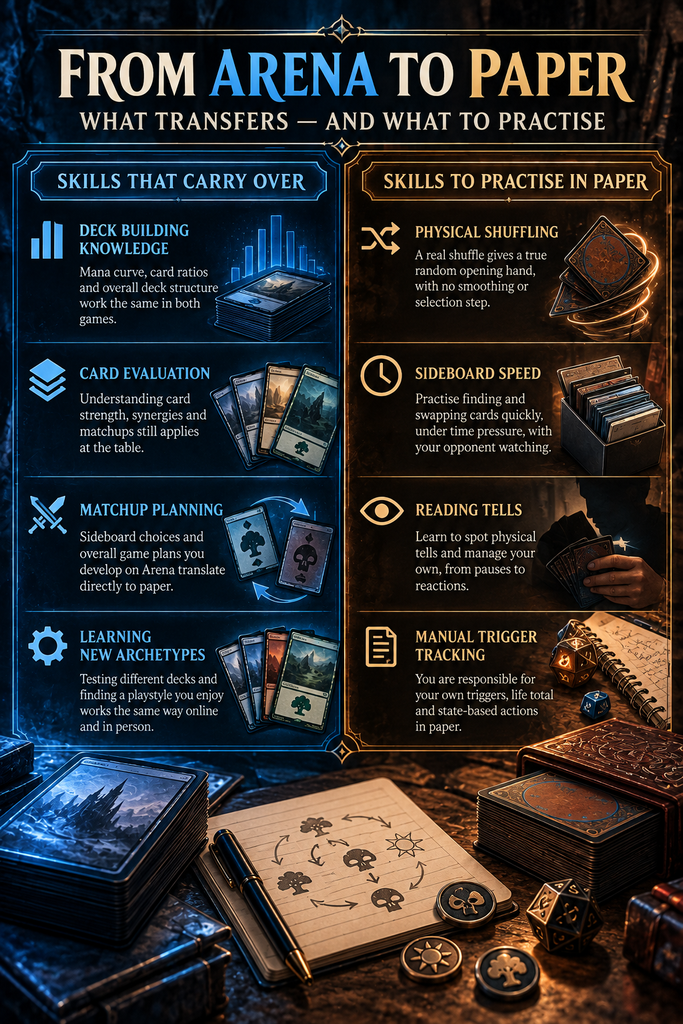
What does not transfer is anything tied to the interface itself. Shuffle-tech habits, physical sideboard execution, and reading a human opponent across a table are paper-only skills that Arena reps simply cannot build for you.
- Carries over: mana curve, land ratios, matchup game plans, card evaluation
- Does not carry over: shuffle feel, physical sideboard speed, reading opponent tells, manual trigger tracking
Treat your Arena reps as a proving ground for the deck’s strategy, not a full simulation of the paper experience.
🧭 Bringing It Back to the Table
None of this means Arena testing was wasted effort. It means the two platforms test different halves of the same skill set, and a paper event asks for both halves at once. Your list is still good, and you just need a few live reps to catch your hands up to what your head already knows.
Next time your “proven” Arena list feels off in paper, check whether the problem is the deck or the platform gap before you touch a single card.