
As an Amazon Associate I earn from qualifying purchases and sometimes recommend products from other sellers at no extra cost you. For more details see my disclosure policy and privacy policy.
You’ve had the box on your shelf for months. The game hits the table whenever the group gets together, but those sessions are getting harder to schedule. What you might not realise is that there’s an excellent chance your favourite multiplayer board game already has a solo variant — either packed in the box from day one, or waiting for you on BoardGameGeek courtesy of someone who felt exactly the same way you do.
Solo gaming has evolved from a niche afterthought into a fully legitimate way to experience strategy games. Modern publishers often build solo support into their designs from the ground up, and the hobby community has spent years crafting unofficial solutions for the games that didn’t ship with one. Whether you’re a seasoned hobbyist or someone who got into strategy gaming through group play, there’s almost certainly a solo path into your collection that you haven’t tried yet.
This guide breaks down how solo variants actually work in practice, which approaches suit different playstyles, and spotlights a handful of standout games that prove solo play doesn’t require compromise.

How Solo Variants Actually Work
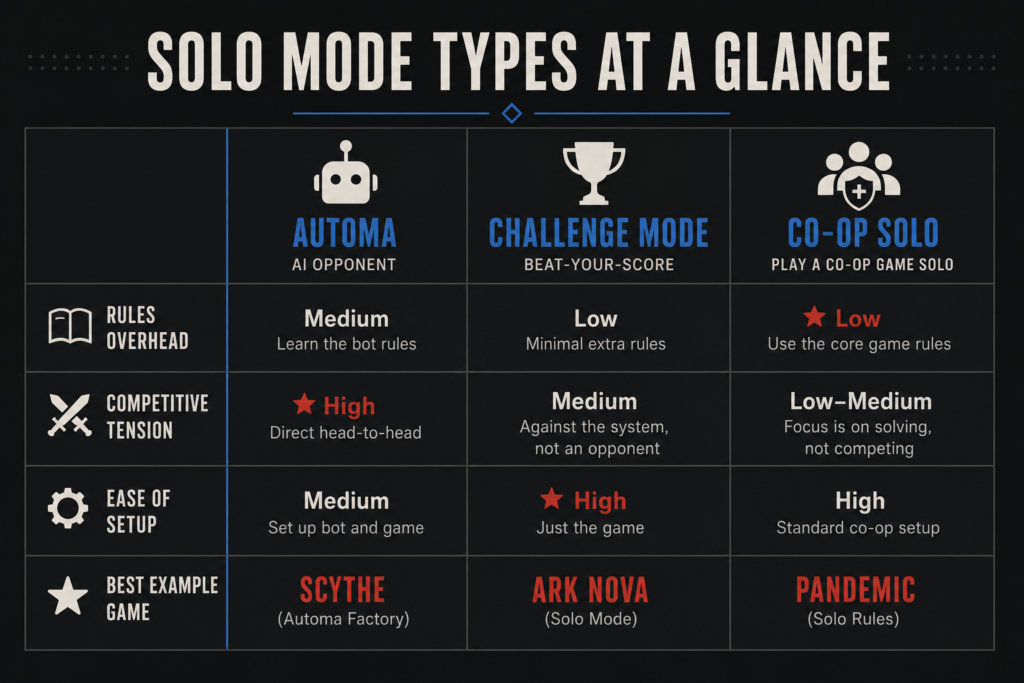
Not all solo modes are built the same way. Understanding the different approaches helps you know what you’re signing up for before you clear the table for one.
The Automa System
The most sophisticated approach to solo play uses what the hobby commonly calls an Automa — a simulated opponent that takes turns alongside you, driven by a dedicated card deck or a scripted decision tree. When it’s the Automa’s turn, you flip a card and execute whatever the card instructs: it places a worker here, drafts that card, claims this bonus. The Automa never plans, never adapts, and never outsmarts you — but it creates pressure, blocks resources, and forces you to respond, which is most of what an opponent actually does in a Euro game.
Wingspan’s Automa is probably the most widely praised example in the hobby. It captures the feeling of racing against another player surprisingly well, keeps turns quick, and requires minimal overhead between rounds. Dune: Imperium takes a similar approach with its rival House system, which can also be driven through a companion app if you prefer that workflow.
The tradeoff with Automa systems is upkeep. Running a bot means maintaining a separate deck, executing its actions each round, and tracking its scoring — none of which takes long individually, but it adds up across a full game. Some players find this energising; others find it breaks the meditative flow they were looking for.
Beat-Your-Own-Score and Challenge Modes
The lightest-touch approach to solo play doesn’t add an opponent at all. Instead, it gives you a target. Terraforming Mars is the canonical example: in solo mode, you race against a fixed generation limit, trying to fully terraform Mars within 14 rounds using the Corporate Era rules. There are no milestones, no awards, no opponents — just you against the puzzle the game always was.
This style of solo play suits heavier Euros particularly well. Many Uwe Rosenberg titles — Agricola, Le Havre, A Feast for Odin — use variations of this model, asking you to score above a threshold or complete objectives rather than beat a rival. The rules overhead is minimal because you’re just playing the game normally and measuring the result against a standard. For players who find game systems inherently satisfying to optimise, this approach can be deeply compelling.
What it doesn’t give you is any sense of competition or blocking. If that head-to-head tension is what you’re chasing, a challenge mode will feel more like a structured puzzle than a game — which is fine if that’s your thing, but worth knowing in advance.
Playing Co-ops Solo
The easiest solo mode of all is also the most overlooked: just play a co-operative game alone. Fully cooperative designs are built for people to work together against the game itself, and controlling multiple roles solo works perfectly with most of them.
Spirit Island is routinely cited as one of the best solo gaming experiences in the hobby, and it achieves this without any solo-specific rule adjustments whatsoever. You control one Spirit (or more if you want the challenge), you follow the same rules, and the game’s automa-like invader system does exactly what it does in multiplayer. The complexity of the game comes from mastering your Spirit’s powers and managing board state — none of which requires an opponent.
For players who came to solo gaming from co-ops, this is often the gateway. You already own the game, you already know the rules, and the only thing that’s changed is you’re the only person sitting at the table.
Standout Games With Excellent Solo Modes
Terraforming Mars
Terraforming Mars built its reputation as a multiplayer engine-builder, but the solo challenge mode has become one of the most-played ways to experience it. The 14-generation time limit forces aggressive, efficient play — you can’t afford to pace yourself the way you might at a full table. Every card you play, every action you take, needs to move the needle on one of the three global parameters: temperature, oxygen, or ocean tiles.
The game has also received an Automa variant that gives you a bot to race against rather than just a clock, providing a different solo texture for players who find the challenge mode too solitary. Both approaches are worth trying. The challenge mode tends to reward optimisation instincts; the Automa rewards competitive awareness. If you’re using solo play to sharpen strategy for group games, the challenge mode is probably more useful.
Wingspan
If you’re interested in deck-building and engine-builder mechanics, Wingspan’s solo implementation is worth studying. The Automa deck simulates another player drawing and caching birds without you needing to manage an entire second engine. Its scoring is simplified but creates genuine competition — the Automa accumulates points steadily and without mercy, which means you can’t afford to coast.
The solo mode ships in the base game, requires no extra setup beyond shuffling the Automa deck, and plays in about 45 minutes once you know the rules. It’s become many players’ preferred way to learn the game before introducing it to a group, which speaks to how well it captures the multiplayer experience in a condensed form.
Dune: Imperium
Dune: Imperium is a worker placement and deck-building hybrid — and those mechanics make it a natural fit for solo play because competition for spaces is built into the design. The rival House Automa takes spaces and accumulates Solari, Spice, and influence in ways that directly constrain what you can do on your turn.
The solo mode is widely regarded as one of the most tense solo experiences in modern board gaming. The rival system escalates meaningfully across the game’s three rounds, and the final scoring can come down to a handful of points. If you’re looking for a solo mode that genuinely keeps you on the back foot, this is an excellent starting point.
The West Kingdom Trilogy
The games in Shem Phillips’ West Kingdom series — Paladins, Viscounts, and Architects — all ship with solo bot systems that are well-regarded for their quality and low overhead. The bots claim spaces, score points, and advance tracks without requiring much management, leaving you free to focus on your own engine. If you enjoy area control and worker placement dynamics, at least one of these titles is worth adding to your solo playlist.
Paladins of the West Kingdom in particular is frequently mentioned in solo gaming discussions as a standout example of how to design a bot that creates genuine strategic pressure without being burdensome to operate. The solo mode also scales naturally — if you want more challenge, run two rival bots.
Spirit Island
Spirit Island doesn’t technically need a solo mode because it already works as one. But it’s worth calling out specifically for players who are nervous about the complexity of learning a new game solo. Spirit Island’s rulebook is thorough, its systems are logical once you understand them, and the solo experience of controlling a single Spirit against the invader system is completely self-contained.
The game has also become a touchstone for what cooperative design can achieve in terms of asymmetry and replayability. Each Spirit plays completely differently, which means single-player board game sessions can feel genuinely distinct from one another even before you start mixing in the game’s scenario and adversary systems.
Fan-Made Variants: Community as Co-Designer
Not every beloved multiplayer game shipped with solo support, and the board gaming community has spent years filling that gap. BoardGameGeek’s files sections for games like Catan, Ticket to Ride, and Carcassonne contain dozens of fan-made solo variants — unofficial bots, challenge scoring systems, and dummy player rules created by players who didn’t want to wait for an official solution.
Sky Team is an interesting case. It’s a two-player cooperative game by design, with no official solo mode. But a number of fan-made solo adaptations exist on BGG that convert the game into a scripted solo challenge, using fixed setup sequences or modified partner rules. The quality varies, but the best community variants are polished enough to feel intentional.
For classic games like Catan and Ticket to Ride, solo variants tend to function more as practice tools than fully fledged experiences. The systems in those games weren’t originally tuned for solo, so fan adaptations often involve simplified bot behaviour or scoring challenges rather than true head-to-head simulation. That’s not a criticism — playing Catan solo to practise resource timing before a competitive session is genuinely useful. Just don’t expect the full group experience in miniature.
The easiest way to find community variants for any game is to search BGG’s Files section for the game in question, filtered by “Fan Expansion” or “Solo Variant.” You’ll often find discussion threads with recommendations on which variant the community considers the definitive solo experience for that title.
Choosing the Right Solo Experience for You
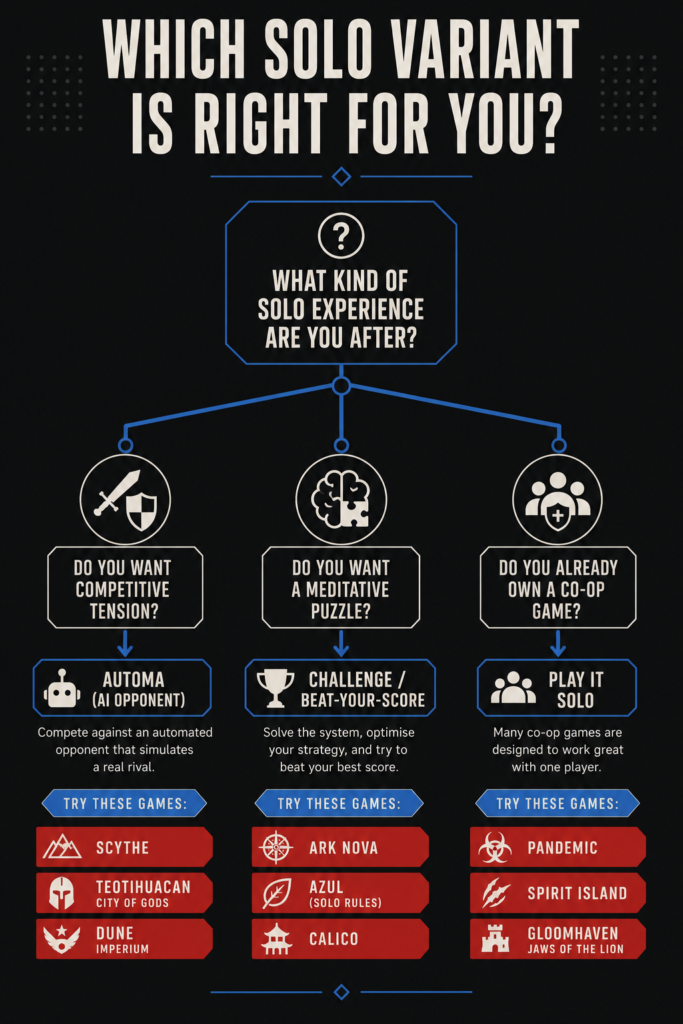
The best solo variant is the one that matches what you actually want from the session. If you’re looking to practise for a group game, a challenge mode or Automa that replicates the game’s core decisions is ideal. If you want a meditative puzzle to play through at your own pace, a beat-your-own-score format in a heavy Euro will serve you better. If you want genuine competitive tension — something that pushes back, blocks your plans, and keeps you guessing — look for games with robust Automa systems like Dune: Imperium or the West Kingdom titles.
Quick Quiz
What’s Your Solo Gaming Style?
Four questions. Find out which solo variant suits the way you actually want to play.
Question 1 of 4
When you sit down to play solo, what are you most in the mood for?
How do you feel about rules overhead between your turns?
What would make a solo session feel like a success?
Are you playing solo to get better at a group game, or for its own sake?
Your solo style
The Automa Player
You want competition, not just a challenge. You’re most satisfied when something is actively working against you — taking spaces, scoring points, making your plans harder. A well-designed Automa system gives you that without needing another human at the table.
Where to start
Dune: Imperium’s rival House system is one of the tightest solo experiences available — tense, escalating, and rarely comfortable. Wingspan’s Automa is a lower-stakes introduction if you’d prefer to ease in.
Games to try
Your solo style
The Optimiser
You’re drawn to the puzzle inside the game — the question of how efficiently you can operate when nothing is getting in your way. Beat-your-own-score and challenge modes suit you well. The pressure comes from the clock or a scoring threshold, not a bot, and that’s exactly how you like it.
Where to start
Terraforming Mars’ solo challenge mode is the classic here — fully terraform within 14 generations or lose. The constraint is tight enough that every decision counts, but the rules stay clean.
Games to try
Your solo style
The Co-op Solo Player
You want the game to tell a story and put you in a situation — reactive, evolving, unpredictable. Cooperative games played solo give you exactly that. You’re managing a system rather than racing an opponent or chasing a number, and that suits your headspace.
Where to start
Spirit Island is the strongest recommendation for this playstyle. Control a single Spirit, follow the standard rules, and let the invader system provide all the pressure you need. No solo-specific setup required.
Games to try
There’s also nothing wrong with starting where you are. If you already own a co-op game, play it solo before spending anything. If you have Wingspan, shuffle in the Automa deck this week. The barrier to entry for most of these experiences is lower than you might think, and discovering that a game you already love plays beautifully solo is one of the most satisfying moments in the hobby.
Solo gaming has moved well past being a fallback option for when the group can’t meet. The best solo experiences are worth scheduling just as deliberately as any group session — they just require a bit less coordinating.
Continue Your Journey
- Single Player Board Games: Our Picks for Solo Strategy — a guide to games designed specifically for solo play
- Deck Building Games: Rules and Strategies — essential reading if Wingspan or Dune: Imperium caught your attention
- Area Control Games — expand your understanding of the mechanics that make so many Automa systems tick
- Best Board Games for Big Groups — for when the group does finally get together
Which multiplayer game in your collection would you most want to try solo? Let us know in the comments below — we’d especially love to hear if you’ve found a fan-made variant that surprised you.
Want more strategy gaming content delivered directly? Subscribe to our newsletter for guides, news, and recommendations every week.
15 pages on the best solo strategy games, setup tips, and how to build a solo shelf worth playing. Free when you join the newsletter.
- ✓ Advanced strategy breakdowns for new releases
- ✓ Monthly buying guides for different budgets
- ✓ First access to in-depth game reviews
- ✓ Exclusive tips from experienced players