
As an Amazon Associate I earn from qualifying purchases and sometimes recommend products from other sellers at no extra cost you. For more details see my disclosure policy and privacy policy.
Open up Limited on MTG Arena for the first time and you’re handed three drafting queues with names that don’t explain themselves. Traditional, Quick, and Premier all let you draft a deck from packs, but the pick order, the opponents, the cost, and the payout all differ enough that picking blind usually means picking wrong for what you actually want.
Here’s what separates the three, so you can match the mode to your goals instead of defaulting to whichever one Arena puts at the top of the list.
🎯 The Core Difference: Who You’re Drafting Against
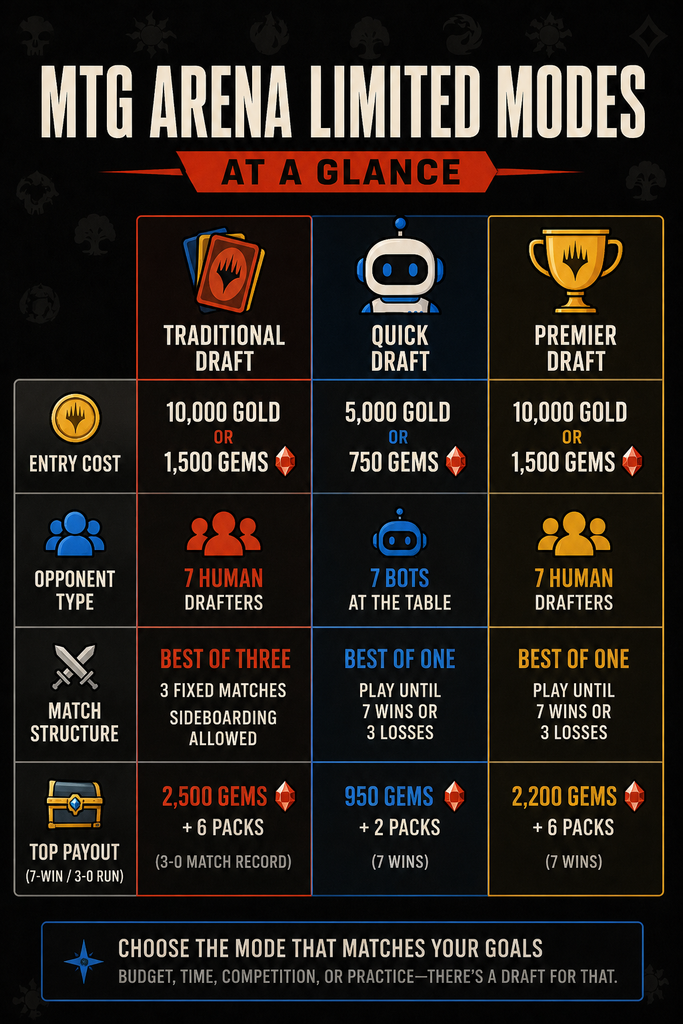
Quick Draft fills the other seven seats at your table with bots. You pick from packs at your own pace, with no one waiting on you, and you can even step away mid-draft and come back to it later.
Traditional Draft and Premier Draft both put you in a live pod with seven other human players, picking in real time. That means faster decisions and packs that get read and reacted to by people, not a fixed algorithm.
In all three modes, the actual games you play afterwards are against other human opponents. The bots-versus-humans difference only affects the draft portion itself.
💰 Entry Cost and Currency
Quick Draft is the cheapest way in, at 5,000 gold or 750 gems. Traditional Draft and Premier Draft both cost more to enter, at 10,000 gold or 1,500 gems each.
If you’re playing on a gold budget rather than spending gems, Quick Draft is the only one of the three that’s realistically sustainable to play often without topping up your currency through other means.
🏆 Match Structure: Best of One vs. Best of Three
This is the detail that trips up most players new to limited on Arena. Quick Draft and Premier Draft are both best-of-one: you play a single game per opponent, and the event continues until you hit 7 wins or 3 losses.
Traditional Draft is best-of-three, with sideboarding allowed between games against the same opponent using the rest of your drafted cards. It also runs as three fixed matches regardless of your record, rather than ending early on a third loss.
That structural difference matters more than the entry fee. Best-of-three rewards a deck built to adjust between games and punishes narrow, all-in strategies less harshly, since you get a chance to sideboard around whatever beat you in game one.
🎁 Payout and Reward Structure
Quick Draft has the flattest reward curve of the three. A run to 7 wins pays out 950 gems and 2 packs, but the curve is gentler at the low end, so a mediocre record still returns a reasonable amount of your entry back.
Premier Draft pays out more at the top: 2,200 gems and 6 packs for a 7-win run. The curve is steeper, though, so a poor record returns less than the equivalent Quick Draft result.
Traditional Draft’s payout is tied to match wins rather than game wins: 2 match wins returns 1,000 gems and 3 packs, and going 3-0 across all three matches returns 2,500 gems and 6 packs. Because it’s best-of-three, a slightly weaker deck has more room to convert games into match wins than it would in a single-elimination-style best-of-one event.
⏱️ Time Investment and Pace
Quick Draft is the most flexible option for time. The bot draft has no pick timer pressure, and Arena lets you pause and resume, which makes it the easiest mode to fit around a busy schedule.
Premier Draft moves fastest once you’re in games, since it’s best-of-one and ends the moment you hit 3 losses or 7 wins. It’s a good option if you want a complete session in a single sitting without a three-match commitment.
Traditional Draft takes the longest per entry, since you’re committed to three full best-of-three matches. Budget more time for it than you would for either of the other two.
🧭 Which Mode Fits Which Player
New to limited, still learning card evaluation: Quick Draft. The untimed bot draft gives you room to think through picks, and the lower entry cost makes mistakes cheaper while you’re still finding your footing. Our guide to drafting the Arena Cube is a good next stop once you’ve got a few Quick Drafts under your belt and want to try a different card pool.
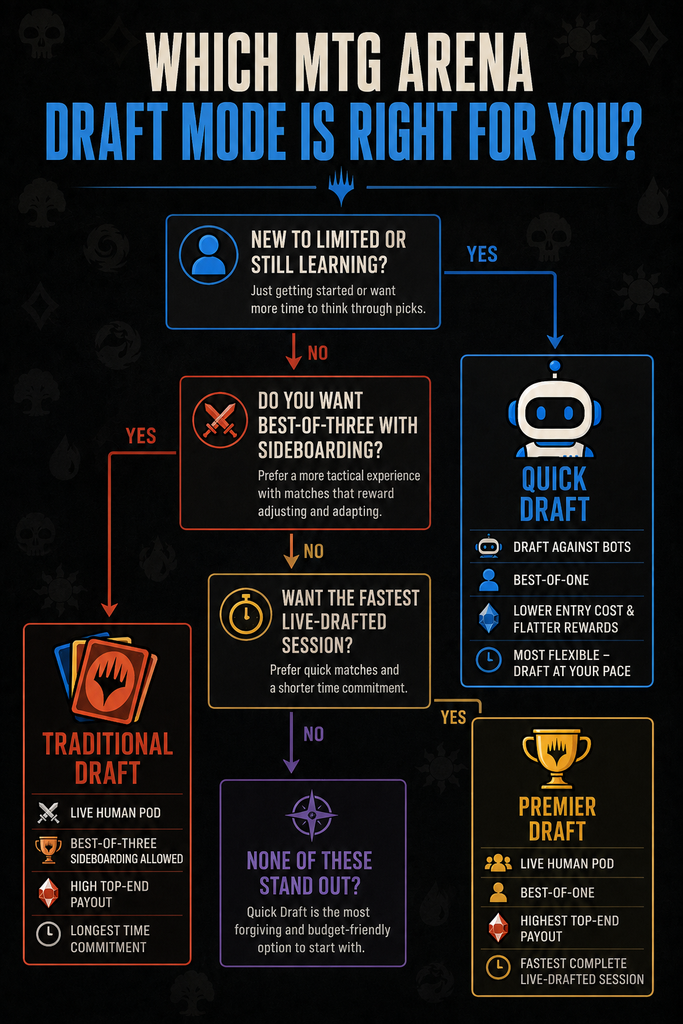
Budget-conscious but want live human drafting: this is the awkward middle ground, since Traditional and Premier cost the same to enter. If currency is tight, lean Premier for the lower time commitment and accept the steeper payout curve, or stick with Quick Draft until your gem or gold reserves are healthier. Our breakdown of Arena’s wildcard economy is worth a read if currency management is the deciding factor for you.
Competitive players who want their deckbuilding to matter most: Traditional Draft. Sideboarding between games rewards reading your opponent and adjusting, which is closer to how limited plays in paper events, and the fixed three-match structure means one unlucky game one doesn’t end your run.
Players who just want the fastest complete session: Premier Draft. Live human drafting for the sharper experience, best-of-one for speed, and a stronger payout ceiling if your deck is strong.
If you’re still deciding whether best-of-one or best-of-three suits your playstyle better outside of just this format comparison, our piece on Bo1 vs Bo3 on MTG Arena goes deeper into how that single structural choice changes deckbuilding priorities across the board.
The Short Version
None of these three modes is objectively the best. Quick Draft is the accessible, budget-friendly, low-pressure option. Premier Draft is the fast, competitive, human-drafted format with the highest payout ceiling. Traditional Draft is the slower, best-of-three format that rewards adaptability over raw deck power. Pick based on your budget, your available time, and whether you’d rather draft against people or against the clock.