
As an Amazon Associate I earn from qualifying purchases and sometimes recommend products from other sellers at no extra cost you. For more details see my disclosure policy and privacy policy.
Most Eldritch Horror advice assumes a table full of friends arguing over which gate to close first. Sit down alone with a single investigator sheet and the whole game changes shape. There is no one to catch your mistakes, no second opinion on which mystery to chase, and no spare set of actions to bail you out when the Mythos deck turns nasty.
This guide is written for that exact situation: running Eldritch Horror by yourself, with one investigator, and no safety net. If you already own the game or are about to pick up your own copy of the base game, everything below assumes you are playing straight out of the box with standard components. We will cover how true solo differs from multi-handed solo, how to pick an investigator built to stand alone, and how to structure your turns so the Ancient One does not simply outpace you.
Untangling True Solo from Multi-Handed Solo
Eldritch Horror has no dedicated solo mode. The base rules scale down cleanly, whether you run one investigator or several, which is exactly why the term “solo play” gets used loosely across the community.
True solo means controlling a single investigator with a single set of actions each round, exactly as if you were the only human at the table in a group game. Multi-handed solo means you take on two, three, or more investigators yourself, giving each their own turn while you make every decision for all of them. The distinction matters because the two experiences feel almost nothing alike.
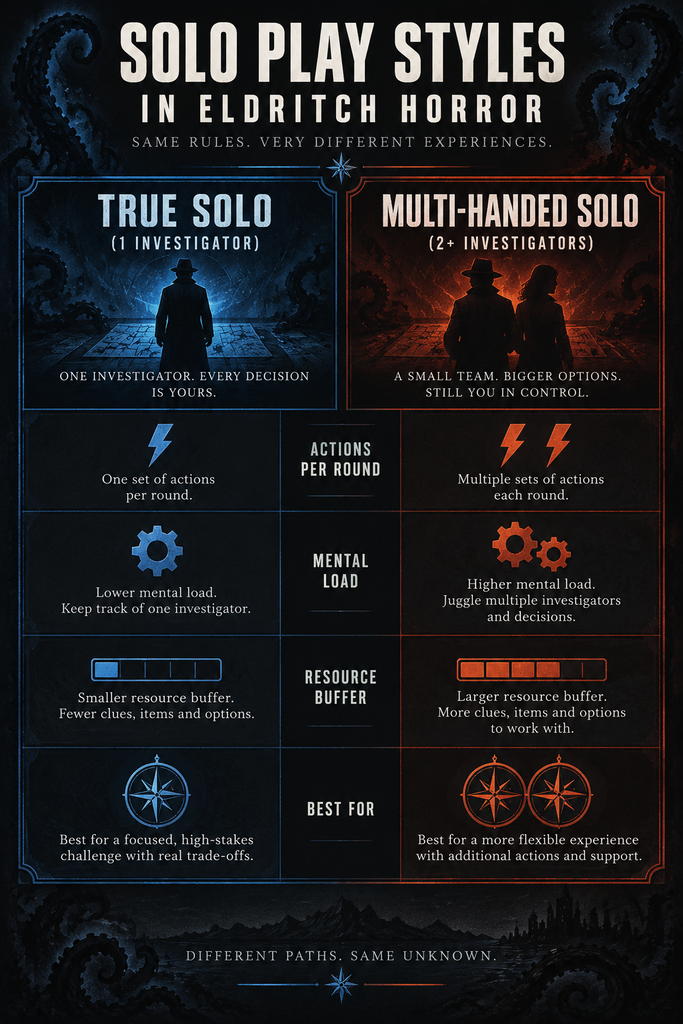
Running one investigator keeps the bookkeeping light and forces real trade-offs, since you genuinely cannot do everything each round. Multi-handed solo gives you more raw actions and resources to throw at the board, but it also means juggling several trains of thought and never quite forgetting you are the one steering both sides of every choice. Our broader piece on how your tactics change between solo and multiplayer play covers this tension in more general terms if you want the wider context before diving into Eldritch Horror specifically.
The Doom Track Doesn’t Slow Down for You
One investigator means one set of clues gathered, one set of monsters fought, and one mystery advanced per round, while the Mythos deck keeps revealing threats on schedule regardless. We already broke down how the Doom track and Mythos deck interact in detail in our Eldritch Horror Strategy Guide, so we won’t repeat the mechanics here.
What matters for solo players is the ratio. Doom advances at the same rate whether you have one investigator or four, but your problem-solving throughput drops sharply with just one, so every wasted round costs proportionally more. If you are still shaky on the underlying rules for gates, encounters, or the mystery structure, our full rules guide is the better starting point before you commit to a solo run.
Choosing an Investigator Who Can Stand Alone
We have already covered general beginner-friendly picks in our guide to the best Eldritch Horror investigators for beginners, so this section skips that ground entirely. What matters for true solo play is a narrower filter: self-sufficiency over synergy.
Look for investigators whose stats spread reasonably across the four core skills rather than leaning hard into one, since you will face lore, influence, observation, and strength checks with no teammate to cover your weak spot. Favour investigators with built-in ways to recover health or sanity, or to generate their own money and clues, because resting to recover wastes a round you cannot spare when you are the only engine on the board. Be wary of any investigator whose signature ability depends on “another investigator on your space” or trading items back and forth, since those abilities simply do nothing when you are playing alone.
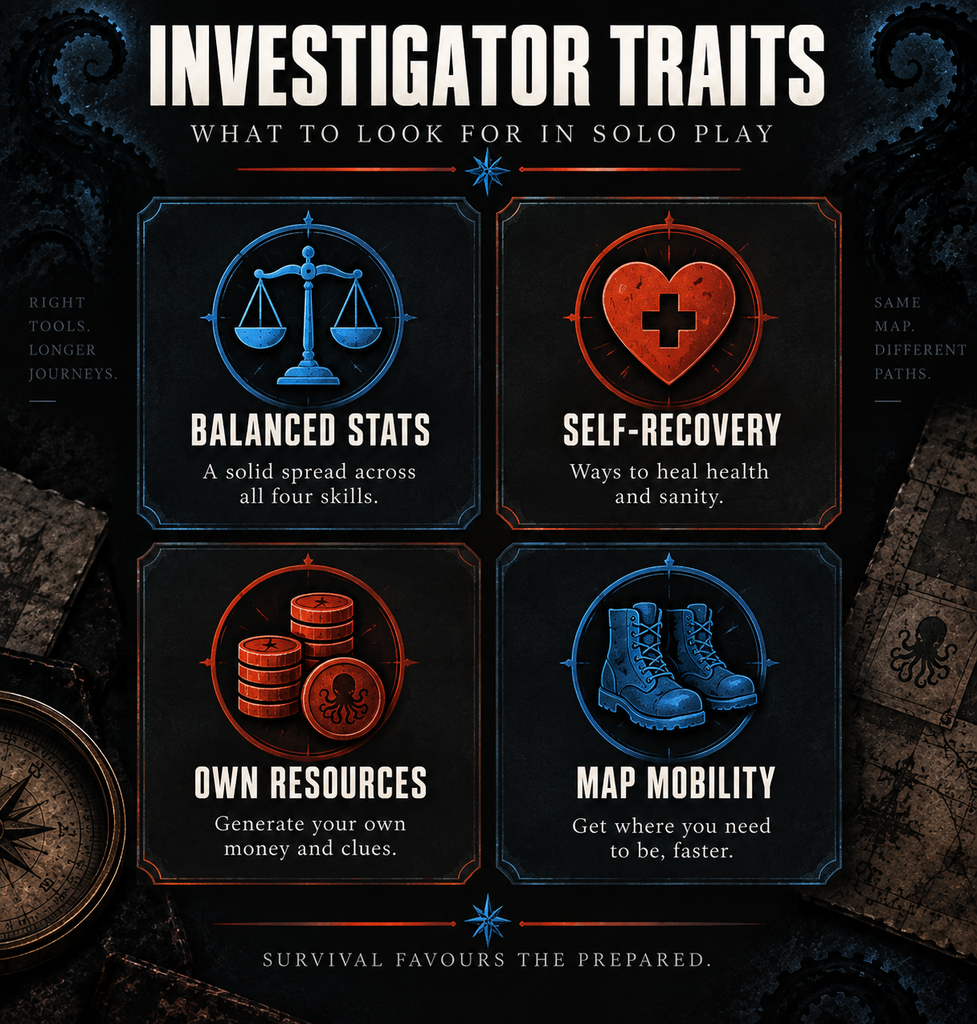
Mobility matters more than usual too, since a single investigator has to cover the whole map without help closing distant gates. If you are running any of the expansions, some also shift the pacing and difficulty enough to affect how forgiving true solo feels, which our Eldritch Horror expansions guide breaks down if you are deciding what to add to your collection.
A Turn Structure That Keeps You Moving
Without a group to split responsibilities, it helps to run through the same checklist every round instead of re-deciding your priorities from scratch each time. Start by reading the Mythos card’s effects and noting anything that changes your immediate risk, such as a new gate or an approaching monster. Then deal with direct threats on or near your investigator’s space before anything else, because an ignored monster attack can undo several rounds of progress in one hit.
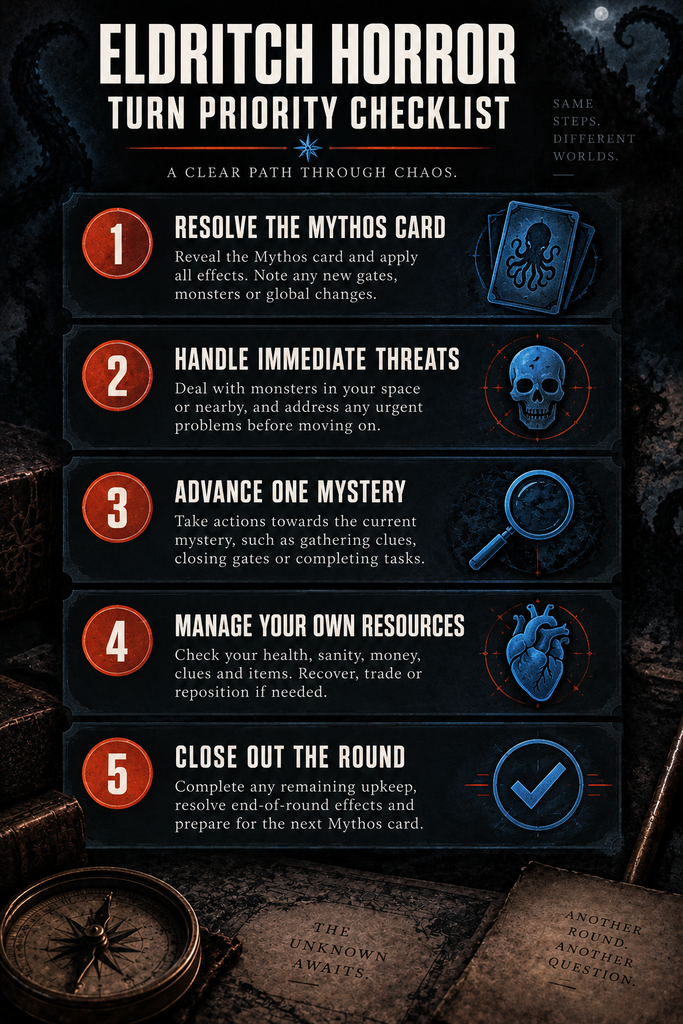
Once the board is stable, commit to advancing exactly one mystery clue or objective rather than splitting effort across several leads at once. Playing solo means you cannot chase every thread simultaneously, so pick a mystery, work it methodically, and let the others wait. Close out the round by checking your own condition, resting if your health or sanity is genuinely low, and only then move on to the next Mythos card.
This kind of single-track focus is similar to the discipline that solo Gloomhaven players lean on, and our Gloomhaven solo setup and strategy guide covers a comparable prioritisation habit if you play both games.
The Pitfalls Only Solo Players Face
Decision fatigue creeps in fast when every single choice, from which train ticket to buy to which encounter to resolve, rests entirely on you with no one to bounce ideas off. Set yourself a rough time limit per turn so you are not second-guessing the same decision five times over. If you find yourself replaying a round in your head after moving on, that is usually a sign you are overthinking rather than under-preparing.
Over-scripting is the opposite problem, where solo play turns into an optimisation puzzle and you stop engaging with the story the game is actually telling. Read the encounter flavour text properly instead of skimming straight to the mechanical outcome, since that narrative texture is a big part of why people play Eldritch Horror at all. Losing that narrative momentum is common in long solo campaigns, so consider jotting a one-line journal entry after each session to keep the Ancient One’s rise feeling like a story rather than a spreadsheet.
When One Investigator Is Enough (and When It Isn’t)
True solo with one investigator suits shorter sessions, focused narrative runs, and anyone who wants the lightest possible mental load while still facing real tension. It is also a good way to learn a new expansion or Ancient One before adding the complexity of extra investigators. The trade-off is pace: a single investigator can genuinely struggle to keep up with faster Ancient Ones or Doom tracks that start low.
Multi-handed solo becomes the better call when you want more actions in play to match the board’s speed, or when you are running a longer campaign and want the extra resilience that a second investigator’s health, sanity, and skills provide. It costs you the tight simplicity of true solo and adds real cognitive overhead, so treat it as a deliberate trade rather than a default. Either way, if you are still comparing this game against its Lovecraftian siblings before committing to a copy, our breakdown of Arkham Horror versus Eldritch Horror versus Mansions of Madness is worth a read.
Final Thoughts
Running Eldritch Horror with one investigator is less about mastering new rules and more about respecting the ones you already know under tighter constraints. Pick an investigator who does not need a teammate to function, commit to one mystery at a time, and treat the Doom track’s steady advance as the real opponent rather than any single monster. Once you settle into that rhythm, solo one-investigator play becomes one of the most focused ways to experience the game.
If this is your first solo board gaming session in general rather than just your first solo Eldritch Horror game, our wider guide to the best solo board games is a good next stop for building out the rest of your collection.
15 pages on the best solo strategy games, setup tips, and how to build a solo shelf worth playing. Free when you join the newsletter.
- ✓ Advanced strategy breakdowns for new releases
- ✓ Monthly buying guides for different budgets
- ✓ First access to in-depth game reviews
- ✓ Exclusive tips from experienced players