
As an Amazon Associate I earn from qualifying purchases and sometimes recommend products from other sellers at no extra cost you. For more details see my disclosure policy and privacy policy.
Every cooperative board game hands you the same two resources: the rules on the box and the people sitting round the table. Most groups spend hours optimising the first and almost no time on the second. That’s backwards. The games you lose to Gloomhaven’s clock or Spirit Island’s escalating Blight are rarely lost because someone picked the wrong card. They’re lost because nobody said the right thing at the right moment.
This guide is about fixing that. Whether you’re running a tight two-player campaign or wrangling a table of six, the same core skills apply: talk clearly, assign roles that fit your group, and keep the whole thing fun enough that you actually want to play again next week.
The tricky part is that “communicate more” isn’t useful advice on its own. Two-player tables and six-player tables break down in opposite directions, so the fix looks different depending on your group size. What follows is a practical playbook for both, plus specific notes for a few of the genre’s biggest games.
At a glance: communication and roles by group size
| Group size | Biggest risk | Fix |
|---|---|---|
| 2 players | One player quietly takes over both hands | Alternate who states the plan first each round |
| 3-4 players | A confident player becomes the “quarterback” | Require two viable options before any vote |
| 5-6 players | Side conversations split the table into sub-groups | One voice at a time, information holder recaps out loud |
🗣️ Why Communication Wins or Loses the Game
Cooperative games are, underneath the theme, information puzzles played by a group with unequal access to the same information. You know what’s in your hand. Your friend across the table knows what’s in theirs. The game only gets solved well when that information moves cleanly between you.
The most common breakdown isn’t a lack of talking. It’s the wrong kind of talking. Vague statements like “I think we should go here” give the table nothing to act on. Specific statements like “I can clear the northeast room if someone blocks the south exit” give everyone a decision to respond to.
Toxic table talk kills the mood faster than any bad die roll. Sighing at a teammate’s move, talking over people, or treating a shared loss as one person’s fault turns a fun puzzle into a chore. The Meeple Mountain community’s writing on alpha players makes a point worth repeating here: the goal isn’t silence, it’s structure. Groups that build in a moment for every player to speak before anyone commits to a plan consistently make better decisions than groups where the loudest voice wins by default.
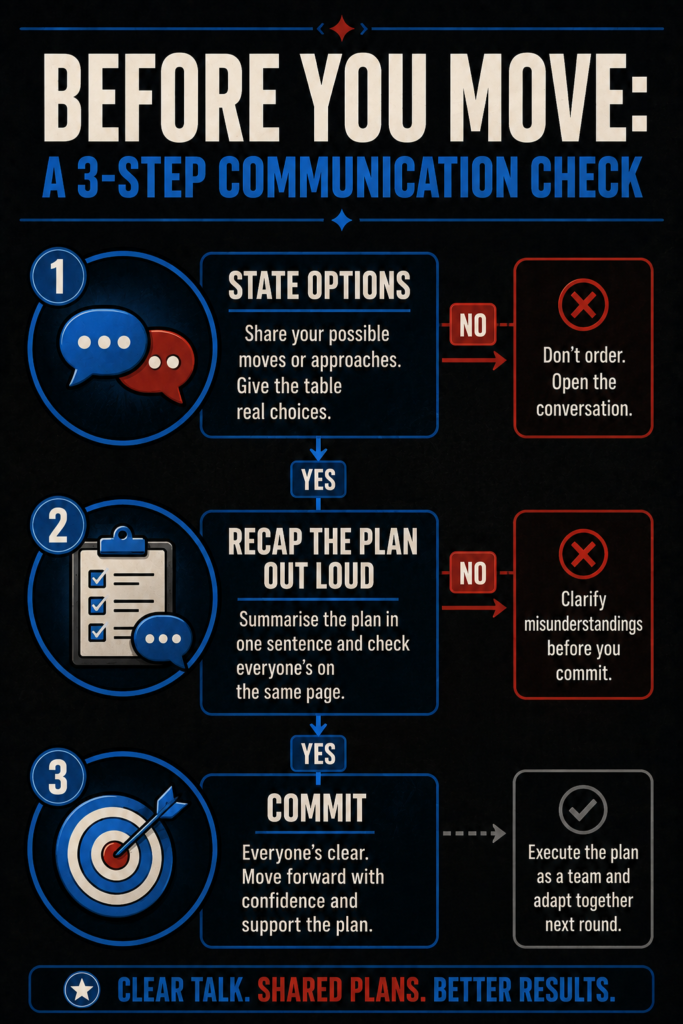
Three ground rules that fix most tables
State your options, not your orders. “I could do A or B” invites a response. “Do A” shuts the conversation down.
Recap before you commit. Whoever proposed the plan repeats it back in one sentence before anyone moves a piece. This catches the misunderstandings that cost turns.
Separate the plan from the person. A bad outcome is a bad plan, not a bad player. Keeping that distinction out loud protects the table’s mood over a long campaign.
🎭 Assigning Roles Without Assigning Blame
Some cooperative games hand you a role on a card. Pandemic gives you the Medic or the Scientist. Gloomhaven gives you a character class built around a playstyle. Others, like Spirit Island, hand you a set of powers and expect the table to work out who does what.
Either way, four functional roles tend to emerge at every cooperative table regardless of what the box says.
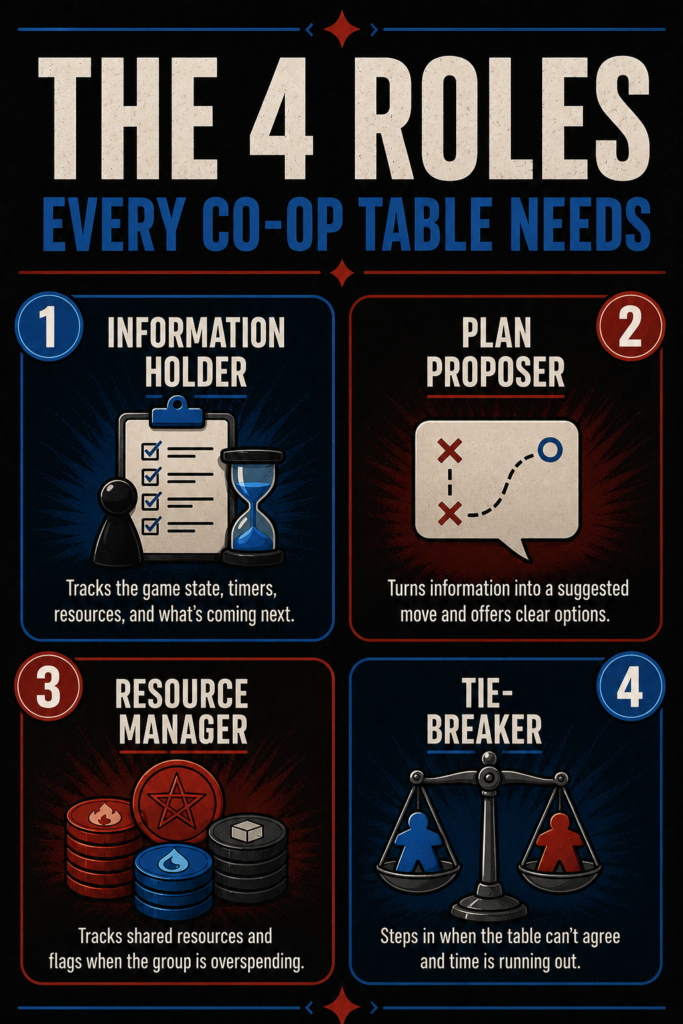
The information holder tracks the game state. They know the threat timer, the remaining resources, and what’s coming next turn. This role suits a detail-oriented player who doesn’t mind being asked “wait, how many turns do we have left” constantly.
The plan proposer turns information into a suggested move. This is the role most at risk of tipping into quarterbacking, so it works best when it rotates or when the proposer is explicitly asked to offer two options instead of one.
The resource manager tracks shared pools such as money, cards, or actions and flags when the group is about to overspend. In heavier Euro-style co-ops this role alone can be the difference between a comfortable win and a last-round scramble.
The tie-breaker steps in only when the table genuinely can’t agree and time is running out. Rotating this role each session stops any one player from becoming the de facto leader by default.
None of these roles need to be assigned out loud at the start of a game. They form naturally within the first few turns. What matters is noticing who has fallen into which role and checking, every few sessions, whether the same person is always the tie-breaker. If they are, that’s worth talking about.
🧩 Communication Tools That Actually Help
You don’t need an app or a rulebook addition to fix most communication problems. A few low-effort tools do most of the work.
A shared notepad or whiteboard next to the board lets the information holder jot down the threat timer or turn count without repeating it verbally every round. This matters most in longer campaign games where the same question gets asked six times an hour.
A simple thirty-second timer for open discussion before any vote keeps debate from spiralling while still giving quieter players a real window to speak. Set it, let everyone talk, then decide.
A “rule of two” works well for groups that keep landing on one player’s plan by default: no move gets made until at least two different options have been said out loud, even if the second one gets rejected immediately. This alone breaks most quarterbacking patterns without anyone having to call it out directly.
For remote or hybrid groups playing over video call, muting isn’t the enemy, turn-taking is the fix. Go around the call in a fixed order for the open-discussion phase rather than letting whoever unmutes first drive the plan.
👥 Two-Player Co-op: Tight Communication, Shared Roles
Two-player cooperative games look simple on paper. There’s no table full of side conversations to manage, no quiet player getting talked over. In practice, two-player co-op has its own failure mode: one player slowly starts making both players’ decisions.
It happens gradually. One person is a little faster at spotting the optimal move, and the other starts deferring instead of thinking it through themselves. Six sessions later, one player is playing solitaire with a second set of hands attached.
The fix is structural, not personal. Alternate who proposes the opening plan each round, regardless of who’s “better” at the game. If your game supports it, deliberately split information so each player genuinely needs the other’s input, the way Spirit Island’s spirit synergy forces two players to coordinate innate powers that only work well in combination. Games built around limited communication, like The Crew or Hanabi, sidestep the problem entirely by making full information-sharing against the rules, which forces both players to stay actively engaged.
If you and your partner or regular co-op buddy are looking for games built specifically around this dynamic, our roundup of cooperative board games for two is a good place to start hunting for your next box.
Two-player campaigns also benefit from an explicit check-in every few sessions. Ask each other directly: does this still feel like a partnership, or does it feel like one of us is playing and the other is watching? It’s a small question, but campaigns run for months, and small imbalances compound over dozens of sessions if nobody names them early.
🧑🤝🧑 Larger Groups: Distributing the Load
Add more players and the risk flips. Instead of one person quietly taking over, you get a louder version of the same problem: a confident player states a plan with enough conviction that nobody pushes back, even when they privately disagree. Board game writers call this quarterbacking, and it is the single most cited complaint about cooperative games with five or six players at the table.
The Alexandrian’s writing on quarterbacking frames it well: the issue isn’t that one player has opinions, it’s that the group stops generating alternatives once someone speaks first with confidence. The fix isn’t asking that player to talk less. It’s making sure the table always has at least two live options to weigh against each other before committing.
Practical ways to distribute the load in a five- or six-player group:
Go around the table once before any vote, giving each player ten seconds to say what they’d do with the current information, no debate yet.
Split the table into resource zones or character clusters (as many heavier games like Gloomhaven’s character synergy system naturally encourage) so no single player has visibility into the whole board.
Appoint a rotating “devil’s advocate” whose only job that round is to argue for the second-best plan, even if they agree with the first.
If you’re building a group games night around this and want more options built for team play specifically, our list of cooperative strategy games for team play covers titles designed with exactly this kind of role distribution in mind.
🚫 Taming the Alpha Player (Without Benching Anyone)
Every regular gaming group eventually has an alpha player: someone sharp enough to see the optimal move two turns before anyone else and confident enough to say so immediately. The instinct is to ask them to hold back. That rarely works and often makes the game less fun for them.
A better approach reframes what the alpha player is asked to contribute. Instead of stating conclusions, ask them to state questions. “What happens if we move here instead?” invites the table into the reasoning. “Move here” ends the conversation before it starts.
If a friendly nudge doesn’t land, name it directly and kindly. “Can you give us a second to think it through?” is a normal thing to say to a friend and works better than stewing about it for three sessions. Most alpha players don’t realise they’re doing it until someone says so.
Here’s what that shift sounds like in practice. Quarterbacking version: “Move your fighter to the north room, use your area attack, then I’ll clear the loot.” Reframed version: “What do people think happens if the fighter goes north instead of south? I’ve got a read but I want to hear it first.” Same information, same player, completely different table dynamic.
Some games solve this at the design level, which is worth knowing if quarterbacking is a recurring problem for your group specifically. Limited-communication games remove the option to over-explain. Character-secrecy mechanics, where players can’t see each other’s full hand or role, force decisions to stay distributed by rule rather than by etiquette.
🎮 Applying This to Specific Games
The general rules above hold up across the genre, but a few games reward specific approaches worth knowing before your next session.
Gloomhaven and Frosthaven live or die on party composition. A well-built party naturally divides into tank, support, and damage roles, and character synergy does a lot of the role-assignment work for you before communication even becomes an issue. The remaining challenge is card management. Because each character’s hand is genuinely private, resist the urge to plan another player’s turn for them. Ask what they’re considering instead.
Spirit Island is built around combining innate powers that are individually weak and collectively strong, which means the cooperative complexity of the game is really a communication puzzle wearing a board game’s clothes. Spend the first few turns of a new spirit combination explicitly stating what each spirit needs from the others rather than assuming it’ll become obvious.
Pandemic and Pandemic Legacy hand out roles that map neatly onto real functional needs. The Medic clears disease, the Researcher shares cards efficiently, the Scientist cures faster. Resist the temptation to let the Researcher direct every turn just because they understand the card economy best. Their expertise is valuable input, not a mandate. In Legacy campaigns specifically, rotate who plays which role every few games rather than letting the same person keep the Researcher card because they’re “good at it.” The whole point of a legacy campaign is that everyone grows into the game together.
The Crew and Hanabi solve the alpha player problem by rule rather than etiquette. Players physically cannot see each other’s full hand, and communication is either banned outright or restricted to a handful of legal signals. If your group’s quarterbacking problem feels unsolvable through table talk alone, spending a few sessions with a strict limited-communication game resets everyone’s habits fast. It’s hard to dominate a plan when you’re not allowed to describe it.
Horrified and other themed horror co-ops lean on asymmetric monster-specific objectives, which naturally forces role talk since no single player can see the whole solution. Treat the player tracking a specific monster’s mechanics as a temporary information holder for that thread, then hand the role to someone else once that monster’s story resolves.
😄 Keeping It Fun and Avoiding Conflict
Cooperative games are supposed to feel like you’re on the same side, but a table that plays too many sessions without addressing communication friction can start to feel the opposite. A few habits keep the vibe intact over a long campaign.
Debrief for two minutes after a loss, not to assign blame but to name one thing the group would try differently. This keeps the conversation about the puzzle, not the people.
Rotate roles deliberately every few sessions, even in games that don’t require it. The player who’s always the tie-breaker gets tired of the responsibility eventually, whether they say so or not.
Celebrate good calls out loud, including the ones that didn’t work. A well-reasoned plan that fails because of bad luck deserves as much credit as one that happens to succeed.
Keep the tone playful. A shared loss to the game is still a shared experience. The best cooperative groups treat every session, win or lose, as a story they’re building together rather than a scoreboard they’re managing.
Build in a real break for long sessions. Communication quality drops fast once people are hungry, tired, or three hours deep into a campaign scenario. A five-minute pause to reset is often more effective than any rule change.
Finally, set a “no backseat gaming” norm for anyone not actively in a role that turn. It’s tempting to call out the obvious move from across the table, but that habit erodes the exact ownership and engagement this whole guide is trying to build. Let each player’s turn belong to them, even when you can see a better option.