
As an Amazon Associate I earn from qualifying purchases and sometimes recommend products from other sellers at no extra cost you. For more details see my disclosure policy and privacy policy.
You already know how to play Magic. You know how to read a stack, evaluate a curve, and figure out when to hold up removal instead of tapping out. What you might not know yet is how to turn all of that into a Commander deck you will actually enjoy building and playing, without getting buried under 100-card decklists and format jargon you have never needed before.
Commander (also called EDH) is now the most popular way to play paper Magic, and for good reason. It is multiplayer, social, and built around a huge card pool that rewards creativity over raw power. But if you have spent your Magic life in 60-card formats like Standard, Pioneer, or Modern, the jump to a singleton 100-card deck can feel disorienting.
This guide walks you through that transition step by step, so by the end you will have a clear framework for building a first Commander deck that feels coherent, fun, and genuinely yours.
🎲 What Commander Actually Is
At its core, Commander is a multiplayer format built around one legendary creature (or, in some cases, a planeswalker) that leads your deck. That card is your commander. It starts the game in a special zone, you can cast it from there, and it defines the rest of your deck in a way no card does in 60-card formats.
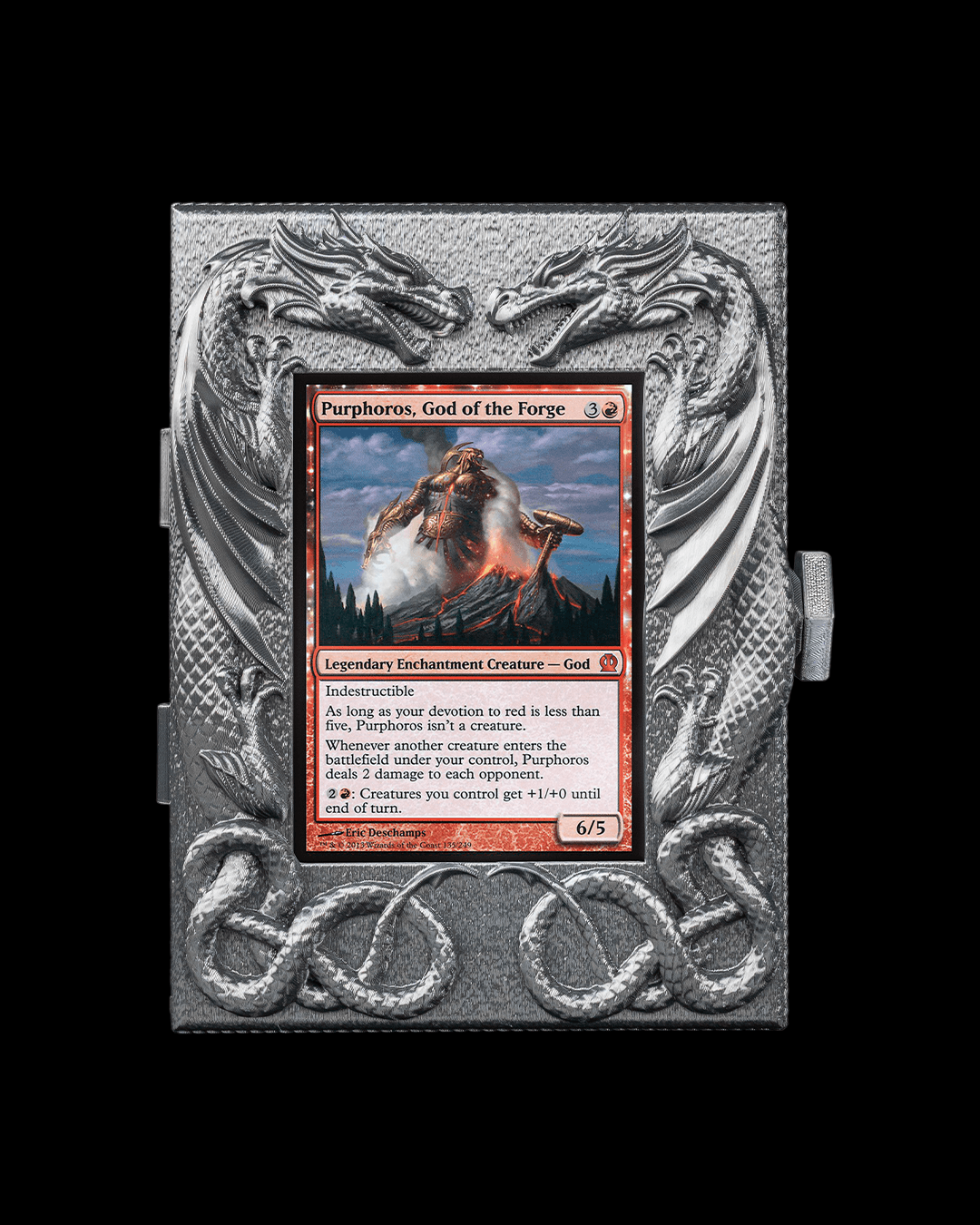
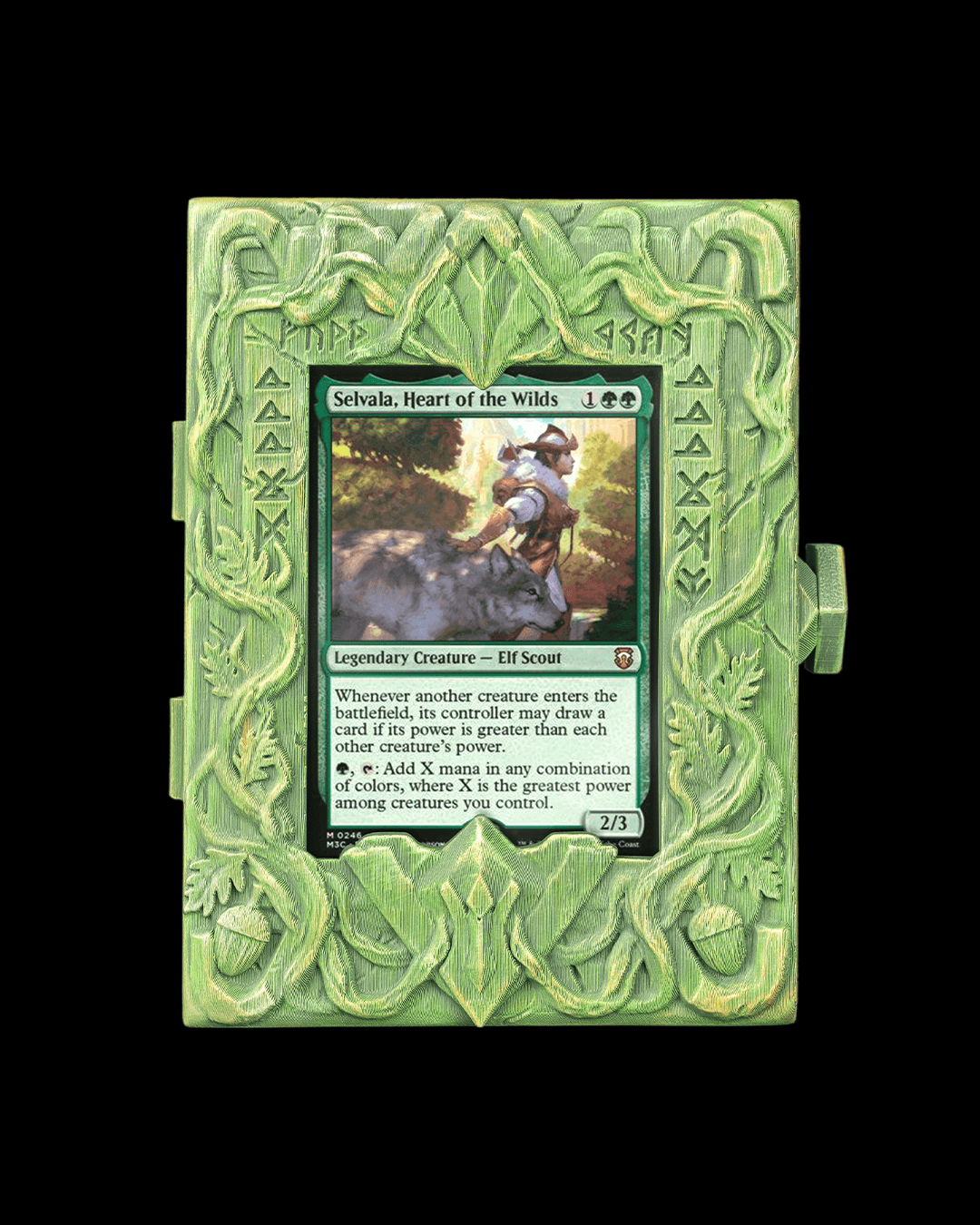
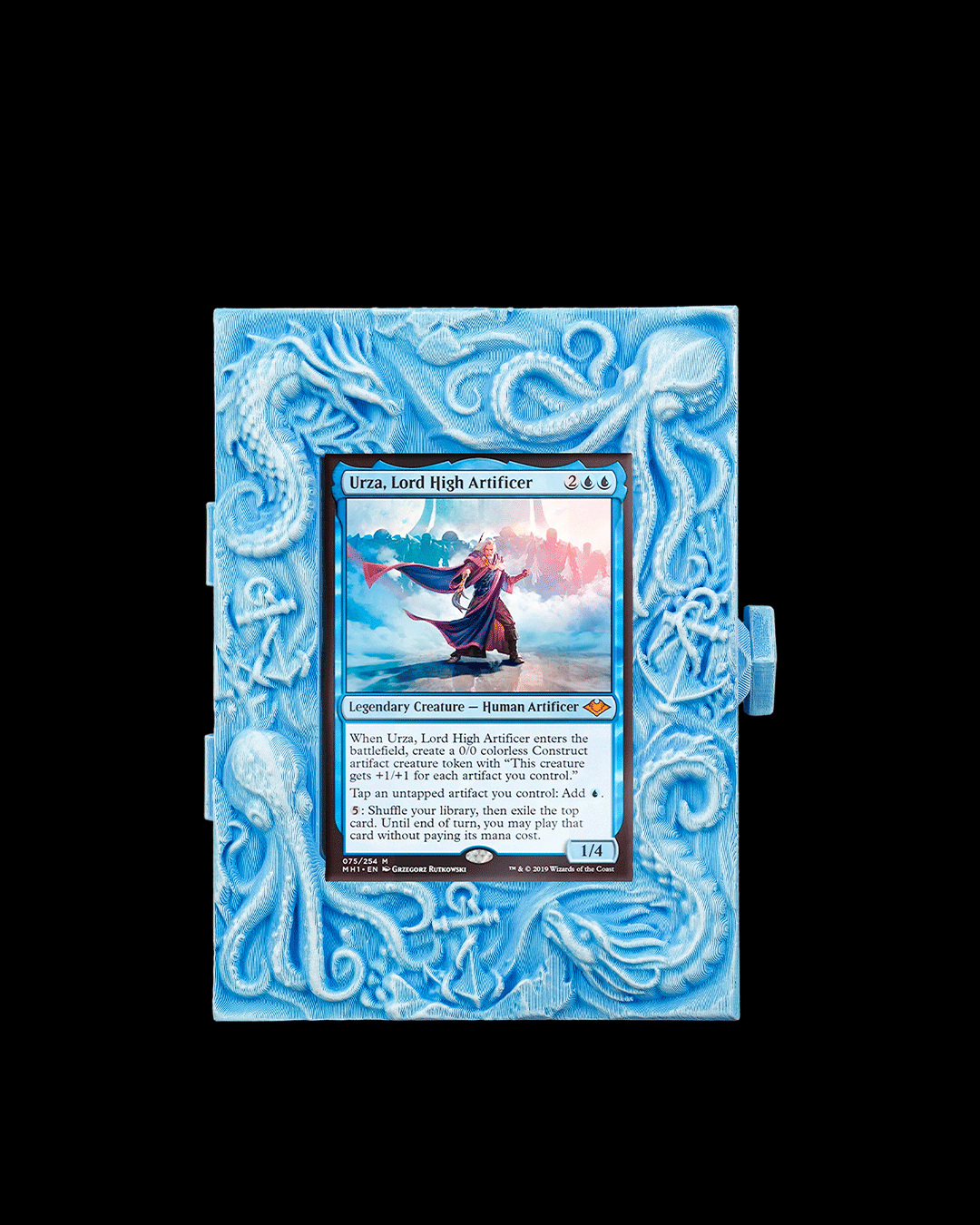
Games are typically played with three or four players at a table, everyone starting at 40 life instead of 20, and a strong emphasis on politics and table dynamics alongside pure strategy. That social layer is part of the appeal, but it is worth keeping your competitive instincts intact. Reading the table, picking the right moment to commit your removal, and threat-assessing which opponent is closest to winning are still the same skills you have already built in other formats. Commander just asks you to apply them across three opponents instead of one.
🎨 Color Identity Explained
The single biggest adjustment coming from other formats is color identity, and it is worth understanding well before you start picking cards.
Your commander’s color identity is determined by every colored mana symbol on that card, both in its mana cost and in its rules text. Every card in your deck, aside from basic lands, has to fall within that color identity. So if your commander is Azorius (white and blue), you simply cannot play cards that contain red, black, or green mana symbols anywhere on them, even as a small part of a hybrid cost or an activated ability.
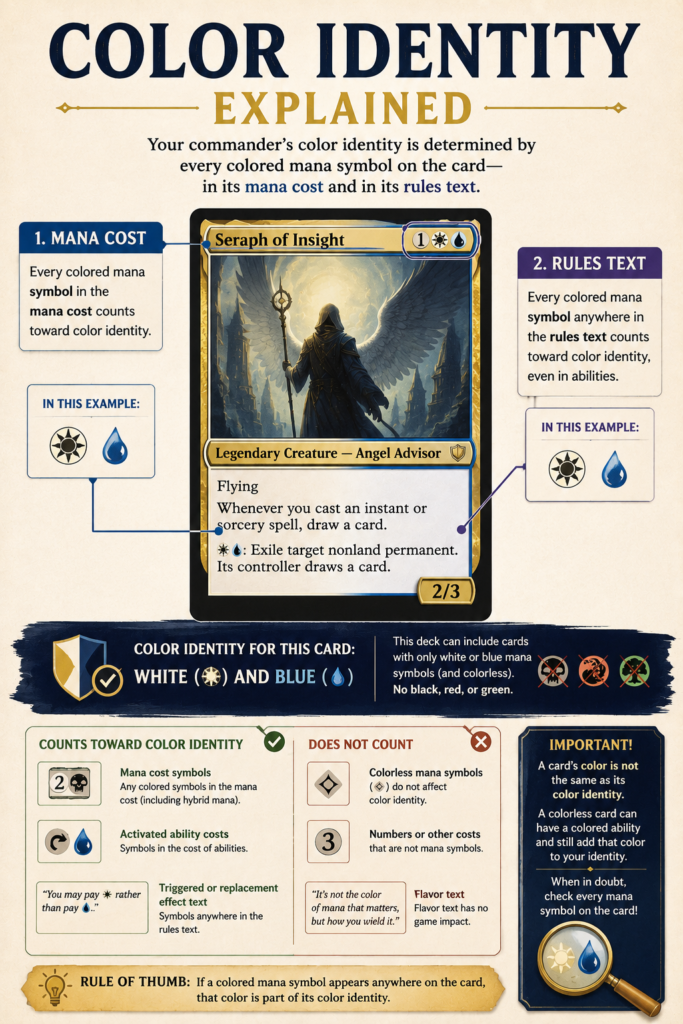
This is different from a card’s color, which only looks at its mana cost. A colorless artifact with a black activated ability in its text box still has black in its color identity, even though the card itself is colorless. It is a small distinction, but it trips up a lot of new Commander players who assume color identity works the same way “color” does everywhere else in the game.
Once you get comfortable with the rule, it becomes a useful shorthand for what your deck can and cannot do. Each color also tends to carry a rough personality in Commander: blue leans into card draw and control, green into ramp and big creatures, black into recursion and sacrifice value, red into aggression and chaos, and white into protection and board control. Knowing those tendencies helps you predict what a two or three color commander will actually want to do before you have read a single card.
🃏 The Singleton Rule and What It Means for Deckbuilding
Commander decks run exactly 100 cards including the commander, and outside of basic lands you can only include one copy of any given card. That single rule changes deckbuilding more than almost anything else about the format.
In a 60-card deck, you can run four copies of your best removal spell and count on drawing it fairly often. In Commander, you cannot rely on drawing any single card, so you build in redundancy by including several cards that do similar jobs. Instead of four Doom Blades, you might run six or seven different removal spells that all answer creatures in slightly different ways. The same logic applies to ramp, card draw, and win conditions.
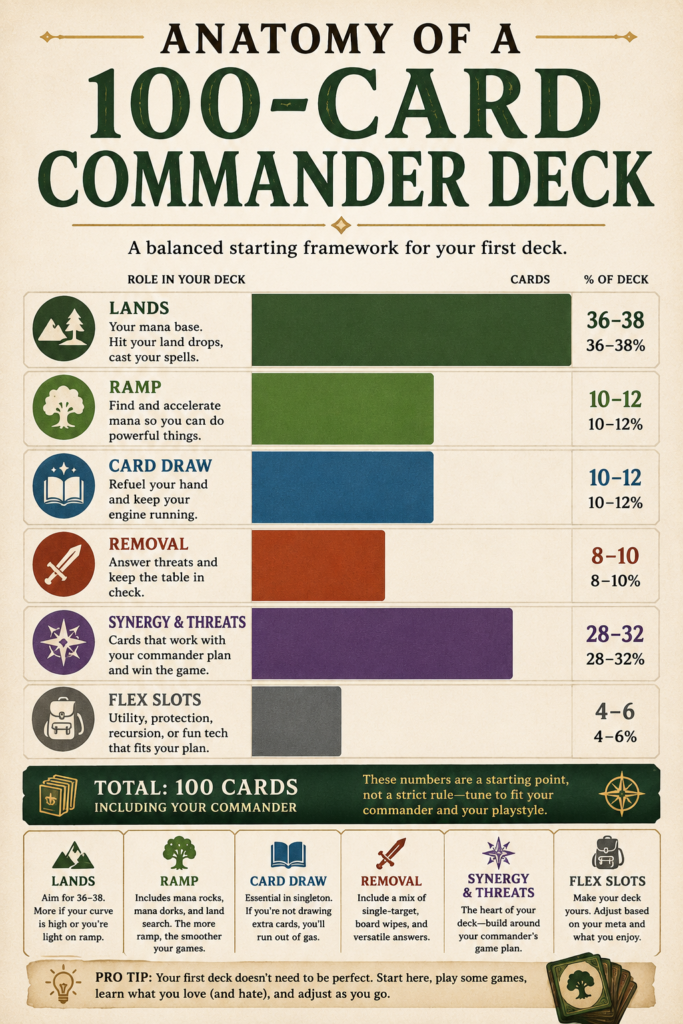
Because you cannot count on any one card showing up, searching, card draw, and recursion become much more important than they typically are in constructed formats. They are what let you find the effect you need instead of hoping it is in your opening hand, and they help offset the extra randomness that comes with a singleton card pool.
🧙 Choosing a Commander That Matches Your Playstyle
The best first commander is not the most powerful one you can find. It is one with clear, simple rules text, a build-around ability that immediately suggests what kinds of cards you want, and a color identity that is not so restrictive it limits your options before you have even started.
A good way to narrow things down is to think about the kind of games you already enjoy in other formats and match that to a Commander archetype:
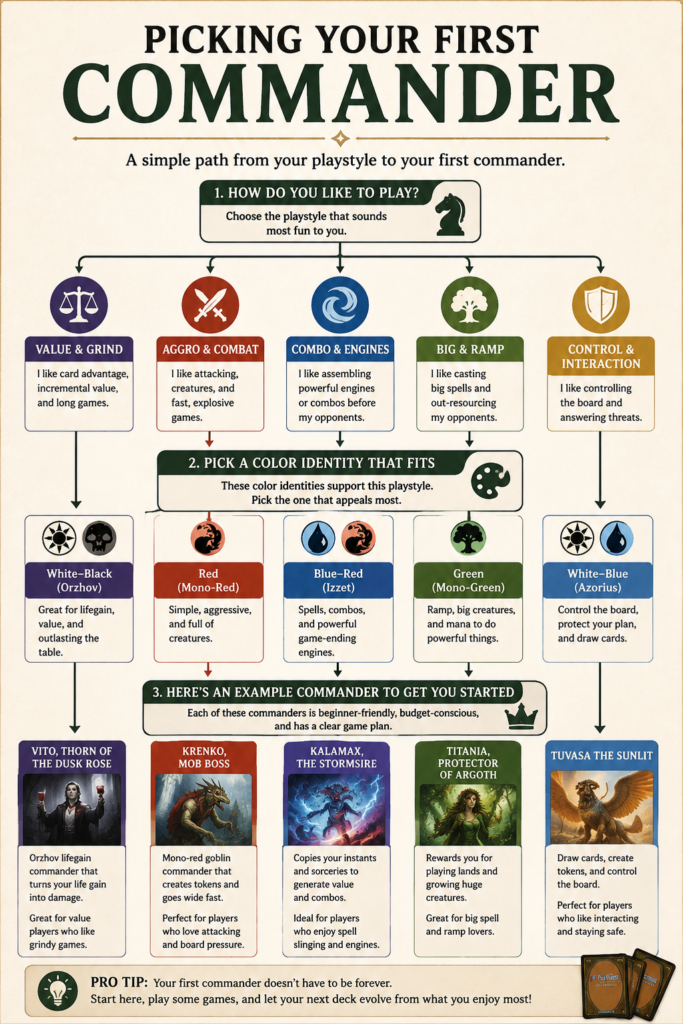
Value and grind players who like incremental card advantage often gravitate toward something like Vito, Thorn of the Dusk Rose, an Orzhov commander that turns your lifegain into direct damage. It is a simple idea to build around: every lifegain effect in your deck doubles as a win condition.
Aggro and combat-focused players tend to enjoy Krenko, Mob Boss, a mono red commander that pumps out goblin tokens every combat and rewards you for attacking early and often. It is inexpensive to build and has one of the most straightforward game plans in the format.
If you like the combo-oriented decks style of play from constructed Magic, where you are assembling a payoff before your opponents can interact with it, look for a commander with a repeatable engine rather than a fragile two-card combo. Kalamax, the Stormsire is a good entry point: it rewards you for casting instants and sorceries by copying them, so your deck naturally builds toward big spell-slinging turns instead of needing an exact combination to function.
Control and pillow-fort players who like to stabilize before taking over the game should look at Grand Arbiter Augustin IV, an Azorius commander that makes your spells cheaper and your opponents’ spells more expensive. It is an easy concept to build around and buys you time to develop your board.
If you have ever enjoyed a ramp-heavy, board-flooding deck in other formats, tokens and go-wide strategies scratch a similar itch in Commander. Rhys the Redeemed, a Selesnya commander that doubles your tokens, is a classic beginner pick because the plan is easy to explain and cheap to assemble.
Whichever direction you lean, resist the urge to start with a high-complexity “toolbox” commander that wants to do five different things at once. A focused, simple game plan is easier to build well and far more satisfying to pilot in your first few games.
🏗️ Building the Skeleton of a 100-Card Deck
Once you have a commander, it helps to work from a flexible structural template rather than trying to pick 99 cards from scratch. A commonly used starting skeleton looks roughly like this:
Around 35 to 38 lands, since Commander games run longer than constructed formats and you need to hit your land drops consistently across a whole game rather than just the first several turns.
About 8 to 12 ramp pieces, whether that is mana rocks, ramp spells, or land-fetching effects, to help you reach your bigger plays on time.
Roughly 8 to 12 card draw or card advantage effects. This is arguably the most important category in the whole deck, because more cards in hand means more access to your ramp, your removal, and your win conditions. A one-time cantrip is fine as smoothing, but prioritize effects that net you two or more cards over time.
Around 8 to 12 pieces of interaction, split between single-target removal and a small number of board wipes, typically three or four, for when you fall behind.
The remaining slots, usually somewhere between 15 and 20 cards, go to win conditions, synergy pieces, and protection for your commander and your game plan.
As you fill in each category, keep tying your choices back to your commander. Ask what your commander wants you to do, then fill each slot with cards that do that efficiently in your colors. It is also worth learning to identify a card’s function rather than memorizing specific names. Once you can look at a card and immediately recognize “that’s ramp” or “that’s removal,” you can adapt your deck to whatever is actually in your collection instead of chasing a fixed list.
💧 Mana Base and Fixing in Commander
A stable mana base matters even more in Commander than in most constructed formats, since a huge number of decks run two or three colors and games last long enough that a stumbling start can cost you the whole match.
Start with a solid basic land count in your primary colors, then layer in budget-friendly fixing on top: check lands, pain lands, and scry lands can all fix two colors for well under a dollar each, and generic fetchers like Terramorphic Expanse or Evolving Wilds smooth out your draws for very little cost. If you are running three or more colors, taplands and tri-lands do a lot of the heavy lifting, and a card like Command Tower, which taps for any color in your commander’s identity, is close to a free include in almost any deck.
If you are building on a budget, a simple rule of thumb is to prioritize lands that fix your colors before you reach for expensive duals. If you have enjoyed building around ramp and mana efficiency in other formats, this is the same instinct applied to a slower, longer game.
🔗 Synergy vs. Goodstuff
As you finalize your list, it helps to understand the difference between a synergy deck and a goodstuff deck. A synergy deck is built around cards that actively work together toward a clear game plan. A goodstuff deck is just a pile of individually powerful cards with no real connective tissue between them.
For a first deck, lean into a simple synergy tied directly to your commander, something like “when creatures die, things happen,” rather than jamming in every strong card you own. If a card does not help your commander’s plan, whether that is ramping you, drawing you cards, removing threats, or protecting your strategy, it is usually worth cutting even if it looks powerful on its own.
🎯 Playtesting, Tweaking, and Table Etiquette
Once your list is built, the real tuning happens at the table. Goldfish a few hands on your own to see how consistently your deck reaches its game plan, then get in several casual games against other decks. Pay attention to what feels clunky, what never comes up, and where you are drawing too many or too few lands.
Commander is also a social format, and Krenko-style aggression aside, it is worth being upfront with your group about your deck’s power level before you sit down, adjusting your play to match the table rather than trying to win as fast as possible every single game. A deck that is fun to play against is a deck people will want to keep inviting to game night.
If aggressive strategies interest you, it is worth noting that fast, proactive decks reward strategic thinking just as much as slower ones do. Speed does not mean playing on autopilot, and Commander punishes autopilot aggression quickly once your opponents start holding up interaction.
Building your first Commander deck is as much about learning a new way to think about deckbuilding as it is about picking 99 good cards. Start with a focused commander, build outward from a flexible skeleton, keep your mana base honest, and let your first few games teach you the rest.