
As an Amazon Associate I earn from qualifying purchases and sometimes recommend products from other sellers at no extra cost you. For more details see my disclosure policy and privacy policy.
The alpha player problem shows up in almost every new cooperative board game group sooner or later. One player, usually the most confident or the most experienced, starts making decisions for everyone else. Turns stop being “what do you want to do?” and become “here’s what you should do.” The game is still technically cooperative, but only one brain is doing the deciding.
New co-op groups are especially exposed to this. When the mechanics are unfamiliar, the player who reads rules fastest or has played the genre before naturally becomes the reference point, and the rest of the table defers to them out of relief rather than any actual agreement. That deference sets fast, and once it has, it gets mistaken for a personality trait rather than what it usually is: a structural pattern that forms when a group hasn’t agreed on how it wants to make decisions together.
This isn’t a five-tips list written after the damage is done. It’s organised around when the dynamic actually shows up, so a new group can head it off before it takes hold.
🎲 What’s Actually Happening (and Why New Groups Are Vulnerable)
An alpha player isn’t someone who happens to be good at the game. It’s someone who ends up directing other players’ turns, whether by telling them what to play, reaching for their pieces, or answering questions the game asked someone else. The other players become executors of instructions instead of people making choices.
New groups are more vulnerable because unfamiliar mechanics create an information gap, and the person introducing the game or the one who has played similar games before fills it fast. Every suggestion they make lands with extra weight, because the rest of the table assumes experience with games in general translates into being right about this specific decision. That assumption is rarely tested out loud, which is exactly how the pattern locks in before anyone’s discussed it.
🤝 Setting the Table: Agreements to Make Before the First Turn
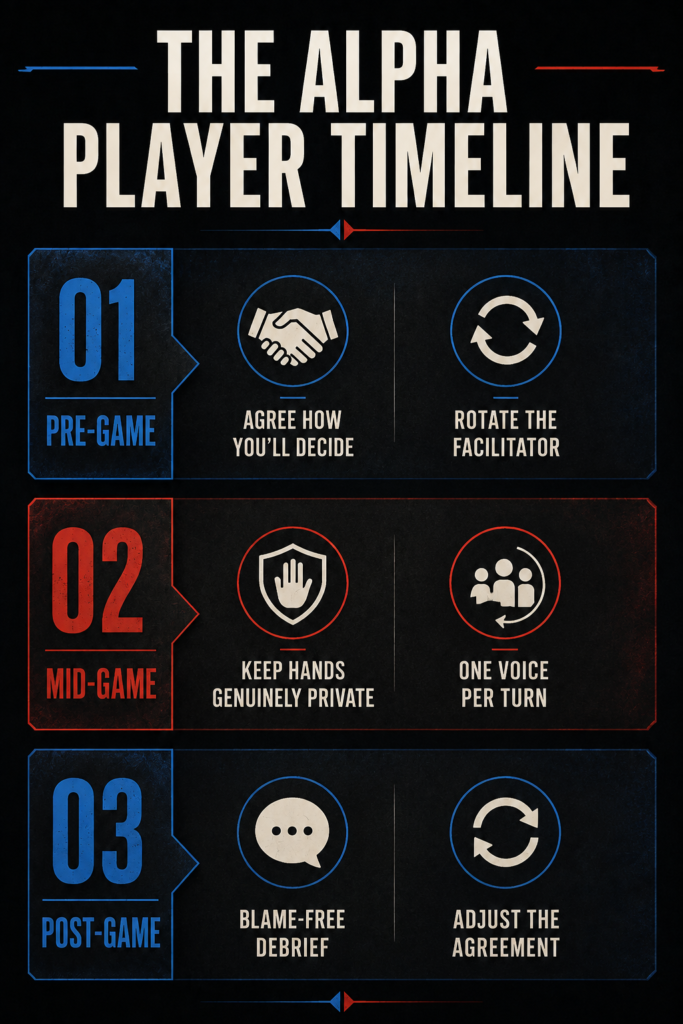
The most useful thing a new group can do happens before anyone picks up a card: agree, out loud, on how you’ll handle disagreements when they come up mid-game. Waiting until the first tense moment to figure this out means figuring it out under pressure, which usually favours whoever talks fastest.
One option worth trying is a “one voice per turn” agreement: whoever’s turn it is states their own move before anyone else weighs in, and other players can offer thoughts only if asked. Some groups prefer a rotating facilitator instead, whose job for that session is to check in with quieter players before decisions get made, not to make the decisions themselves.
Neither of these is a universal fix, and a rule that works brilliantly for one table can feel stiff and over-engineered for another. Treat the pre-game conversation as picking a starting point you’re willing to adjust, not settling on a permanent house law.
🧩 Mid-Game: Structural Tools That Do the Enforcing For You
Verbal agreements are easy to forget once a game gets tense. Structural tools built into the game itself are harder to override, which is why some designers lean on them directly. Hanabi is built around a hidden-hand mechanic where you can see everyone’s cards except your own, so no player can simply direct another’s turn since nobody at the table, including the “expert,” actually knows what’s in your hand.
The Crew: The Quest for Planet Nine goes further and restricts communication outright: players cannot discuss their hands at all during a round, and can only signal information about a single card once per mission using a limited communication token. That structural limit does a lot of the alpha-prevention work that a verbal house rule struggles to enforce consistently.
Groups playing games without those built-in limits can borrow the underlying idea: keep resource cards or player boards genuinely private rather than visible to the whole table, stick to strict turn order where only the active player’s move is discussed, and set a soft rule against commenting on what’s in someone else’s hand unless the game explicitly makes that information shared.
🗣️ If You’re the Quiet One: Reclaiming Agency Without a Confrontation
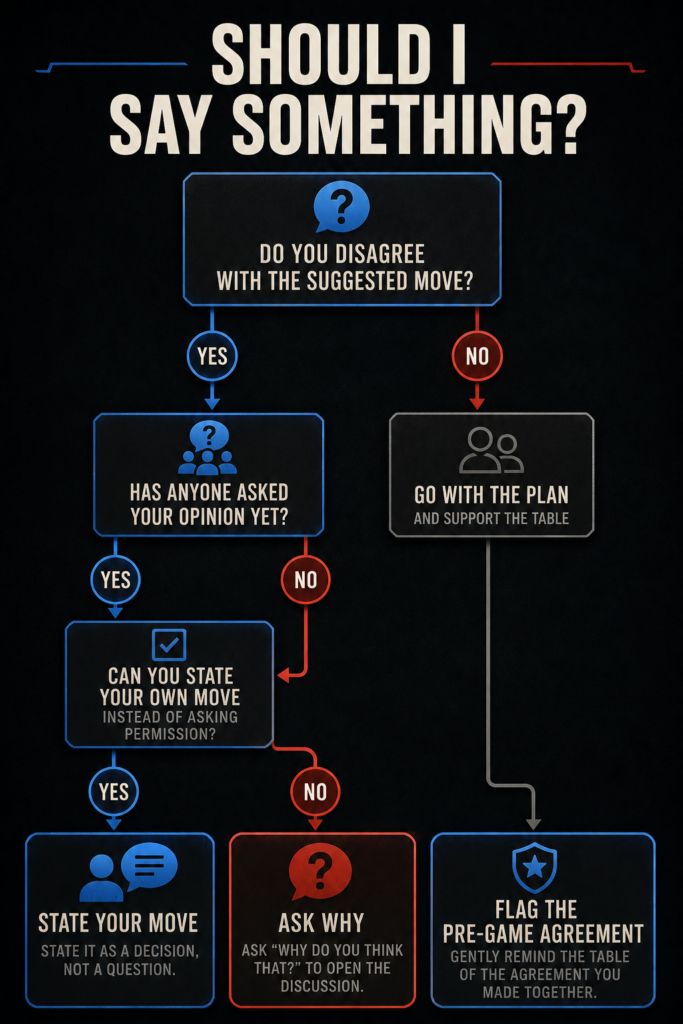
If you’ve noticed yourself going along with instructions rather than making your own calls, there are low-friction ways back in that don’t require calling anyone out. Stating your move as a decision rather than a question helps immediately: “I’m playing this” lands differently than “should I play this?” and gives the alpha player less room to redirect you before you’ve finished the sentence.
Asking “why do you think that?” instead of just complying is another useful habit. It’s not confrontational, but it does something a passive nod doesn’t: it puts the reasoning back on the table where the whole group can weigh in, rather than letting one player’s read on the situation quietly become the group’s decision.
If your table set a pre-game agreement, you can invoke it directly and lightly: “we said one voice per turn” is a much easier sentence to say than “please stop telling me what to do.”
🪞 Self-Check: Are You the Alpha Player?
Alpha play rarely feels like alpha play from the inside. It usually feels like helping. A few honest questions can catch it before it becomes a pattern: are you finishing other players’ turns in your head before they’ve spoken? Do you find yourself reaching for someone else’s pieces or cards? When a question gets asked at the table, are you answering it even when it wasn’t directed at you?
A simple self-monitoring habit is counting how often you talk about your own turn versus someone else’s during a session. If the answer is skewed heavily toward managing everyone else’s decisions, that’s worth naming to yourself, and eventually to the group, as a pattern to adjust rather than a flaw to feel bad about. Structural and behavioural, not character-based, works both ways: it’s not a personality flaw when you’re doing it either.
📝 Post-Game: Making the Debrief Do Some of the Prevention Work
A short, blame-free debrief after the game is one of the more underused tools here. Asking “what felt good and what felt rushed?” gives quieter players an opening to flag moments where they felt overridden, without it turning into a pointed conversation about any one person.
If your group used a facilitator role, rotating it to a different player next session keeps the responsibility for drawing out quieter voices from becoming its own kind of alpha position. And if the agreements you set before the game didn’t quite hold, the debrief is the moment to adjust them for next time, rather than quietly hoping they work better by themselves.
🎯 Which Co-op Games Make This Easier (and Which Invite It)
Some games are simply more forgiving for a new group learning to navigate this dynamic, and some make it more likely almost by design. Hanabi and The Crew sit at the forgiving end because their communication limits are built into the rules rather than left to the table to self-police, which takes a lot of pressure off a group that hasn’t found its footing yet.
Pandemic has a well-documented reputation in the board gaming community for tipping into alpha play, particularly when there’s a wide skill gap at the table, because all player hands and the board state are fully visible and open to discussion. That transparency is great for teaching the game but makes it easy for one confident player to start narrating everyone’s options.
Higher-complexity co-op games like Spirit Island and Gloomhaven tend to invite the same dynamic for a different reason: dense rules and card interactions mean one player who’s read ahead can end up explaining everyone’s options out of genuine helpfulness, which slides into directing without anyone intending it. Active BoardGameGeek discussion on both games frames this as a byproduct of complexity, not a fixed design flaw.
For a new group’s first few sessions, our guide to choosing games for cooperative strategy play is a useful next stop if you’re still building out your shelf. Pick something with built-in guardrails first, and save the denser campaign games for once your group has a few sessions of practice negotiating decisions together.
The Short Version
The alpha player problem isn’t a character flaw and it isn’t inevitable. It’s a pattern that forms fastest in groups that haven’t yet agreed on how they want to make decisions together, and it loosens its grip fastest when a group builds in structure, whether that’s a pre-game agreement, a game with hidden hands, or just a habit of asking “why do you think that?” instead of nodding along. New groups that expect the dynamic and plan for it tend to get past it a lot faster than groups who wait until someone’s already frustrated.