
As an Amazon Associate I earn from qualifying purchases and sometimes recommend products from other sellers at no extra cost you. For more details see my disclosure policy and privacy policy.
Everyone has an opinion on which horror board game to play this Halloween. Almost nobody talks about what happens after you’ve picked one. The table setup, the lighting, the pacing of the actual evening, that’s the part that decides whether your group is still leaning in three hours later or checking their phones by round two. This guide skips the “which game” debate entirely and focuses on running the night itself.
🎲 Match the Game to the Room First
Before any table setup happens, you need a quick read on what your group can actually handle. A table of horror veterans who own Betrayal at House on the Hill and Mansions of Madness wants something different from a table where half the players have never touched a co-op horror game before.
Rather than re-ranking games here, lean on a proper scare-tolerance framework. Our guide to the best horror board games for every scare tolerance level breaks games down by intensity, so you can hand it to your group ahead of time and let them self-select rather than guessing.
If your group leans toward the deeper, more analytical end of horror gaming, something like Arkham Horror or Eldritch Horror, the decision gets less about scariness and more about which specific game suits your table. That’s a separate conversation from tonight’s setup, so treat the hand-off guide as your decision point and come back here once the game is chosen.
🪑 Table and Space Setup
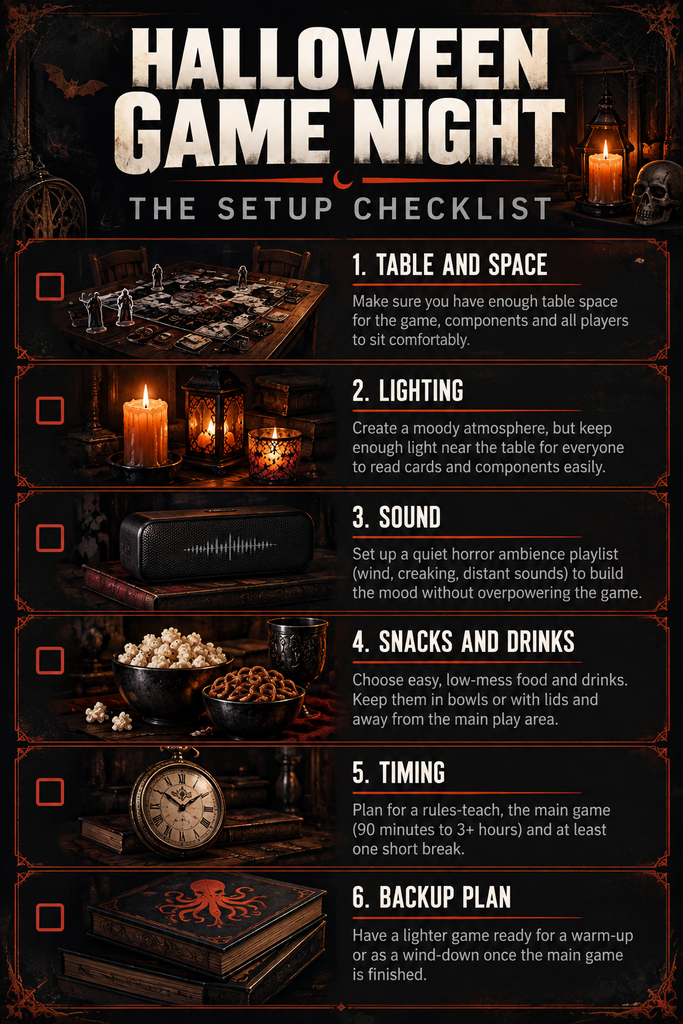
Big co-op horror games eat table space fast. Betrayal, Arkham Horror and Mansions of Madness all sprawl across a standard dining table by round three, so measure your play space against the game’s box footprint before the night, not during it.
Seating matters more in horror games than in most genres, because you want everyone able to see the shared components (the map tiles, the mythos deck, the monster standees) without leaning across the table constantly. A rectangular table with players down both long sides usually works better than a round table for anything with a large central board.
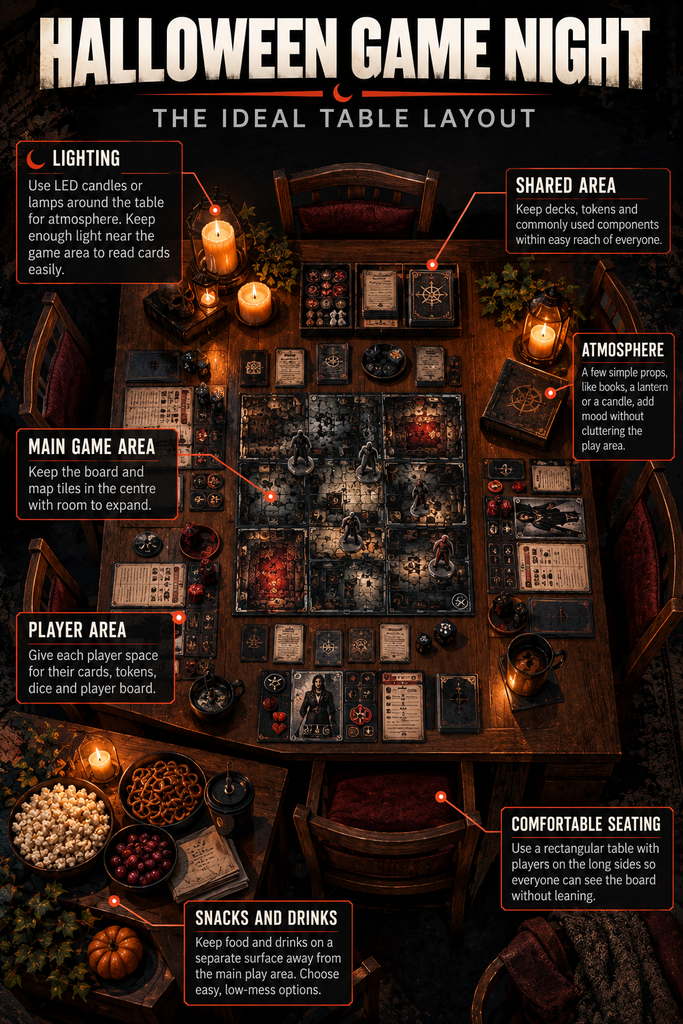
Lighting is the trickiest balance in the whole setup. You want the room dim enough to feel like mood lighting, but every player still needs to read small card text without squinting or reaching for a phone flashlight, which instantly kills the atmosphere you just built. A few strategically placed lamps or LED candles near the table, rather than one dim overhead light, usually solves this: enough ambient glow for mood, enough direct light near the cards for readability.
🕯️ Atmosphere on a Budget
You don’t need a full haunted-house budget to shift the mood of a game night. Sound does most of the heavy lifting: a horror ambience playlist (wind, distant creaking, low drones) running quietly in the background costs nothing and works on almost any streaming service.
LED flickering candles are worth the small investment over real flame, since you’ll have components, cards and snacks within arm’s reach of them all night. Battery-operated ones with a warm, uneven flicker read as genuinely atmospheric rather than gimmicky, and you can pick up a set of flameless LED candles without worrying about anyone knocking one over onto the game board.
Props are where it’s easy to overdo things. A couple of well-placed items, an old book, a scattering of fake cobwebs near the table edges, a single unsettling object as a centrepiece, do more than a room fully decorated for a party. Keep props away from the actual play area; nothing kills momentum like fishing a card out from under a decorative skull.
⏱️ Running the Evening
A horror game night runs better with a loose schedule than with no plan at all. Budget real time for a rules-teach if anyone’s new to the game; horror games often have more moving parts than they first appear, and rushing this step sets the whole night off balance.
If your group is mixed-experience, consider a short warm-up game, something quick and lower-stakes, before diving into the main event. It gives newer players a chance to settle in and gives everyone a shared rhythm before the tension ramps up.
Plan for the main horror game to run longer than the box suggests. Most co-op horror titles run 90 minutes to 3+ hours depending on player count and how much the group deliberates, so build in a natural stopping point or two rather than assuming you’ll finish in one sitting. A wind-down, a lighter game, snacks, or just conversation, gives the night a proper landing instead of ending abruptly the moment the credits (or the losing condition) hit.
🎭 Keeping Tension and Pacing in Co-op Horror
Co-op horror games live or die on how the group manages information and turns. One player who solves every puzzle and calls every shot (commonly known as quarterbacking) can flatten the tension for everyone else fast, even with the best intentions.
Rotating who reads flavour text or narrates story beats keeps engagement spread across the table rather than concentrated in one person. If your game has defined player roles, lean into them: a player playing their specific strength (combat, clues, support) keeps decisions distributed naturally instead of funnelling through whoever’s most confident.
Build in a natural break partway through longer games. A five-minute pause to refill drinks or stretch resets the room’s energy and lets the tension build again in the second half, rather than plateauing because everyone’s mentally tired by hour two.
🍿 Practical Extras
Food and drink need to survive proximity to cards, dice and small components. Skip anything greasy, saucy or crumb-heavy near the table, think pretzels, popcorn in bowls kept off the play area, or drinks with lids, rather than a full meal balanced on someone’s knee mid-game.
Have a plan B ready before the night starts. If someone gets genuinely too spooked to continue, or you’re running short on time, know which game in your collection can step in as a lighter alternative, and don’t treat switching games as a failure. A group that swaps to something calmer and has a good time beats a group that grinds through a game nobody’s enjoying anymore.
🎃 Ready to Run Your Own Night
The best horror game nights aren’t about owning the scariest box on the shelf, they’re about a room that’s set up to let the game do its job. Get the table and lighting right, pace the evening with breaks built in, and have a backup plan for when the mood shifts. Pick your game using the scare tolerance guide, set the room up with this guide, and the atmosphere takes care of itself.