
As an Amazon Associate I earn from qualifying purchases and sometimes recommend products from other sellers at no extra cost you. For more details see my disclosure policy and privacy policy.
Not everyone wants to spend game night curled up in a cold sweat. Some players want a spooky atmosphere without anything that keeps them up afterwards. Others actively want a game that makes them feel hunted, betrayed, or one bad dice roll away from something terrible. And plenty of people sit somewhere in between — they’ll happily lean into dread and tension, as long as things don’t tip over into genuinely disturbing territory.
The good news is the horror board game genre has something for every one of those players. The trick is knowing where to look.
This guide organises the best horror board games by scare tolerance rather than by mechanics or player count. Each tier defines what kind of experience you’re actually signing up for, so you can match the game to the room before you punch out the cardboard.
| Tier | What to Expect | Best For |
|---|---|---|
| Low | Spooky vibes, eerie art, light themes | Mixed groups, Halloween nights |
| Medium | Mounting dread, atmospheric tension | Hobby gamers who enjoy a chill |
| High | Psychological horror, brutal choices | Players who want to feel the pressure |
How to Think About Scare Tolerance in Board Games
Before getting into the games themselves, it helps to understand what actually makes a board game feel scary. It isn’t one thing — it’s a combination of factors that hit different players in different ways.
Theme intensity is the most obvious dimension. Ghosts and classic monsters read very differently to body horror, infection mechanics, or stories involving real-world trauma. A game’s theme sets the ceiling for how unsettling things can get.
Visual tone matters almost as much. Cartoonish or stylised art keeps even dark themes at arm’s length. Realistic or painterly artwork that lingers on violence or decay hits harder. Two games with identical mechanics can feel completely different based purely on what’s on the cards.
Mechanical stress is where board games diverge from other horror media. A horror film is something you watch passively. A horror board game can make you feel responsible for bad outcomes — running out of time, losing teammates, making a choice that goes horribly wrong. Games that build genuine stakes through their systems create tension film can’t replicate.
Narrative darkness covers the emotional tone of the story. Some horror games are ultimately hopeful — you fight back, you save the town, you survive. Others are nihilistic by design, and winning feels more like delaying the inevitable than actually triumphing. Both are valid, but they produce very different experiences.
Once you know which of these dimensions affects you most, you’ll have a much clearer sense of which tier — and which specific games — actually suit you.
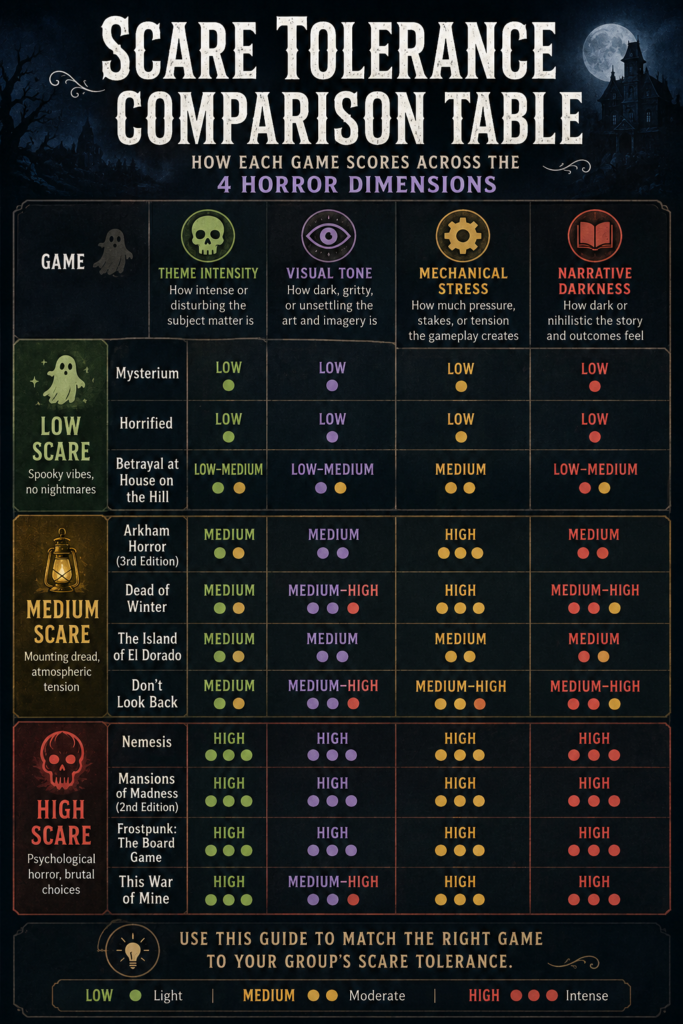
Low Scare Tolerance: Spooky Vibes, No Nightmares
These games lean into Halloween aesthetics, eerie stories, and unsettling imagery without any content that’s going to stick with you after the table is cleared. They’re ideal for mixed groups, players who enjoy atmosphere but not genuine dread, or anyone who wants something thematic without committing to a full horror experience.
Mysterium
Mysterium is the gold standard for low-scare horror gaming. One player takes on the role of a silent ghost, communicating only through dream vision cards — gorgeous, surreal illustrated images that hint at suspects, locations, and murder weapons. The other players are psychic investigators trying to interpret those visions and solve the ghost’s death.
The art is eerie in the way a strange dream is eerie: unreal, symbolic, slightly off. There’s nothing upsetting here, and the cooperative nature of the game keeps the mood collaborative rather than oppressive. It’s frequently recommended for families, casual groups, and anyone who wants the Halloween vibe without anything remotely frightening.
The one caveat: Mysterium rewards a certain type of player who enjoys lateral, intuitive thinking. If your group tends towards literal-minded strategy, the vision card communication can frustrate as much as it delights.
Horrified
Horrified takes the Universal Monsters — Dracula, the Creature from the Black Lagoon, the Wolf Man, Frankenstein’s Monster — and turns them into a co-operative game where players defend a town while working to defeat each creature using their individual weaknesses. It’s pulpy, cinematic, and fun in the way that old monster movies are fun: you’re never genuinely scared, but you’re thoroughly entertained.
The game scales well across player counts and difficulty levels, and the asymmetric monster mechanics give each game a different flavour. Non-horror fans tend to find it approachable because the monster designs are classic and familiar rather than disturbing. If your table includes someone who rolls their eyes at horror gaming, Horrified is often the game that converts them.
Betrayal at House on the Hill
Betrayal is a uniquely useful game for low-tolerance players because of how variable its “haunts” are. The first half of every game involves exploring a haunted house tile by tile, triggering events and encounters that build atmosphere. Then the haunt begins — one of 50 possible scenarios that completely change the game’s objective and often turn one player into a traitor.
Here’s the key detail: some of those haunts are genuinely campy and silly. You might end up fighting a giant spider with a makeshift weapon, or racing to stop a ritual that plays out like a B-movie plot. The tone varies wildly between scenarios, which makes it possible to cherry-pick haunts that stay light. Just read through the haunt list with your group first — a few of the scenarios do go darker, and being surprised by tone is no fun for anyone.
Medium Scare Tolerance: Tense and Creepy, But Manageable
This is where the genre starts to breathe. These games build real atmosphere — creeping dread, mounting tension, a persistent sense that things could go badly wrong — without crossing into genuinely disturbing content. The horror here is largely implied and narrative rather than explicit.
Mansions of Madness (Second Edition)
Mansions of Madness is one of the most acclaimed horror board games ever made, and for good reason. The app-driven system handles the scenario, tile reveals, enemy movement, and storytelling — all delivered alongside atmospheric music and ambient sound that transforms your table into something genuinely cinematic.
The Lovecraftian theme means the horror leans towards the psychological and the unknowable. You’re not fighting serial killers; you’re fighting things that shouldn’t exist, in situations your characters can barely comprehend. Investigators accrue mental trauma as well as physical damage, and the sense of escalating wrongness across a scenario is masterfully constructed. The content is unsettling but not explicit — it’s the horror of implication and imagination rather than anything graphic.
For players in the medium tier, this is the game to start with. It offers a full horror experience with polished production and accessible mechanics, and it’s genuinely one of the best board game experiences in any genre.
Fury of Dracula (Fourth Edition)
This is a hidden movement masterpiece. One player secretly moves Dracula across a map of Gothic Europe, leaving encounters and traps in their wake, while the other players take on the roles of hunters trying to track and destroy him. The asymmetry is elegant: Dracula controls the pacing and the narrative, but the hunters are always closing in.
The tone is classic gothic fiction rather than shock horror — it feels like you’re living inside a Victorian novel. There’s genuine tension in the hunting mechanics, and the occasional moment where Dracula is finally located creates real table drama. This is a great pick for players who enjoy cat-and-mouse tension and strategy games, as the mechanics are deeper than they initially appear.
The Night Cage
The Night Cage earns a strong reputation among horror game fans for doing more with less. Players explore a shifting labyrinth of candle-lit tiles in total darkness — mechanically, tiles outside your candle’s range are removed from the game, creating a constantly contracting world. The feeling of claustrophobia and isolation it generates is remarkable for a game with relatively simple rules.
The horror here is entirely atmospheric. There are no graphic images, no explicit violence, and no disturbing theme. It’s the discomfort of the unknown: you don’t know what’s around the corner, and your limited light means the world is always smaller than you’d like. Players who love the feeling of horror without any of its typical content will find The Night Cage hits exactly right.
Alien: Fate of the Nostromo
Based on the original film, this cooperative survival game captures the creeping dread of being hunted on a spaceship with no safe exits. Players work together to complete objectives and ultimately escape, while the Alien stalks them using a card-driven system that creates genuine unpredictability.
It’s streamlined enough to be accessible, short enough that a bad outcome doesn’t feel punishing, and faithful enough to the source material that fans of the film get a lot of joy from the references. The horror is sustained and tense — you’re never not aware of where the Alien might be — but never explicit or extreme. A solid entry point for medium-tolerance players who want something with a clear narrative arc.
High Scare Tolerance: For Players Who Want to Feel the Pressure
These games are for players who find horror movies relaxing and consider being put through the wringer a feature, not a bug. The horror in this tier is active and demanding — psychological, strategic, often brutal. You won’t just watch bad things happen; you’ll feel responsible for them.
Nemesis
Nemesis is survival horror in a box. You’re trapped on a spaceship with Intruders — nightmare alien creatures — and the game is relentless about reinforcing how outgunned and vulnerable you are. Players have individual objectives that may or may not align with each other, which introduces an undercurrent of mistrust even in a technically cooperative game. You might be working with someone who needs you alive, or someone who doesn’t.
The noise system, the Intruder bag draws, and the constant resource scarcity combine to create sustained mechanical stress that very few games match. Players who’ve described their Nemesis sessions reach for words like “exhausting,” “intense,” and “genuinely terrifying.” That’s a recommendation — just make sure everyone at your table is opting into that experience before you set it up.
The Thing: Infection at Outpost 31
Based on the John Carpenter film, this is a hidden traitor game with real teeth. One or more players are secretly infected from the start, working to sabotage the group’s efforts to escape and ensure the Thing survives. The paranoia this generates is visceral — you can’t trust anyone, and the game makes that suspicion tangible through every decision.
The psychological horror of social deduction — genuinely not knowing who to trust, watching yourself become suspicious of friends — is something unique to board games, and The Thing executes it exceptionally well. For players who enjoy the tension of games like Betrayal at House on the Hill but want something darker and more mechanically tight, this is the natural upgrade.
Arkham Horror: The Card Game
This is a campaign-driven Lovecraftian experience that builds and builds across multiple sessions. Your investigators deteriorate over time — mentally and physically — and the sense of doom escalates with each scenario. Losing isn’t a reset; it’s a development in an ongoing story that gets darker as you go.
The card game format gives it exceptional strategic depth. You’re building and tuning your investigator deck throughout the campaign, making decisions that affect not just this session but every session that follows. For players who want horror that also rewards analytical thinking, Arkham Horror: The Card Game sits at a rare intersection of strategic depth and genuine atmospheric dread. Those already comfortable with deck-building mechanics will find the system intuitive to pick up.
Final Girl
The last game on this list is also the most deliberately sadistic. Final Girl is a solo game — one player against a slasher-movie killer — and it’s entirely committed to recreating the horror movie experience from the perspective of the survivor who might not survive. Each scenario features a different killer with unique mechanics, and the game gives you just enough tools to fight back while making sure you always feel like you’re on the edge of losing.
It’s brutal, tight, and deeply satisfying when you pull off a win. It’s also explicitly inspired by horror cinema, which means the theme and tone are unambiguous. This is a game for solo gaming enthusiasts who want maximum tension and no one to blame but themselves when things go wrong.
Upgrade Paths: Moving Between Tiers
If you’re working your way up through horror gaming rather than knowing exactly where you land, these natural progressions work well:
Mysterium is the starting point for almost anyone — it’s approachable enough to work as a first horror game for players who’ve never tried the genre. From there, Horrified offers a slight step up in thematic commitment without adding stress. When you’re ready for real atmosphere, Mansions of Madness is the logical leap.
From the medium tier, The Thing or Nemesis are both strong moves up, depending on whether you prefer social deduction or mechanical pressure. Arkham Horror: The Card Game is the deepest option in the high tier and rewards patience — it’s worth playing the introductory scenario before committing to a full campaign.
The most important thing is to discuss tolerance levels with your group before setup. Horror gaming at its best is genuinely one of the most immersive experiences tabletop has to offer — but only when everyone at the table is there by choice.
Final Thoughts
Horror board games span a wider range of experiences than any single shelf section suggests. Whether you want a dreamy cooperative mystery, a gothic pursuit across Europe, or a mechanically punishing solo survival sim, the genre has it. The tier framework above isn’t a hierarchy — every level has games worth playing — it’s a map to help you find the experience that fits your table tonight.
The best horror games don’t just create fear through theme. They use mechanics to make you feel things that film and other media can’t touch. When a noise token comes out of the bag at the wrong moment in Nemesis, or you realise halfway through a Betrayal haunt that your friend is about to become your enemy, that’s a uniquely game-native experience. It just requires knowing how much of it you actually want.
Which of these tiers sounds most like your ideal game night? And which game on the list is already in your collection — or moving to the top of your wishlist? Let us know in the comments below.
Continue Your Journey
- Mysterium: A Deep Dive Into the Ghost That Communicates in Dreams — everything you need to know before your first game
- Best Single Player Board Games — solo gaming picks across all genres, including Final Girl
- Deck Building Games: Rules and Strategies — if Arkham Horror: The Card Game has you interested in the format
- Best Board Games for Big Groups — for when you need something that plays well at 6+ players
- Area Control Games — another deep strategic genre worth exploring once you’ve got your horror fix
Enjoying the site? Sign up for the Everything Is A Game newsletter and get new strategy guides, buying recommendations, and game news straight to your inbox.