
As an Amazon Associate I earn from qualifying purchases and sometimes recommend products from other sellers at no extra cost you. For more details see my disclosure policy and privacy policy.
You have two corporation cards in front of you, a 10-card starting hand, and roughly ninety seconds before someone at the table starts sighing. Most people grab the one with the bigger number and hope for the best. That works about as often as you would expect.
The problem with most corporation tier lists is that they hand you a single flat ranking and call it done. A corporation is only as good as the plan it fits, and the same card can look brilliant or dead in your hand depending on what else is on the table.
So this list does two jobs. It ranks every base game and Prelude corporation from S to C, then picks the best corporation for each main strategy: card engine, plants, heat, cities and awards. After that, it shows how the rankings shift with Prelude, drafting and player count.
⚖️ How These Tiers Are Judged
Three things decide a placement: how much starting money (MC, short for MegaCredits) you get, how strong the corporation’s ability is across a whole game, and how forgiving it is when your hand does not match.
The baseline setup for the rankings is a 3 to 4 player game, no drafting, and no Prelude cards in play. Later sections show what changes when you flip each of those switches.
This list covers the 12 base game corporations and the 5 corporations from the Prelude expansion, which are labelled as Prelude wherever they appear. Venus Next, Colonies, Turmoil and Prelude 2 corporations are saved for later articles.
Starting MC and ability text were checked against the card data from the open-source Terraforming Mars project, with Prelude setup rules checked against Fryx Games’ official Prelude rulebook. Where I mention a number, it comes from the card, not memory.
One honest caveat. Tiers are opinion informed by the cards and by public win-rate stats, and they depend heavily on your setup and your playgroup’s meta. A table full of aggressive city-spammers changes what is good, and so does a table that never funds awards.
As a sanity check, I looked at the win-rate table on the British Open Terraforming Mars site. It puts Tharsis Republic first, and puts Helion, Thorgate, Robinson Industries and United Nations Mars Initiative at the bottom. That table mixes in other expansions and strong players, so treat it as a second opinion, not gospel.
If you are still working out what to do with your first few generations, our Terraforming Mars strategy guide covering corporation selection and the early game walks through that. This list stays focused on which corporation to pick, and a few placements here differ from that guide because the setup assumptions are different.
🏆 The Corporation Tier List
Each entry shows the expansion and the starting MC printed on the card, followed by what the corporation does and why it sits where it does. Within a tier, the order is roughly strongest to weakest, but the gaps inside a tier are small.
If a corporation is one spot away from a tier boundary, a good hand can push it up and a bad one can drop it. Treat the tier labels as guidelines for the first look, then let the cards in your hand make the final call.
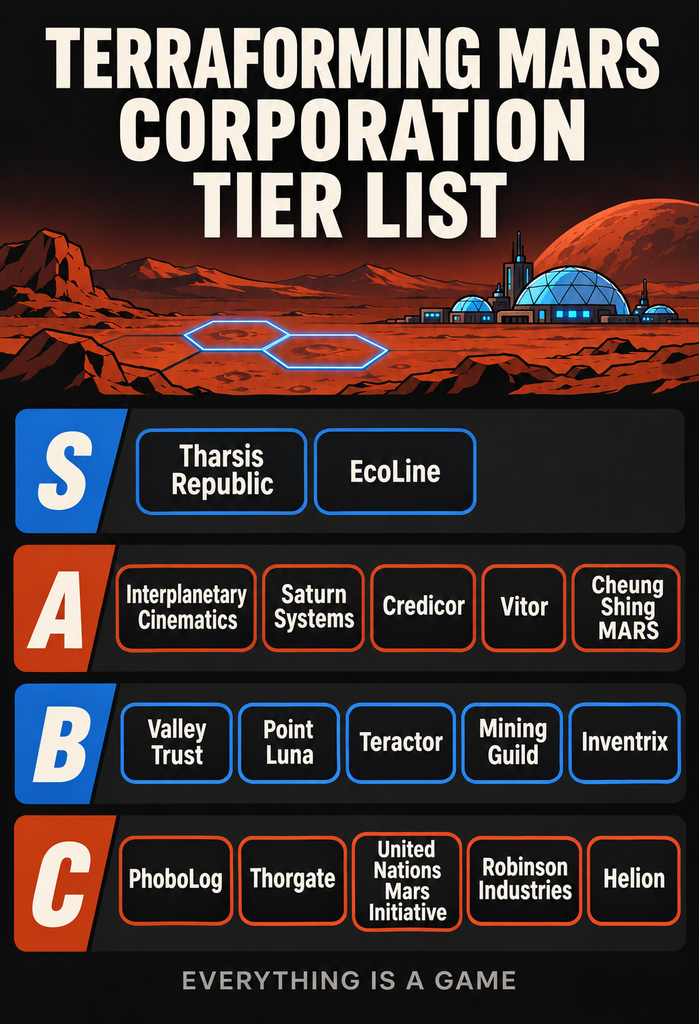
S Tier: Pick These Without Overthinking
- Tharsis Republic (base, 40 MC): Your first action is to place a city tile, you gain 3 MC every time you place a city, and you raise your MC production by 1 whenever any city goes down on Mars. It pays you for other people’s cities too, which makes it the most reliably rewarding corporation in a full table.
- EcoLine (base, 36 MC): You start with 2 plant production and 3 plants, and you can pay 7 plants instead of 8 to place a greenery. The plan is written on the card, so you always know what you are doing.
A Tier: Strong, With a Clear Plan
- Interplanetary Cinematics (base, 30 MC): It starts you with 20 steel, and you gain 2 MC each time you play an event. Great when your opening hand has a few events and building cards to spend that steel on.
- Saturn Systems (base, 42 MC): You start with 1 titanium production, and every Jovian tag that enters play, yours or anyone else’s, raises your MC production by 1. It gets stronger the more players there are.
- Credicor (base, 57 MC): Only Teractor starts with more money. Each time you pay for a card or standard project with a basic cost of 20 MC or more, you gain 4 MC back.
- Vitor (Prelude, 45 MC): Your first action is to fund an award for free. Each time you play a card with a non-negative VP icon, you gain 3 MC, which rewards a point-hungry style.
- Cheung Shing MARS (Prelude, 44 MC): You start with 3 MC production, and cards with a building tag cost you 2 MC less. It is a simple, steady economy that never has a dead turn.
B Tier: Good in the Right Hand
- Valley Trust (Prelude, 37 MC): Your first action is to draw 3 Prelude cards and play one, and science tag cards cost you 2 MC less. It leans on the Prelude deck, so it is at its best when Prelude is in your game.
- Point Luna (Prelude, 38 MC): You start with 1 titanium production, and each Earth tag you play, including this card, draws you a card. A genuine card engine, but it needs Earth tags to show up.
- Teractor (base, 60 MC): The most starting money of any corporation here, and Earth tag cards cost you 3 MC less. It is simple and safe, though the ceiling is lower than the S tier.
- Mining Guild (base, 30 MC): You start with 5 steel and 1 steel production, and you raise steel production each time you place a tile on a space with a steel or titanium bonus. It is a solid building corporation, held back by the low starting money.
- Inventrix (base, 45 MC): You draw 3 cards as your first action, and your global requirements are 2 steps flexible in either direction. Useful when your hand is full of awkward requirements, less so when it is not.
C Tier: Specialists That Punish Mistakes
- PhoboLog (base, 23 MC): You start with 10 titanium, and each titanium is worth 1 MC extra. The 23 MC start is the lowest in the box, so it needs a hand packed with space cards.
- Thorgate (base, 48 MC): You start with 1 energy production, and power tag cards and the Power Plant standard project cost 3 MC less. Fine value, but it rarely wins games on its own.
- United Nations Mars Initiative (base, 40 MC): Once your Terraform Rating has risen this generation, you may pay 3 MC to raise it 1 step more. A late-game engine that is slow to build up, so it asks a lot from a new player.
- Robinson Industries (Prelude, 47 MC): You can pay 4 MC to raise one of your lowest productions by 1 step. Flexible, but an expensive action to take every single turn.
- Helion (base, 42 MC): You start with 3 heat production, and you may spend heat as MC. It is a real engine for heat, and heat is a slow way to win.
🎯 Best Corporation for Each Strategy
Overall rank only tells half the story. If you already know the plan, the best corporation is the one that makes that plan cheaper.
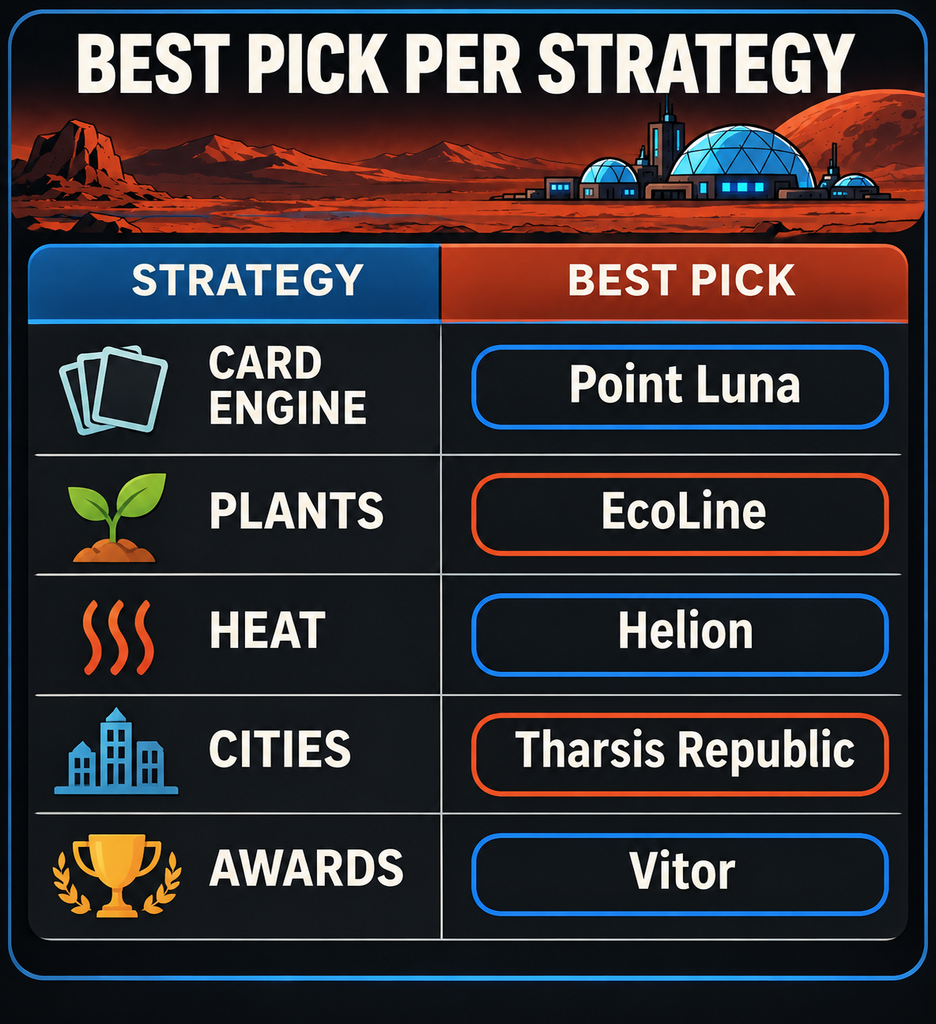
Card Engine
Point Luna is the purest engine here, drawing a card for every Earth tag you play. Inventrix is the runner-up, because drawing 3 cards up front gets the engine started.
The catch is that engines pay off late. If your table races to finish the game quickly, a card engine can run out of time before it turns into points.
Plants and Greenery
EcoLine is the obvious answer, and it is S tier for the same reason. Starting plant production plus a cheaper greenery gives you an early lead in the race for oxygen and tiles.
Heat and Temperature
Helion is the heat corporation, and it can use heat as MC, which is a neat trick. Its C tier placement is a warning: building around heat alone is a slower plan than people expect.
If you pick Helion, treat heat as a flexible bank rather than a strategy. Spending it as MC on the cards you actually want is where the corporation earns its keep.
Cities and Board Control
Tharsis Republic is the pick, with an easy MC income boost for every city that appears. If you want a building-flavoured alternative, Cheung Shing MARS gives you steady MC production and cheaper building cards.
Milestones and Awards
Vitor is built for this, with a free award funded as your first action. The free award saves a chunk of MC and nudges you to pick a plan early, which is the whole game with milestones and awards anyway.
Pair it with a corporation-agnostic habit: look at which milestones and awards are on the board before you commit. A free award is only a bargain if you are genuinely in the running to win it.
🪑 Common Mistakes When Picking a Corporation
The first mistake is choosing on starting MC alone. A big number feels safe, but a corporation with 57 or 60 MC and no plan can leave you with money and no direction.
The second is ignoring your starting hand. If you are holding three Earth tag cards, Teractor or Point Luna suddenly jumps a tier. If your hand is full of expensive space cards, PhoboLog stops looking so risky.
The third is forgetting what the rest of the table is doing. If two players are already racing for greenery tiles, a plants plan will be crowded, and it is worth knowing that before you commit.
🌱 Beginner Picks vs Corporations That Punish New Players
For a first few games, you want a corporation that tells you what to do and has money behind it. EcoLine, Tharsis Republic, Credicor and Teractor all do that. The card describes a clear plan, or you simply have extra MC to cover mistakes.
The corporations that punish beginners are the ones that need a perfectly matching hand. PhoboLog starts with 23 MC. United Nations Mars Initiative and Robinson Industries reward careful planning of every action.
The base game also comes with a Beginner Corporation card, which gives you 42 MC and 10 free cards instead of choosing from a dealt hand. If you are teaching someone brand new, it removes a lot of decisions.
🔁 How Setup Changes the Rankings
Everything above assumed one setup. Here is how the picture moves when you change it.
With the Prelude Expansion
Prelude deals each player 4 Prelude cards, and each player keeps 2. Kept Prelude cards cost nothing, so everyone starts stronger.
That tends to push money-heavy corporations down slightly, because extra starting MC matters less when everyone gets a free boost. Valley Trust moves up, because its ability is built around the Prelude deck.
With Drafting
Drafting means you see and pass more cards, so engine corporations like Point Luna and Inventrix get better. You can build toward your corporation’s tags instead of hoping the right cards turn up in your hand.
Raw-money corporations lose a little ground, since a draft rewards plans over cash. Plan-less picks like Teractor and Credicor still hold up, just with less of an edge.
By Player Count
Corporations that trigger off other players’ actions improve as the table grows. Tharsis Republic and Saturn Systems both pay you for what everyone does, so a 4 or 5 player game gives them more triggers.
In 2-player games the same corporations still work, but with fewer opponents the triggers dry up. A solid, self-contained economy like Cheung Shing MARS or Credicor tends to feel better there.
If you play a lot of 2-player games, our best 2-player strategy board games roundup has more picks that work well with a smaller table.
🏁 Final Thoughts: Treat the Tiers as a Starting Point
S tier is a safe default, and C tier is a warning label. Neither is a rule. The best corporation is the one whose plan you can finish, in the setup you are actually playing.
If you enjoy the plans-and-engines side of games like this, our guide to engine building board games shows the same ideas in other titles. If you want something with a similar sense of board control, take a look at our area control games tier list.
Where does your table disagree with these rankings? Tell us which corporation you think is too high or too low, and why.
🧭 Continue Your Journey
- Terraforming Mars Strategy Guide: Corporation Selection and Early Game Mastery
- Engine Building Board Games: The Complete Strategy Guide for Every Player
- Area Control Games Tier List: Which Games Dominate the Genre?
- City Builder Board Games: Conquering Concrete Jungles on Your Coffee Table
- Civilization Building Strategy Guide: Mastering Empire Games
- Gaia Project vs Terra Mystica: Which Space Strategy Game Wins?
- How to Choose Your First Strategy Board Game: A Complete Beginner’s Guide
- Best 2-Player Strategy Board Games 2025: Expert Recommendations