
As an Amazon Associate I earn from qualifying purchases and sometimes recommend products from other sellers at no extra cost you. For more details see my disclosure policy and privacy policy.
You’ve got two cards in hand that win the game outright. Your opponent has three cards in hand and four untapped lands. The question isn’t whether you have the pieces. It’s whether you can get them onto the battlefield before they get the chance to stop you.
That tension is the entire appeal of combo as an archetype. While aggro decks race the clock and control decks grind out resources, combo players are playing a different game entirely. You’re not trying to out-value your opponent or out-damage them turn by turn. You’re trying to reach a specific moment where the game simply ends, and then making sure nothing stands between you and that moment.
This guide breaks down what combo actually means on MTG Arena, how to build a deck around a genuine win condition rather than vague synergy, and the sequencing and disruption-management skills that separate players who occasionally combo off from players who do it consistently under pressure.
What “Combo” Actually Means
Every deckbuilder eventually says their deck has “great synergy,” and most of the time that’s true in a loose sense. Cards that support each other feel satisfying to play. But synergy and combo are not the same thing, and mixing them up is one of the fastest ways to misbuild a deck.
A combo deck is built around a specific, repeatable interaction that either wins on the spot or produces a board state your opponent cannot realistically come back from. Think infinite damage, an unbreakable lock, or a loop that generates more resources than the game can account for. The key word is deterministic. Once the pieces are on the battlefield, the outcome isn’t a maybe.
Compare that to a deck where your creatures happen to work well together and your removal happens to clear the way. That’s a good deck. It might even be a great deck. But it isn’t a combo deck unless there’s a moment where two or three specific cards coming together ends the game regardless of what else is happening on the board.
Why the Distinction Matters for Deckbuilding
Once you know you’re building a true combo deck, your card evaluation criteria change completely. A card doesn’t earn a slot because it’s individually powerful. It earns a slot because it finds your combo faster, protects your combo once it’s in hand, or buys you the turns you need to assemble it.
This is where a lot of newer combo players stumble. They keep cutting “the boring enabler cards” for flashier individual threats, and the deck gets weaker even though every card in it looks better on paper. Combo decks live and die by consistency, not raw card quality.
The Three Pillars of a Combo Deck
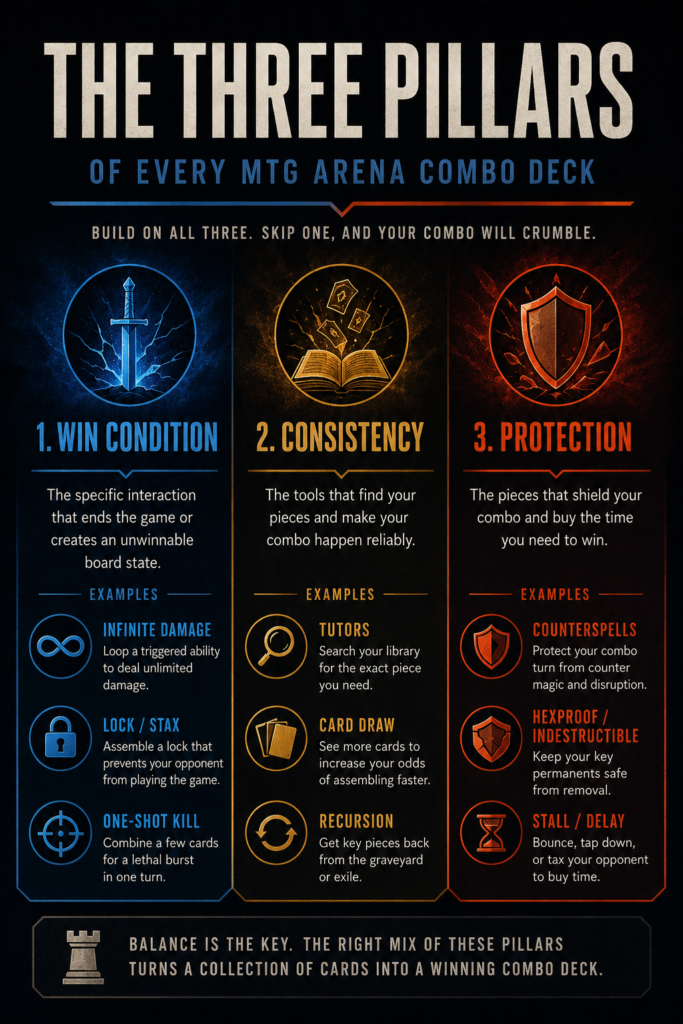
Every functional combo deck on MTG Arena is built on the same three foundations, and skipping any one of them is usually what separates a deck that wins tournaments from one that just wins occasionally against unprepared opponents.
Pillar One: A Clear Win Condition
Start here, always. Your win condition should be two or three cards that, together, either end the game immediately or create a board state your opponent has no real answer to. If you can’t name those cards specifically, you don’t have a combo deck yet. You have a pile of good cards hoping to become one.
Terror of the Peaks paired with a way to flicker or replay Bladewing the Risen is a classic example of this kind of engine: each creature entering the battlefield deals damage equal to its power, and looping the trigger turns a modest board into a lethal one in a single turn. The specifics change from format to format and season to season, but the principle stays the same. Know your two-card (or three-card) kill before you build anything else.
Pillar Two: Consistency Tools
A combo you can’t find isn’t a combo, it’s a daydream. This is where tutors and card draw earn their keep. Tutors that search directly for your key pieces effectively turn your deck into a much smaller, more focused one. Card draw engines increase the number of “live” cards you see each turn, which functions as extra copies of your most important pieces without taking up deck slots.
If you’re building your own list rather than following a guide, count how many ways you have to find each combo piece. If the honest answer is “one,” you’re going to have inconsistent games no matter how strong the payoff is.
Pillar Three: Protection
The best combo in the world does nothing if your opponent removes one piece before you assemble the rest, or counters your finishing spell on the turn you go for it. Protection comes in a few flavours: hexproof or indestructible effects that shield your key permanents, counterspells that protect your combo turn itself, and stall tools like bounce, tap-down, or tax effects that simply buy you more time.
Which protection you prioritise depends heavily on what you expect to face. A meta full of sweepers calls for protecting your board state. A meta full of countermagic calls for protecting your spells. Building blind protection into every combo deck regardless of matchup wastes slots that could go toward consistency instead.
Assembling Before They Interact
The phrase in this guide’s title, “before your opponent interacts,” is doing a lot of work, so it’s worth unpacking exactly what it means in practice. You’re not trying to avoid interaction entirely. You’re trying to reach a board state where your opponent’s removal and counterspells are either used up or irrelevant by the time your combo actually resolves.
This comes down to two separate skills that get conflated more often than they should. The first is speed: can you physically get to your win condition before your opponent is fully set up to answer it? The second is timing: even if you’re not the fastest deck at the table, can you force your opponent to spend their answers on the wrong threat at the wrong moment?
Good combo players think about both constantly, and the balance between them shifts depending on what they’re playing against. Against an unprepared or slower opponent, raw speed usually wins. Against a deck stacked with interaction, timing and information become far more important than how quickly you can theoretically go off.
The Speed Versus Strength Trade-Off
Almost every combo turn on MTG Arena involves a decision between a faster, more fragile line and a slower, better-protected one. Going off a turn earlier with less mana up for protection is tempting, especially when you’re ahead on board or your opponent seems tapped out. But it’s also the version of your plan most likely to get blown out by a single removal spell or counterspell.
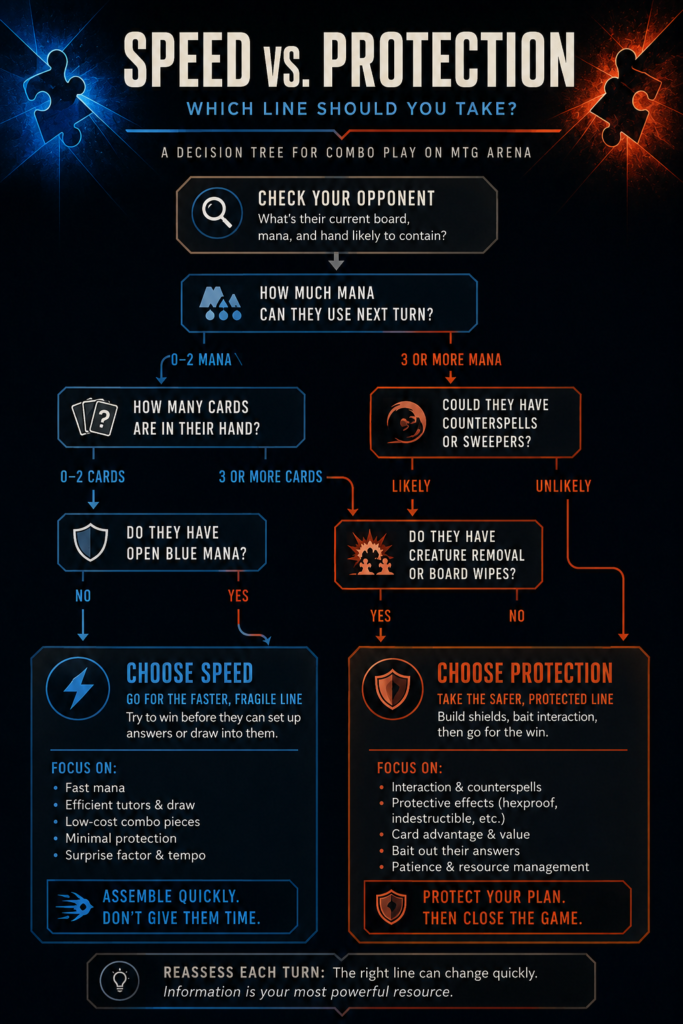
The right call depends almost entirely on what you’ve already learned about your opponent’s hand. If you’ve stripped their hand with discard or forced them to tap out for something else, the faster, riskier line is usually correct, because there’s genuinely nothing left for them to interact with. If they’re sitting on untapped mana and haven’t shown you a reason to think their hand is empty, waiting a turn to assemble a fully protected kill is often worth the extra risk of them drawing an answer in the meantime.
There’s no universal right answer here, which is exactly why this decision separates strong combo players from mediocre ones. It’s a read, not a formula.
Using Information to Your Advantage
Discard spells do double duty in combo decks that most players undervalue. Yes, they strip a card from your opponent’s hand. But they also tell you exactly what that hand contains, which is arguably the more valuable half of the effect.
Once you know precisely which interaction your opponent is holding, you can sculpt your entire turn around it. If they’ve got a single removal spell and nothing else, you can play around it by presenting a second, redundant threat. If they’ve got a counterspell, you can bait it with a lesser spell first and resolve your actual combo piece once their mana is committed elsewhere. This kind of surgical planning is only possible once you have real information, which is why even a modest discard spell often does more work in a combo deck than a much flashier card would.
Scry and “look at the top of your library” effects offer a smaller version of the same benefit. They won’t tell you what your opponent is holding, but they let you plan your own sequencing with more precision, which matters just as much when you’re trying to assemble a combo across multiple turns rather than in one big burst.
Playing Around Counterspells
Control and midrange decks on MTG Arena lean on countermagic to stop exactly the kind of turn a combo deck is trying to have, so learning to play around it is close to mandatory if you’re taking the archetype seriously.
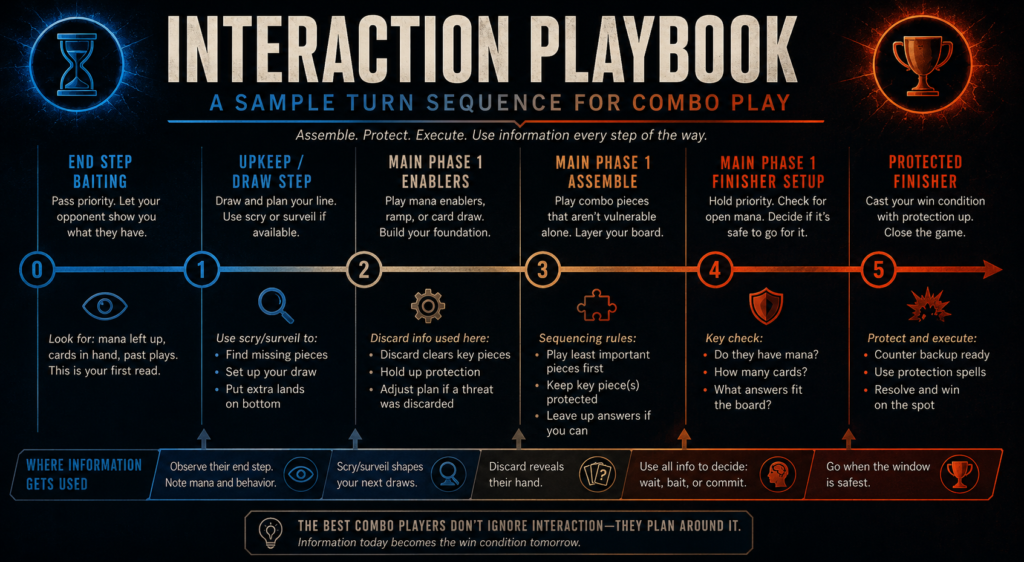
The classic approach is picking fights on your opponent’s end step. Casting instants during their end step forces them to either counter something relatively unimportant or let it resolve, and either way their mana is committed by the time your own turn starts. That leaves your actual combo piece, often a sorcery-speed spell, resolving into a much less protected board.
The other major approach is overloading their mana rather than their cards. If your threats and your own protective spells are individually cheaper than the counterspells guarding against them, holding several spells until you can present more threats in a single turn than your opponent can afford to counter is extremely effective. This works especially well on Arena’s faster Best-of-One ladder, where opponents often can’t afford to hold up mana for interaction every single turn without falling behind on their own plan.
Playing Around Removal
Removal-heavy decks pose a different problem, and it’s less about timing than about restraint. Many control and midrange lists rely on a single sweeper to reset the board, and overextending into that sweeper is one of the most common ways combo players lose games they were winning.
The fix is thinking carefully about which of your permanents are actually load-bearing for your combo and which are just along for the ride. Committing your entire hand to the board the moment you have a strong turn feels good, but it also hands your opponent maximum value from a single Wrath-style effect. Holding back a spare piece or two, even at the cost of looking less threatening for a turn, is often the difference between recovering from a sweeper and losing to it outright.
Prioritising threats and engines that are individually awkward to remove, or that generate value even when answered, also pressures your opponent into “bad trades.” That pressure buys space for your actual combo pieces to stay safely in hand until the turn you need them.
Sequencing Your Combo Turn
Even a perfectly built combo deck can lose to poor sequencing, and this is the skill most guides gloss over in favour of talking about card choices. The general rule is to resolve your lowest-risk, least important pieces first: mana acceleration, cheap permanents, and card draw. Save the piece your opponent is most likely to have an answer for until last.
This matters because it gives you information and options at every step. If your opponent counters or removes an early enabler, you’ve lost tempo but not your entire turn, and you can often still find another way to your combo later. If you’d led with your actual finisher instead and it got answered, you might not get another shot that game.
Strong combo players tend to spread the “setup” across several turns rather than trying to do everything at once. Mana rocks and card draw pieces come down early, so that by the time you’re ready to go for the actual kill, your turn is mostly a single spell converting all that groundwork into a win. That single-spell turn is much easier to protect than a turn where you’re casting five things in a row and hoping none of them get answered.
Building In Resilience
No combo deck should be entirely dependent on one specific line of play working exactly as planned every single game. The strongest lists bolt a genuine combo finish onto an otherwise functional shell, so that even when your key pieces get removed or discarded, you’re still playing a deck capable of winning through more conventional means.
Which protection to prioritise depends on what you expect to face most often. If you’re staring down a removal-heavy meta, hexproof or indestructible effects on your key pieces matter more than anything else. Against a counterspell-heavy field, proactive discard and information-gathering earn their slots instead. If you’re playing blue yourself, flexible countermagic to protect your own combo turn rounds out the plan nicely.
This is also where a lot of combo decks quietly become better midrange decks with an upside, which is exactly the point. You want to win with the combo when you can assemble it cleanly, and you want to still be in the game when you can’t.
Combo on Arena’s Formats
How aggressively you lean into speed versus resilience depends heavily on which format and mode you’re actually playing. On Historic and other faster Arena environments, especially in Best-of-One, the priority is usually racing your opponent’s early interaction with a streamlined, low-curve build and a fast, reliable win condition. You often won’t see a second game to adjust your approach, so consistency in game one matters more than a perfectly tuned sideboard plan.
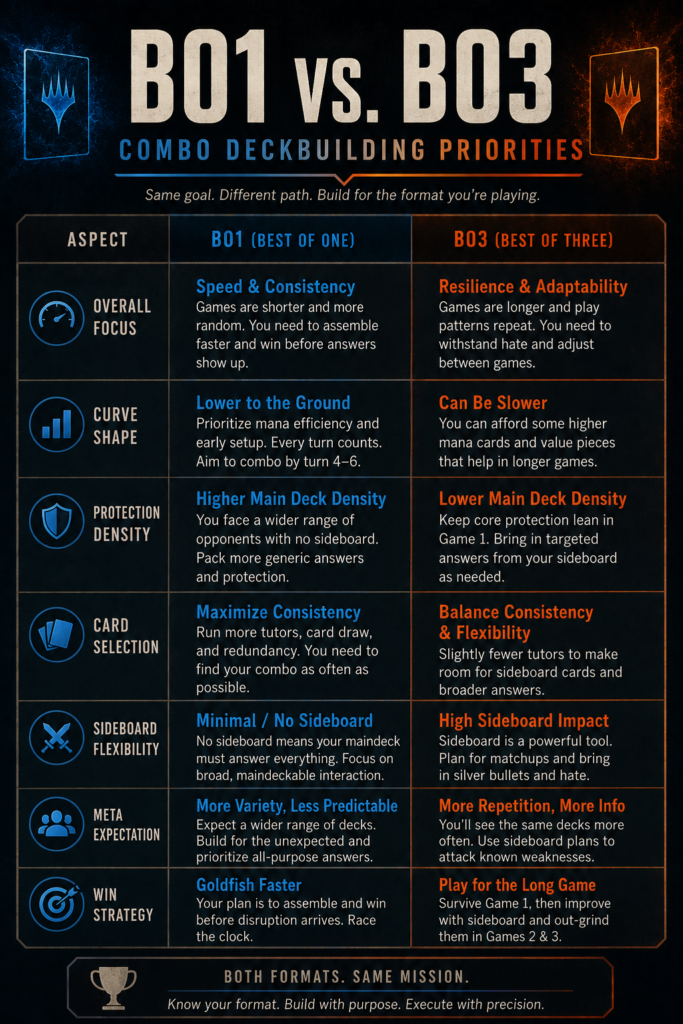
Longer matches, particularly Best-of-Three, reward the opposite instinct. Successful combo decks in that environment lean harder on card-advantage engines, tutors, and layered protection, because they need to grind through multiple pieces of interaction across a full match rather than getting through in one clean burst. If you’re upgrading a deck toward a combo shell, it’s worth deciding early which of these two environments you’re building for, since the correct card choices genuinely diverge.
Players coming from paper Magic sometimes underestimate how much Bo1 versus Bo3 changes combo deckbuilding specifically, more so than it changes most other archetypes. A combo list that’s excellent across a three-game match can feel clunky and overbuilt in the single-game ladder, and vice versa.
Putting It All Together
Combo on MTG Arena rewards a different kind of mastery than the other major archetypes. It’s less about reading the board and more about reading your opponent’s hand, their mana, and the shape of the turns still to come. Every decision, from which enabler to play first to whether you go off this turn or wait one more, comes back to the same underlying question: what does my opponent actually have, and how do I make sure it doesn’t matter?
Start with a genuine, nameable win condition rather than a vague sense of synergy. Build in real consistency tools so you can find that win condition reliably, not just occasionally. Layer in protection that matches what you expect to face, and practise the sequencing that keeps your most vulnerable pieces safe until the moment they actually need to come down.
Combo decks aren’t for every player, and that’s fine. But if the idea of out-thinking your opponent rather than simply out-resourcing them appeals to you, there’s no more satisfying archetype on the ladder once you’ve got the fundamentals down.
What’s the trickiest combo matchup you’ve faced on Arena, and how did you play around their interaction? Let us know in the comments below.
Continue Your Journey
If you’re building toward a combo shell yourself, testing your paper deck ideas on Arena first is a low-risk way to check your sequencing before committing wildcards. For a broader look at how disruption-heavy decks operate on the other side of this matchup, our guide to playing control on MTG Arena covers the exact toolkit you’ll be playing around. And if speed is more your priority than resilience, our breakdown of aggro strategy on Arena digs into the racing mindset that fast combo lists borrow from heavily.
Want more MTG Arena strategy breakdowns like this one delivered straight to your inbox? Subscribe below and never miss a format deep-dive.