
As an Amazon Associate I earn from qualifying purchases and sometimes recommend products from other sellers at no extra cost you. For more details see my disclosure policy and privacy policy.
Twelve investigators are staring back at you from the box, and your group is waiting for someone to pick before the Ancient One wakes up. Choose wrong here and your first game can turn into a slog of forgotten abilities and confused turns before anyone’s even had fun. Choose right, and the cosmic horror on the table stays exactly where it belongs: in the story, not in the rules confusion.
🔍 Why Your First Investigator Choice Matters More Than It Looks
If you’re still deciding whether to pick up a copy of Eldritch Horror for your group, know that the base box hands new owners twelve investigators right out of the gate, each with their own stats, starting gear, and a unique special ability. That variety is the game’s biggest selling point once you know it well, and its biggest trap on session one, because a handful of those investigators lean on system knowledge you simply don’t have yet.
The stats that matter most starting out are which of the five skills an investigator is strongest in, what gear and clues they begin with, and how forgiving their special ability is if you forget to use it. An investigator with a simple, always-on ability is far easier to pilot than one whose power depends on tracking a resource you haven’t learned to manage yet. For a first game, forgiving beats powerful every time.
🎯 The Beginner-Friendly Picks
The Professor is the safest first pick in the box. His ability lets him swap any die roll result to a 5 or 6 once per turn, which is powerful but requires zero setup and no extra bookkeeping. His stats lean toward Lore, so he’s naturally good at clues and research tasks, which happen to be the bulk of early-game actions anyway.

The Dilettante starts with a pile of money and average stats across the board, making her forgiving in a different way. New players tend to under-resource their investigators, and having extra starting funds to buy Assets at the outset softens that mistake without needing you to understand the economy first.
The Photographer carries strong Observation and a starting item that helps with Encounters, plus an ability that’s simple to remember: it triggers automatically rather than needing an active decision each turn. Passive abilities are ideal for a first game since you can’t forget to use something that just happens on its own.
The Salesman has flexible starting gear and a straightforward Influence-boosting ability that helps at the acquisition stage of the game, one of the trickier systems for brand-new players to grasp. Because his ability smooths over that exact friction point, he tends to make early games feel less punishing.
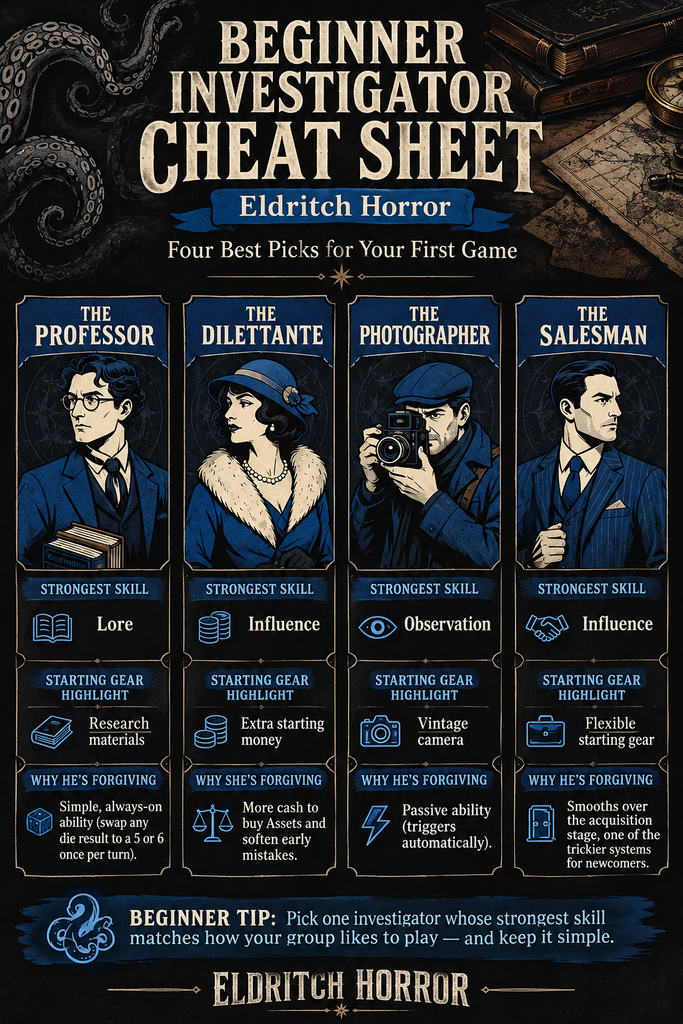
Between these four, aim for one whose strongest stat matches how your group likes to play. If your table wants to talk its way through Encounters, lean Photographer or Salesman. If you’d rather push through Research and clue-gathering, The Professor is hard to beat.
🚫 Investigators to Save for Later
A few investigators ask you to already understand systems a first-time table hasn’t touched yet. The Occultist relies heavily on Spell management, and spells introduce an entire extra rules subsystem (casting checks, backlash risk) that’s a lot to absorb in the same session you’re still learning the core Doom Track and Mythos flow.
The Archaeologist has an ability tied closely to Clue tokens and Expedition-style mechanics that reward players who already know where the game’s pressure points are. It’s not a bad investigator, but her strength only shows up once you understand which Mysteries are worth rushing, and that’s knowledge you build over a few plays, not on your first.
Investigators with weak starting positions, meaning low stats across the board or gear that doesn’t help with early Encounters, also tend to produce discouraging first games even when their late-game ceiling is fine. Save those for once your group already likes the game and wants a harder mode.
If you already read our Eldritch Horror rules guide, you’ll recognise these same Doom Track and Mythos deck concepts driving why simpler investigators feel so much smoother on a first playthrough.
👥 Investigator Choice and Player Count
Eldritch Horror plays best with three to five investigators active, and at lower player counts each person may end up controlling more than one. For a genuine first game, resist the urge to double up. One investigator per player, ideally drawn from the beginner-friendly list above, keeps the cognitive load manageable while everyone learns the turn structure together.
If you’re short on players and need extras in play, pair a beginner pick with a similarly forgiving second choice rather than mixing in an Occultist or Archaeologist as a “second investigator” for someone already juggling two characters. Two simple investigators are far easier to run than one simple and one complicated.
📦 Stick to the Core Box for Session One
Every beginner-friendly pick above comes in the base game, and that’s intentional. Expansion investigators frequently introduce their own bespoke subsystems (new resource types, unique board pieces, extra steps at specific game phases) precisely because expansions exist to deepen the game once you already know it.
Running an expansion investigator in a first game means teaching two things at once: the core rules and that investigator’s bolt-on mechanic. Even confident groups tend to have a smoother, less confusing first session by keeping the roster to core-box characters and saving expansion investigators for game two or three, once the Doom Track and Mythos deck flow feel automatic.
🧩 A Quick Note on Team Composition
If your whole table is new to Eldritch Horror, resist stacking your team entirely around one skill just because it seems efficient on paper. A team of four Lore-heavy investigators will breeze through Research but stall badly on Encounters that call for Influence or Observation instead.
A simple beginner spread looks like one investigator leaning Lore (The Professor), one leaning Influence or Will (The Salesman or Dilettante), and one leaning Observation (The Photographer). That spread covers most Encounter types without anyone needing to fully understand skill matching yet, since the game naturally hands you a mix of checks regardless of which Ancient One you’re facing.
Curious how this compares to the game’s Lovecraftian siblings? Our breakdown of Arkham Horror vs. Eldritch Horror vs. Mansions of Madness is a useful next read if you’re still deciding which cosmic horror game fits your group best, and once the Doom Track feels familiar, our Eldritch Horror strategy guide covers the deeper Mythos deck management that beginner investigators are specifically designed to shield you from early on.
🎲 The Short Version
Start with The Professor, The Dilettante, The Photographer, or The Salesman, since all four have forgiving, low-bookkeeping abilities that let you focus on learning the game instead of managing an extra subsystem. Save The Occultist and The Archaeologist, along with any expansion investigators, for once your group already has a session or two under its belt.
The good news is that a “bad” first pick in Eldritch Horror rarely ruins a session outright, since the game is cooperative and forgiving by design. But starting with an investigator whose ability just works, without asking you to remember anything extra, makes that crucial first game click a lot faster.