
As an Amazon Associate I earn from qualifying purchases and sometimes recommend products from other sellers at no extra cost you. For more details see my disclosure policy and privacy policy.
You have won a few games of Spirit Island on the base setting. The island is safe, the Dahan are happy, and the Invaders keep marching into the same predictable fate. So what now?
The answer is an Adversary. Each one rewrites how the Invaders behave, and the right pick at the right level turns a comfortable win into a proper fight. The wrong pick, on the other hand, can leave your group staring at a Blight-choked board by turn six.
This guide ranks the Adversaries in the order we would tackle them. It is written for players with at least three wins at base difficulty and no Adversary. If you are not there yet, start with our Spirit Island beginner’s guide and come back.
🧭 What an Adversary Actually Adds
Every Adversary brings three things. There is a base rule that changes how the Invaders operate, an escalation that kicks in during the game, and six levels that stack extra effects on top.
Levels are cumulative. Level 3 includes everything from Levels 1 and 2. That is why Level 1 of a brand new Adversary is often easier than a high level of one you already know.
The Adversary also decides which skills the game tests. One punishes slow opening turns. Another punishes sloppy Blight management. Matching the test to the skill you want to sharpen is the whole point of this ranking.
📊 How We Ranked Them
This is a play-order ranking, not an absolute difficulty chart. Difficulty depends on your Spirit, your board count, and the level you pick.
We have not quoted official difficulty numbers here. The rulebook and the community wiki are the places to check exact values and level effects before you set up. Treat the order below as a sensible path through the game, then adjust to your group.
Two things shift the order more than anything else. A Spirit with strong early defence makes the aggressive Adversaries gentler. A slow-starting Spirit makes every one of them sharper.
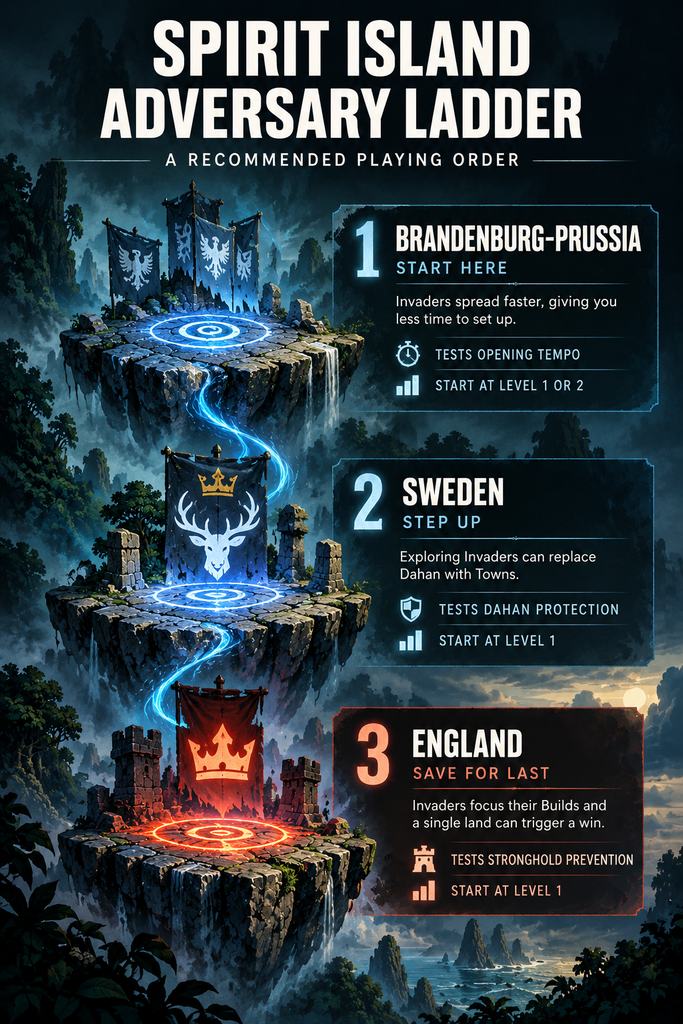
🥇 1. Brandenburg-Prussia: The Gentle Start
Brandenburg-Prussia is the rulebook’s own recommended first pick, and it earns it. It mostly changes setup and the speed of the Invader deck rather than the rules you play by.
Its escalation, Land Rush, adds a Town to a land without one on each board that already has a Town or City. The Invaders spread outward faster, but nothing about how Ravage or Build works has changed.
What it tests is tempo. You need to be killing and containing Invaders from the first turn rather than building up a slow engine and hoping.
Start at Level 1 or 2. Once those feel routine, push on through the middle levels before you consider switching.
🥈 2. Sweden: Pressure on the Dahan
Sweden is a clear step up in how the game feels. Its escalation, Swayed by the Invaders, swaps a Dahan for a Town when Invaders explore into a land where they match or outnumber the Dahan.
That makes Dahan-heavy defence less reliable. You can no longer assume your Dahan will hold a land just because they are standing in it.
Its upper levels also lean on Blight and extra Towns spreading from Ravaged lands. What it tests is how well you protect your defensive lines and how quickly you deal with a land before it tips over.
If you are a team that leans on Dahan to do the dirty work, Sweden will show you how much. Try Level 1 after you have cleared a couple of Brandenburg-Prussia levels.
🥉 3. England: The Hardest of the Base Three
England is the one to save for last. Its escalation, Building Boom, makes the Invaders Build in the land with the most Towns and Cities on each board.
It also adds a second loss condition. If seven or more Towns and Cities ever stand in a single land, the Invaders win outright. A runaway city becomes a real clock rather than a nuisance.
What it tests is pre-emptive thinking. You have to stop a stronghold from forming before it is too big to remove, and that rewards a team that plans two turns ahead.
England is a good Adversary to pair with a Spirit that has reliable ranged damage. It is a rough match for one that needs several turns to set up.
🌍 The Expansion Adversaries
None of the following are required. The base game gives you plenty of runway, and you should only reach for these when the base three feel tame.
Each is tied to a specific expansion or promo, so check your shelf before you plan around one:
- France (Plantation Colony) comes with Branch and Claw. It escalates in ways that punish players who leave coastal lands alone.
- The Habsburg Monarchy (Livestock Colony) and the Tsardom of Russia both come with Jagged Earth. Habsburg makes Blight management harder, while Russia spreads Invaders quickly and rewards strong coastal control.
- The Kingdom of Scotland is a promo Adversary, built around ports and trade. Its escalation adds Towns to the least developed lands, which makes it unusual to defend against.
- The Habsburg Mining Expedition is a newer Adversary in the Nature Incarnate expansion. It is built around a mining mechanic that keeps Ravaging in Mining lands.
As a rough guide, try France or Russia after you have worked through Sweden. Save the Habsburg options and Scotland for when you want something different rather than strictly harder.
🪜 How to Climb Without Hitting a Wall
The most common mistake is jumping straight to a high level of a hard Adversary. Increase one thing at a time.
Here is a progression that works for most groups:
- Win at base difficulty a few times with different Spirits.
- Take Brandenburg-Prussia up through its early levels.
- Move to Sweden at Level 1 or 2.
- Revisit Brandenburg-Prussia at a higher level to see how far you have come.
- Try England at Level 1, and only then think about the expansion Adversaries.
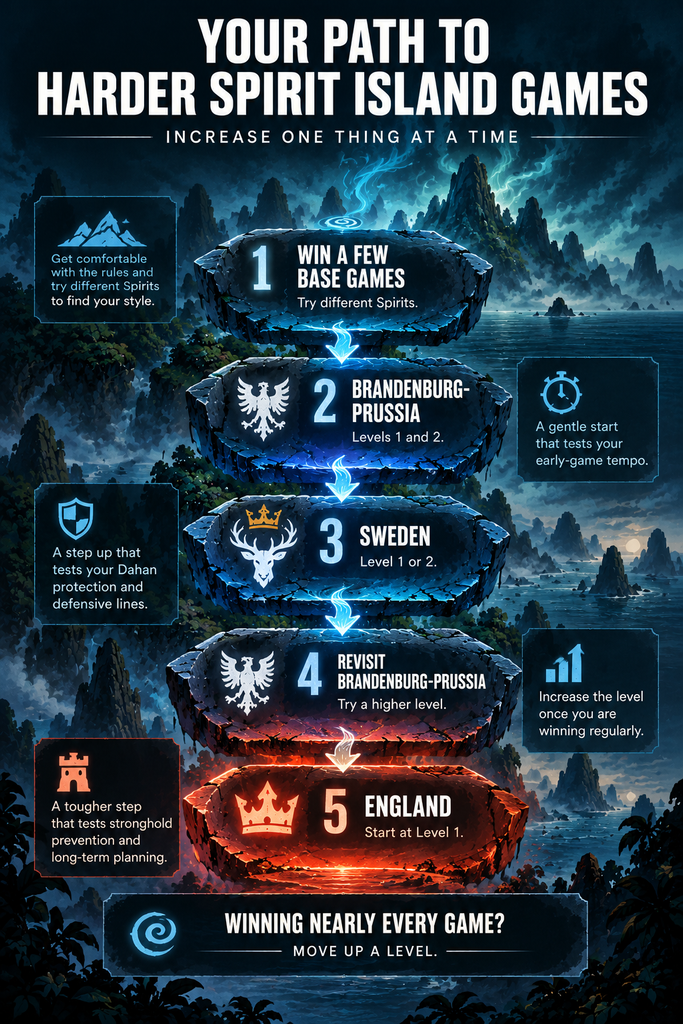
A sensible target is to win roughly half your games at a given level. If you are winning almost every time, move up. If you are losing nearly every time, step down and review how you are using your Fast and Slow powers.
When a level stalls you, switching Adversaries at a low level is often a better test than grinding the same one. A fresh rule set shows you gaps a familiar one hides. Our Spirit Island strategy guide covers the team habits that help here.
🔁 When to Switch Instead of Climbing
Climbing a single Adversary teaches you its quirks, but it can also make you narrow. If you have beaten Brandenburg-Prussia at its higher levels, you are better at beating Brandenburg-Prussia. That is not always the same as being better at Spirit Island.
Switching to Sweden at a low level is a cleaner test. It asks different questions, and your weak spots show up quickly.
A good habit is to keep a short note after each game: which Spirit you played, which Adversary and level, and what finally went wrong. After a few games the pattern is usually obvious.
🛠️ Habits That Make Higher Levels Survivable
Adversaries do not just add difficulty. They expose habits. These are the ones that tend to surface first.
Reading the Invader deck matters far more once an Adversary is in play. Count which lands are about to Build and Ravage, and decide who covers each one before powers are chosen. A group that drifts through the Spirit phase will lose to the Invader phase.
Fear is the second lever. Higher levels often change how many Fear cards you face or how fast the Invaders grow. Generating Fear steadily keeps the terror levels moving, which eases the pressure on your Blight track.
Finally, agree on what you are willing to lose. Sometimes the right call is to let one land go so that two others stay safe. That kind of trade is much easier to make when the team has talked it through before the board is on fire.
Also remember that you can dial the challenge down in small steps. Dropping a level for a casual night does not mean you have failed. It means you have picked a difficulty that fits the group in front of you.
🤝 Your Spirit Changes the Ranking
No ranking survives contact with a different Spirit. A Spirit that kills Invaders early is far more comfortable against Brandenburg-Prussia and England than one that needs time to grow.
Here are a few pairings to think about:
- Dahan-reliant play and Sweden is a tough pairing, since Sweden swaps Dahan for Towns.
- A Spirit with strong early Blight control handles England’s aggressive building better than a slow engine does.
- A slow-growth Spirit against a fast-spreading Adversary asks a lot of the other players at the table.
Treat these as starting points rather than rules. Your own board count and group experience matter more.
If your team is still working out who does what, our guides on cooperative strategy and role assignment and the alpha player problem are worth a look before you raise the difficulty. Higher levels punish a table where one person is making every decision.
📋 Quick Reference Table
| Adversary | Expansion needed | What it tests | Suggested starting level |
|---|---|---|---|
| Brandenburg-Prussia | Base game | Opening tempo | Level 1 or 2 |
| Sweden | Base game | Protecting Dahan and Blight control | Level 1 |
| England | Base game | Stopping a stronghold forming | Level 1 |
| France (Plantation Colony) | Branch and Claw | Coastal control | Level 1 |
| Habsburg Monarchy (Livestock Colony) | Jagged Earth | Blight management | Level 1 |
| Russia | Jagged Earth | Coastal control and speed | Level 1 |
| Scotland | Promo | Dealing with unusual spread | Level 1 |
| Habsburg Mining Expedition | Nature Incarnate | Cutting off Mining lands | Level 1 |
🎯 Pick One and Start
If you only take one thing from this, make it this: start with Brandenburg-Prussia, win a few times, then move to Sweden. England is the exam at the end of the base game.
Do not feel pressured to buy anything to keep progressing. The three Adversaries in the base box will keep a group busy for a long time. If you do not own the game yet, you can pick up a copy of Spirit Island and have everything above in the box.
For a wider look at how it stacks up against other co-ops, see our Pandemic vs Spirit Island vs Gloomhaven comparison or our list of cooperative games by difficulty level.
Which Adversary has beaten you the hardest? Let us know in the comments below!