
As an Amazon Associate I earn from qualifying purchases and sometimes recommend products from other sellers at no extra cost you. For more details see my disclosure policy and privacy policy.
You have the box open, the island map is sitting on the table, and eight very different spirits are staring back at you from their panels. Pick well and you will spend the evening feeling clever. Pick badly and you will spend it squinting at an innate power, wondering why nothing is dying.
Spirit Island is unusual among co-ops because your spirit is not a flavour choice. It is the entire way you interact with the game, and your first impression of the whole thing rides on that one decision. This guide is built to help you make it quickly and with confidence.
🧭 Why Your First Spirit Matters So Much
In most co-ops, characters share a toolbox and differ at the edges. In Spirit Island, two spirits can feel like different games. One plays a steady grind of direct damage, while another spends its first turns doing little but spreading presence and hoping the board stays calm.
That is why the pick matters more here than in most games of its kind. If you land on a spirit that matches how you like to think, the game clicks within a turn or two. If you land on a spirit that fights you, it is easy to blame the game rather than the spirit.
There is a second reason. The first few games are where you build your sense of what a “good turn” looks like. A spirit with clear, readable cause and effect teaches that quickly.
If you are still deciding whether this is even the right co-op for your group, our Pandemic vs. Spirit Island vs. Gloomhaven co-op comparison will help.
Still need a copy? The [AFFILIATE LINK NEEDED: Spirit Island base game] is all you need, because you do not need any expansion for a great first game.
🔍 What “Complexity” Really Means on a Spirit Panel
Every spirit carries a complexity label, and it is worth knowing what sits behind it. The label is shorthand for how many things you have to juggle at once, not for how strong the spirit is.
In practice, three things drive it.
- Energy. Some spirits have a comfortable flow of energy and can play most of their hand. Others are starved early and have to pick one good card instead of three.
- Innate powers. These are the spirit’s signature abilities, and they trigger only when you have gathered the right mix of elements. A friendly innate power rewards the cards you were going to play anyway. A fussy one demands that you plan your whole hand around it.
- Growth and presence. Growth choices are the decisions that grow your spirit each turn. The more unusual the spirit’s presence tracks and special rules, the more you have to hold in your head.
A low complexity spirit keeps those three things simple and readable. That does not make it weak. It makes it easier to learn from, which is what you want in game one.
One honest caveat. Complexity labels are printed on the spirit panels and listed on the community wiki, but different sources occasionally disagree, and some older guides have rated a spirit more kindly than the panel does. Check the label on the panel in your own box before you commit.
✅ The First-Game Shortlist
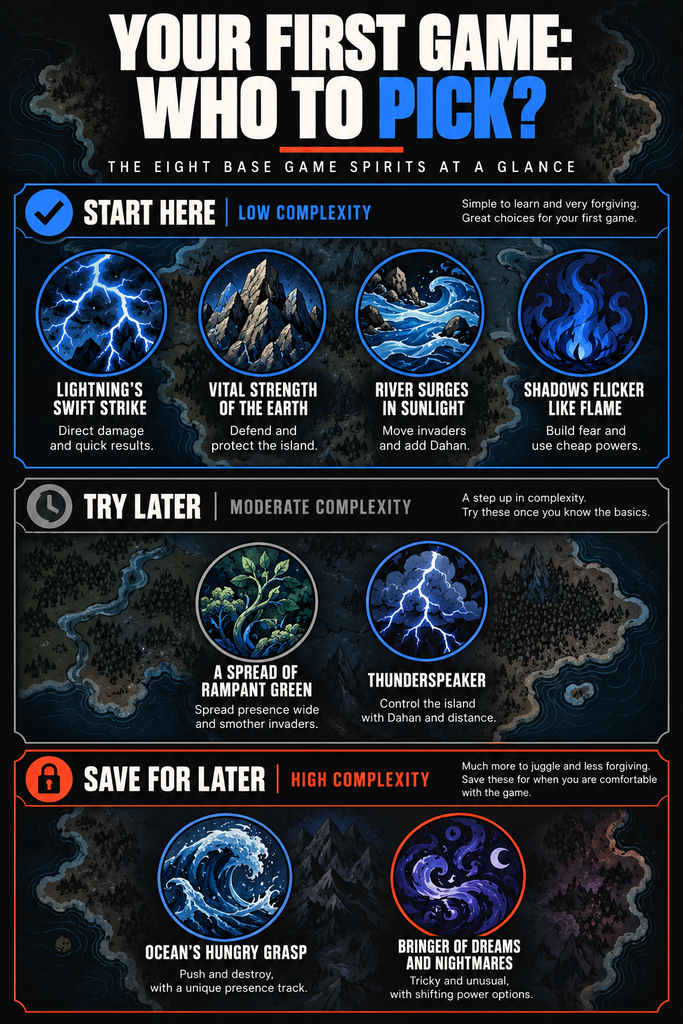
The base game includes eight spirits. Four of them are listed at low complexity, and those are your safest bets. Here is what each one feels like and where beginners tend to trip.
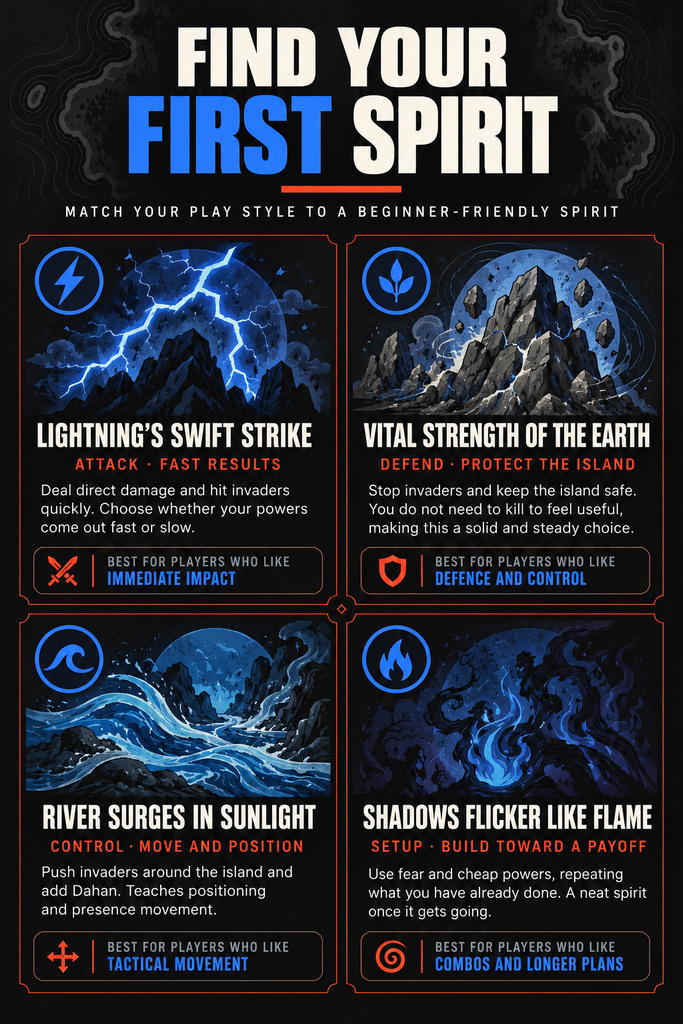
Lightning’s Swift Strike
This is the spirit most guides point a first-timer toward, and for good reason. It deals direct damage, it can choose whether its powers come out fast or slow, and its cheap cards make its innate power easy to trigger.
What it plays like: You hit things, then you hit them again. The satisfaction is immediate.
Learning trap: Energy runs short, so it is tempting to buy a card you cannot really afford to follow up on. Think about next turn’s energy before you spend this turn’s.
Vital Strength of the Earth
Defensive and sturdy, this spirit exists to stop the island from sliding into blight. It does not need to kill invaders to feel useful, which suits anyone who would rather protect than punish.
What it plays like: A fortress. Your teammates, or your own later turns, handle most of the offence while you hold the line.
Learning trap: Defence alone does not win. You still need fear to end the game, so do not let the island stay quiet for too long without a plan for how it ends.
River Surges in Sunlight
River shoves invaders around the board and can add Dahan to the island. It teaches positioning and presence movement better than most spirits.
What it plays like: Geography. You are thinking about where things stand, not just what they are.
Learning trap: It is energy-hungry early and can feel like it is not doing enough. Be patient with the first couple of rounds.
Shadows Flicker Like Flame
This one leans on fear and cheap powers, and it likes to repeat what it has already done. It is a neat spirit once it gets going.
What it plays like: Quick, cheap plays that add up. You are always weighing how many powers you can afford this turn.
Learning trap: It wants card draw to feel strong, and it competes with itself for energy and plays. It is a good second pick, but a little less forgiving than Lightning on turn one.
One step up: A Spread of Rampant Green
Rampant Green is listed at moderate complexity, so it is not the safest first pick. It is still a gentle step up for players who already know they enjoy spreading out.
It spreads presence wide, then smothers invaders with defence and plant tokens. It starts slowly, and it struggles if the board spirals out of control before it has spread. Some players find it one of the easiest spirits to win with once the pattern clicks, so treat it as your second or third game rather than your first.
🎯 Pick by Play Style
If the shortlist feels like a lot, start from what you enjoy doing and work backwards.
- You like attacking: Lightning’s Swift Strike. Direct damage and quick results.
- You like defending: Vital Strength of the Earth. Guard the island and keep blight from spreading.
- You like setting things up: Shadows Flicker Like Flame. Cheap plays, repeated powers, building toward a payoff.
- You like moving pieces around: River Surges in Sunlight. Positioning is the whole game.
Not sure which one is you? Choose Lightning. Nobody has ever regretted a game that started with something satisfying going bang.
It is the spirit that most often gives new players the “oh, I get it” moment.
👥 Pick by Player Count
The base game plays one to four players, and the right pick shifts a little with the table.
Solo or two players
Go with Lightning’s Swift Strike. It is forgiving, and it does not depend on a teammate to unlock its strengths.
If you have two players and both want a quiet start, pair Lightning with Vital Strength of the Earth. One of you handles damage while the other keeps blight in check. Once you are comfortable, our Spirit Island strategy guide covers how to work as a team.
Three players
Take any three of the four low complexity spirits. You will have a mix of attack, defence and positioning without anyone fighting an unfamiliar engine.
Four players
Here you can all take a low complexity spirit, one each. It is a tidy way to learn, because every person gets a clear, readable role.
One tip for bigger tables. A confident player can drift into telling everyone else what to do, which spoils the game for newer spirits. Our piece on the alpha player problem in cooperative games is worth a read before you sit down.
A quick sanity check before you commit. A good first spirit gives you a clear answer to “what do I do this turn?” within about a minute of reading the panel.
If you are still unsure after reading it twice, that is useful information. Put that spirit back in the box for another day and try the next one on the list. There is no prize for starting with the cleverest option, and nobody at the table is keeping score on your first pick.
🚫 Which Spirits to Save for Later
Some spirits are brilliant and are simply not first-game spirits. The community lists these at higher complexity, and the reasons are specific.
- Thunderspeaker. It is listed at moderate complexity, and many players find its mechanics counterintuitive. It moves and uses Dahan like pieces and leans on slow powers early, which is a lot to take in at once.
- Ocean’s Hungry Grasp. Listed as high complexity. It only works in ocean and coastal lands and builds energy from drowning invaders, which is a hard economy to learn blind.
- Bringer of Dreams and Nightmares. Listed as high complexity. It deals no damage at all, so a new player can spend the opening feeling like they are not contributing.
If any guide tells you Thunderspeaker is a low complexity pick, treat that with caution and check the panel in your box. It is the spirit most often placed in the wrong bracket.
All three become rewarding once you know the game. Save them for game three or four.
📦 Do Not Start With Expansion Spirits
You may see expansion spirits recommended online, and some are lovely. They are still the wrong place to start.
Expansion spirits tend to assume you already understand how the base spirits work, and some push the system in unusual directions. The base box has eight spirits, four of them gentle. That is more than enough variety for your first dozen games.
If you want something lighter still, there is also Horizons of Spirit Island, a 2022 spin-off with fewer and simpler pieces and spirits designed to be easier for new players. It is optional, and it is not a substitute for the main game.
🧪 A Quick Way to Try Before You Commit
If you cannot decide, try a practice turn with two spirits before the real game. Read the panel aloud, set up your first growth choice, and play one pretend turn.
The spirit that makes you want to do another turn is usually the one to pick. Even ten minutes spent this way beats discovering halfway through the game that you dislike your own panel.
If you play on a screen, the digital version offers a free-to-learn tutorial that uses four spirits, which is a handy way to feel out a few of them.
Another habit that helps is matching the challenge to your experience. For more on that, see our best cooperative games by difficulty level. An early win is worth more than an early challenge.
🏁 Your First Spirit, Decided
Here is the short version. If you are unsure, play Lightning’s Swift Strike. If you want a defensive game, play Vital Strength of the Earth.
Keep Thunderspeaker, Ocean’s Hungry Grasp and Bringer of Dreams and Nightmares on the shelf until you have a few games behind you. Then, once you are comfortable, our guide to cooperative communication and role assignment is the natural next step.
Pick one, set up the island, and enjoy the first turn. That is where the game starts to make sense.