
As an Amazon Associate I earn from qualifying purchases and sometimes recommend products from other sellers at no extra cost you. For more details see my disclosure policy and privacy policy.
You have terraformed Mars a dozen times, your group knows the base game cold, and now someone has said the dangerous words: “Should we get an expansion?” Open any shop page and you are faced with a wall of boxes, each promising a bigger, better Mars. The truth is that every Terraforming Mars expansion changes the game in a different way, and the wrong first purchase can leave your table with a game that runs too long or leans too heavy.
This guide gives each main expansion the same treatment: what it adds, how it changes play, and who it suits. At the end you will find a buying order for different kinds of group, plus a look at which expansions stack well together. No full rules lessons here, just enough to help you pick.
🚀 The Expansions at a Glance
Before the detail, here is the quick version. Each expansion pulls the game in a different direction, so think about what you want more of rather than which box is “best”.
- Hellas & Elysium: two new maps with their own milestones and awards. More variety, almost no extra complexity.
- Venus Next: a whole new terraforming parameter and a new set of cards. More depth, and longer games.
- Prelude: a short setup phase that kick-starts everyone’s engine. Faster games.
- Prelude 2: more Prelude cards, corporations and project cards, with ties to the other expansions.
- Colonies: colony tiles and trade fleets in the outer solar system. More interaction.
- Turmoil: political parties, delegates and global events. The heaviest add-on of the lot.
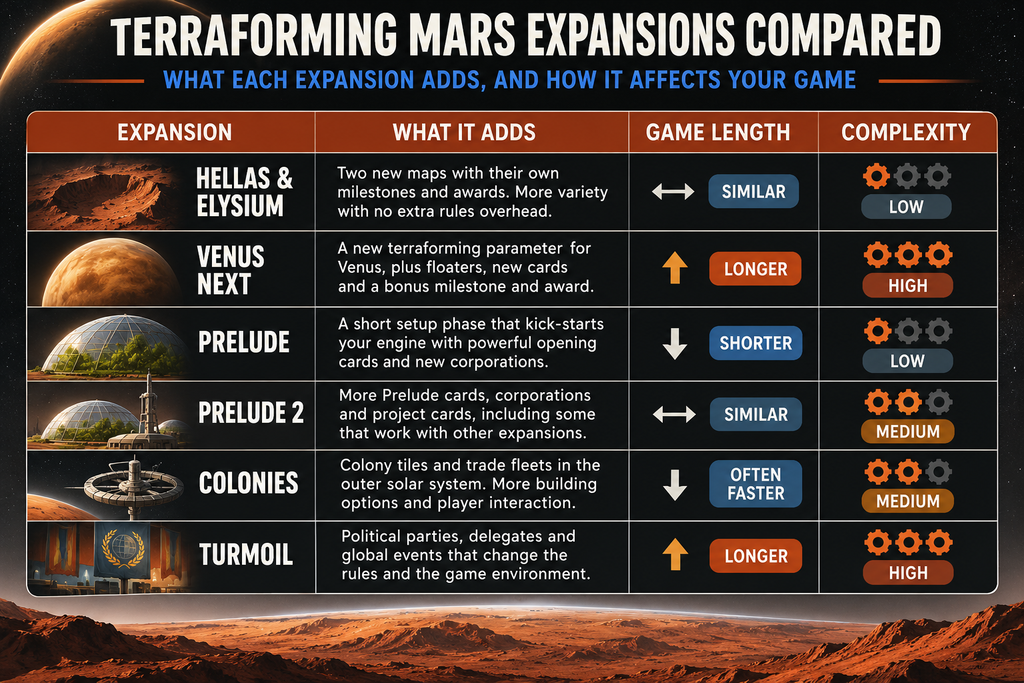
The expansions are modular, so you can mix any combination at the table. That freedom is a big part of the appeal, and we will come back to it in the combining section.

🗺️ Hellas & Elysium: New Maps and the Cheap First Buy
Hellas & Elysium is the simplest expansion in the line-up, and that is exactly its charm. It gives you two new boards to play on, along with a fresh set of milestones and awards for each.
Hellas centres on the south pole, with a large crater you can fill with water and different bonus placements around the map. Elysium shifts the action with ocean spots in the north, Olympus Mons and mineral-rich ground in the south. Neither map changes how a turn works, so nobody needs to relearn anything.
What you gain is variety. The base board starts to feel familiar after enough plays, and a new map shakes up where you want to place cities and greenery. Different milestones and awards also push you towards different strategies from the opening generation.
Who it suits: any group that loves the base game but wants it to feel fresh. It is also the lowest-risk purchase here, because it adds no new rules to teach. If you want a gentle first step, this is the one.
If you are choosing a corporation on a new map, our Terraforming Mars strategy guide covers the early-game thinking that carries across every board.
☁️ Venus Next: A Fifth Parameter and a Longer Game
Venus Next is where the game starts to grow. It adds a new terraforming parameter for Venus alongside oxygen, temperature and oceans, plus a Venus tag, a new floater resource, and a set of new project cards and corporations. It also brings its own milestone and award.
Floaters are the hook. Many Venus cards store floaters and spend them on actions or points, which gives you a new type of engine to build in the clouds above the planet. Venus cards tend to reward commitment, so you will usually either dive into Venus properly or leave it alone.
The expansion also changes how the end of the game works. The World Government funds terraforming on Venus too, which gives the game a nudge towards finishing. Even so, Venus Next generally makes games longer, partly because there is a whole extra track to fill and a bigger deck to draw from.
Who it suits: groups who enjoy engine building and do not mind an extra hour at the table. If your games already run long, think twice. If you want more strategic texture, this is a strong pick.
⚡ Prelude and Prelude 2: Faster Starts, Shorter Games
Prelude is the expansion most groups add once and never take out again. Each player is dealt four Prelude cards, keeps two, and plays them before the first generation. The opening turns give you a boost, which means your engine gets going much faster.
The result is a shorter game with a quicker start and fewer slow early generations. It also makes your first decisions matter more, because the Preludes you keep shape your whole plan. New players can find that choice a bit heavy, so it works best once people know the base game.
Prelude also comes with new corporations, and these are the ones most players meet first. If you want to know which Prelude corporations are worth picking, we have already done the ranking in our Terraforming Mars corporation tier list.
What Prelude 2 Adds
Prelude 2 needs both the base game and Prelude to play. It adds five more corporations, 25 Prelude cards and 24 project cards. Some of the Preludes now have ongoing effects and actions, which is a change from the one-shot cards in the first box.
It also includes cards that reference Venus Next, Colonies and Turmoil. Four of the corporations and 13 of the Prelude cards work without those other expansions, so you do not need to own everything to use it.
Who they suit: Prelude suits anyone who wants faster games, and it is a very common first expansion. Prelude 2 is for groups who already love Prelude and want more variety in their starts.
🛰️ Colonies: Trade Fleets and Outer-Solar-System Interaction
Colonies sends you out beyond Mars. The expansion adds colony tiles for moons and planetoids, and trade fleets that visit them. You can build a colony on a tile, and you can also send a trade fleet to collect a bonus.
The clever part is that colonies create a light form of interaction without any attacking. When you build on a colony, other players who trade with it can benefit you as well. Each colony tile has its own flavour, so which ones are in play changes the feel of a game.
Colonies feeds the engine-building side of the game, since the rewards are resources you already use. It also gives you a use for spare energy, which is a small but nice quality-of-life boost. The game tends to move faster too, as more resources flow into your tableau.
At different player counts, the expansion supports one to five players. With more people at the table, more trade fleets are circling the same colonies, so the interaction tends to feel richer. With fewer players it plays more like a pleasant solo optimisation puzzle. Setup is scaled to the player count, so check the rulebook before your first game.
Who it suits: groups who want more interaction without direct take-that, and anyone who finds the base game a little solitary.
🏛️ Turmoil: Politics, Delegates and Global Events
Turmoil is the heaviest of the main expansions, and the box is labelled for experienced players. It adds a Martian government with six political parties. Players place delegates in these parties to push the political balance in their favour.
The party with the most delegates becomes dominant and rules the next generation. A ruling party brings a one-time bonus and an ongoing policy, and its leader becomes Chairman, who gains terraform rating. Global events also loom on the horizon, shown several generations in advance, so you can plan for what is coming.
Influence is the glue. You earn it from political roles, and it lets you soften or sharpen the effect of the current global event. Every player also loses a point of terraform rating each generation, which adds a gentle pressure to keep moving.
Turmoil asks more of everyone at the table. There is a lot of extra bookkeeping, and the games run longer. Some players find the political layer rewarding, while others find it adds paperwork without enough payoff.
Who it suits: experienced groups who enjoy planning ahead and playing the table as much as the board. If your group likes interaction and does not mind a long evening, Turmoil is a strong choice. If you want a quick game, leave it in the box.
🧩 Combining Expansions: What Stacks Well
Since the expansions are modular, the real question is how they feel together. Here is how the main pairings tend to play out.
- Prelude plus Colonies: a fast, interactive game. Prelude gets everyone going, and Colonies gives those engines something to trade with.
- Prelude plus Hellas & Elysium: the gentlest combination. A quick game on a new map with no real rules overhead.
- Venus Next plus Prelude: Prelude speeds up the start, which helps offset the extra length that Venus adds. It is a popular pairing for that reason.
- Turmoil plus almost anything: it stacks happily, but it adds both length and complexity, so be honest about your group’s patience.
As a rule of thumb, Venus Next and Turmoil lengthen games, while Prelude shortens them. One group of reviewers reports that playing with all the official expansions can push a two-player game to four or five hours. Many tables solve this by adding only the ones they enjoy and dropping the rest.
Complexity stacks in a similar way. Hellas & Elysium and Prelude add very little to teach, Colonies adds a modest amount, and Venus Next and Turmoil ask the most of newer players. A sensible approach is to add one new layer at a time, so you can tell which box is changing your evenings.
It also helps to agree a plan before the cards come out. Decide which expansions are in play, remind everyone of the new rules, and keep the rulebooks nearby. That ten minutes of setup saves a lot of arguing mid-game, especially with a table of players who are new to Turmoil.
If you are building a collection over time, the Terraforming Mars Big Box is worth a mention as a storage product. It is not a game expansion. It holds the base game and expansions, and adds 3D tiles, card dividers and trays, so it is good value if you already own several boxes and want everything tidy.
A Quick Note on Ares Expedition
Ares Expedition is a separate card-driven game set in the same universe, not an expansion, so it is outside this guide.
More Boards Are Available
The line-up has grown beyond the boxes above. Extra double-sided map boards such as Amazonis & Vastitas and Utopia & Cimmeria are available for groups who want yet another planet surface. They suit players who already own Hellas & Elysium and want even more map variety.
🛒 Which Expansion Should You Buy First?
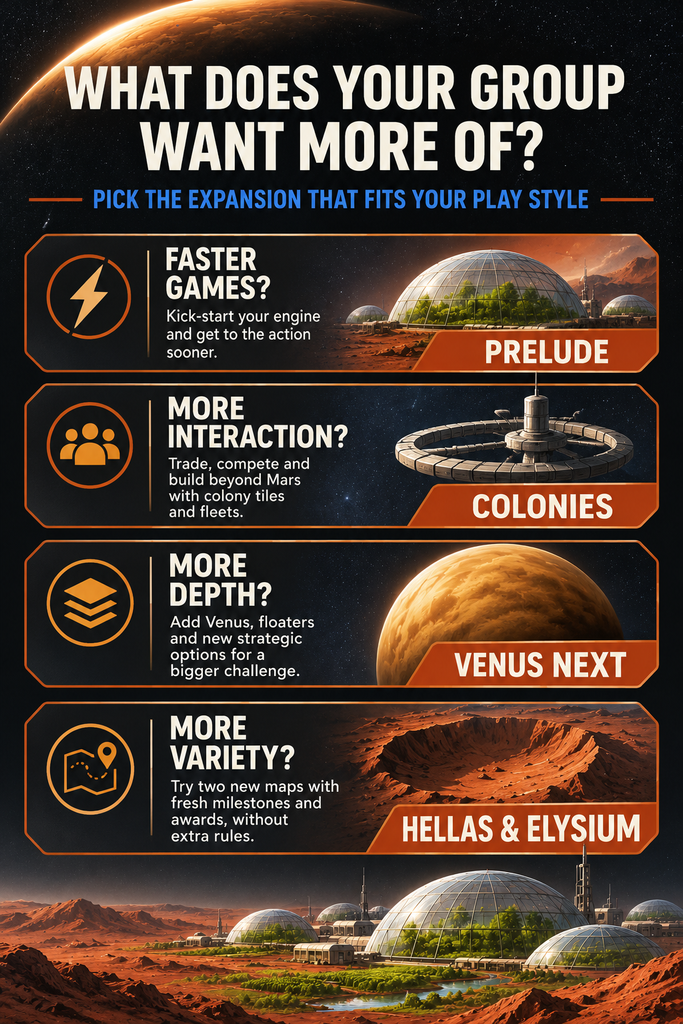
Here is the buying order for four common types of group. Pick the one that sounds most like your table.
For Faster Games
Start with Prelude. It trims the slow opening and gets everyone building straight away. Add Hellas & Elysium next if you want a new map, and leave Venus Next and Turmoil for later, since both stretch the clock.
For More Interaction
Start with Colonies. Trading with colonies gives you something to watch your opponents do, without anything nasty. If your group wants even more player-to-player play, Turmoil is the next step, but only once everyone is comfortable.
For More Depth
Start with Venus Next. It adds a whole new engine to build and a new track to race for. Follow it with Prelude to keep the game length in check, then consider Turmoil if your group still wants more.
For More Variety
Start with Hellas & Elysium. It is the simplest way to change the feel of the game, and it asks nothing extra of your players. After that, Prelude 2 and the extra map boards keep things feeling new.
🎲 Final Thoughts: Choose the Change You Want
There is no single best Terraforming Mars expansion, only the one that fits your group. Prelude shortens things, Hellas & Elysium refreshes things, Colonies adds interaction, Venus Next adds depth and Turmoil adds politics. Pick the direction you want, buy that box first, and build from there.
If you enjoy this style of upgrade-and-expand thinking, you might also like our other expansion guides, including Spirit Island, Wingspan and Eldritch Horror. Happy terraforming.
🧭 Continue Your Journey
- Terraforming Mars Strategy Guide: Corporation Selection and Early Game Mastery
- Terraforming Mars Corporation Tier List: Best Picks for Every Strategy
- Engine Building Board Games: The Complete Strategy Guide for Every Player
- Gaia Project vs Terra Mystica: Which Space Strategy Game Wins?
- Best Gateway Strategy Games: 10 Perfect First Complex Games
- The Ultimate Guide to Gloomhaven Expansions
- The Ultimate Guide to Catan Expansions