
As an Amazon Associate I earn from qualifying purchases and sometimes recommend products from other sellers at no extra cost you. For more details see my disclosure policy and privacy policy.
There’s a particular kind of frustration that solo gamers know well. You carve out a rare free evening, sit down at the table with a clear head and a cup of tea — and then spend the next twenty minutes hunting for the Automa deck, rebuilding the token supply, and trying to remember which bag has the invader cards. By the time the game is actually ready, the mood is already half gone.
Setup friction is one of the most underrated barriers in solo gaming. It’s not a motivation problem. It’s a storage problem. And if you treat it as a storage problem, it’s entirely solvable.
This guide covers everything from shelving strategy to inside-the-box organization, with a particular focus on the kinds of titles that solo players return to repeatedly — engine builders with Automa opponents, campaign games with persistent state, and quick-hit fillers that should be on the table in under three minutes.
The Solo-First Storage Mindset
The biggest mistake in board game storage is applying the same logic to solo play as you would to multiplayer. A shared shelf for game night can afford to look pretty. A solo workbench needs to be optimized for a single person, alone, potentially at 10pm on a Tuesday, who wants zero friction between opening the box and taking their first turn.
That means asking different questions when you organize. Not “does this look good?” but “can I pull this game and have it ready without touching anything else?” Not “are the expansions stored together?” but “are my solo-relevant expansion components immediately accessible without unpacking content I don’t need?”
The distinction matters most for titles you play repeatedly. Wingspan with the Automa, Spirit Island with a specific adversary, or Gloomhaven with a solo character campaign — these are games where setup and teardown happen over and over. The cumulative time cost of poor organization is enormous.
The Collector's Shelf vs. the Solo Workbench
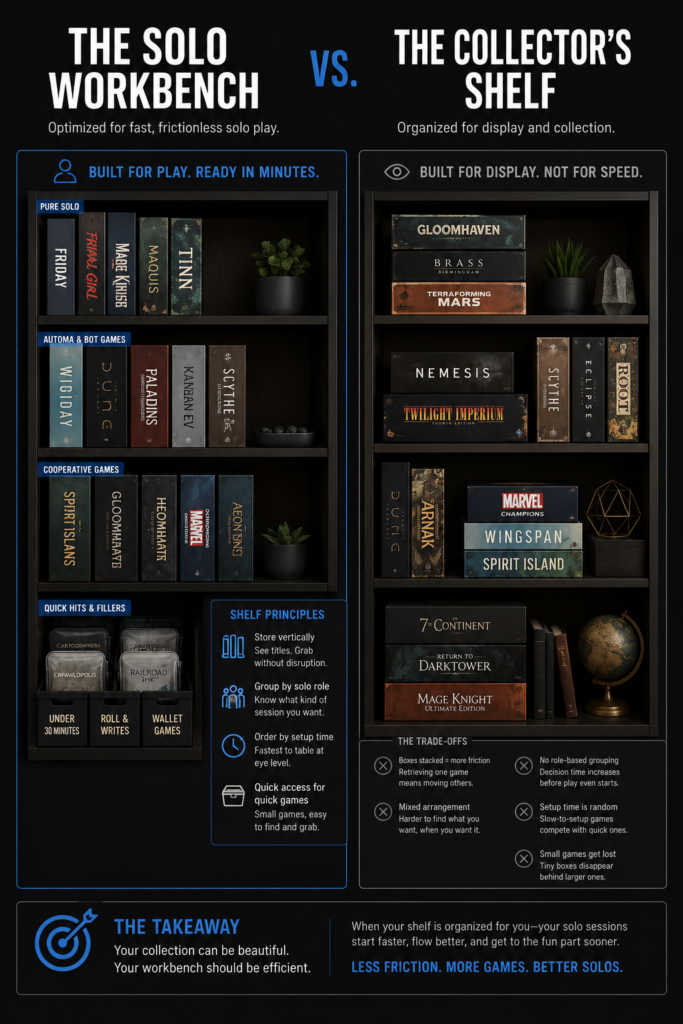
It's useful to think of your collection in two zones. The collector's shelf is where games live when you want to appreciate them, show them to guests, or track what you own. The solo workbench — whether that's a literal dedicated table or just the section of shelving you reach for regularly — is optimized purely for play speed.
These zones don't have to be physically separate, but the thinking should be. When you organize a game for the workbench, the question is: "What does a solo session of this game actually require, and how do I get all of it into one hand movement?"
Shelving Strategy: Organizing for Grab-and-Play
How you arrange games on shelves has a direct effect on what you actually play. Studies of decision fatigue aside, there's simple physics at work: if a game is buried behind other boxes, requires two hands to extract, or needs the box next to it shuffled out of the way, you're adding friction to the decision to play it.
Store Vertically, Not in Stacks
Vertical storage is the single most practical upgrade for a solo-heavy collection. When boxes stand upright on a shelf — spines out, like books — you can read the title at a glance and pull any single game without disturbing the rest. Stacking games horizontally turns your shelf into a Jenga tower where accessing the third game from the top means lifting everything above it.
This matters especially for quick-hit solo games. Titles like Sprawlopolis, Cartographers, Under Falling Skies, and Cascadia should be as easy to grab as picking up a novel. If they're buried in a stack or wedged behind heavier boxes, they'll stay unplayed — not because you don't want to play them, but because retrieving them feels like a project.
Organise by Solo Role, Not Alphabetically
Alphabetical order makes sense for a library. For a solo gaming shelf, it's nearly useless. A better system groups games by how they function in your solo practice.
One natural grouping: pure solo titles in one section (Friday, Final Girl, Mage Knight, Maquis), multiplayer games with Automa or bot opponents in another (Wingspan, Dune: Imperium, Paladins of the West Kingdom), and cooperative games that run well solo in a third (Spirit Island, the Gloomhaven family). You know at a glance which zone to reach into based on what kind of session you want.
A refinement that works particularly well: arrange within each zone by setup time, with fastest-to-table at the most accessible position. Your five-minute setup games go on the top shelf at eye level. Your ninety-minute setup campaign games go lower, or deeper. The physical arrangement of your shelf starts to guide you toward actually playing.
Bins for Microgames and Roll-and-Writes
Small wallet games, Button Shy titles, and roll-and-writes like Railroad Ink deserve their own storage approach. Individual boxes for these are often wasteful of shelf space, and they tend to get lost behind larger games. A labelled bin or basket — one for "under 30 minutes," another for "roll and writes," another for "quick fillers" — corrals them neatly and makes them findable without hunting.
Zipper pouches inside a bin work well for games that have come out of their original packaging. Label the pouches with the game name and player count and you have a tidy, accessible collection of quick solos that takes up a fraction of the shelf space.
Inside the Box: Organization for Faster Setup
The inside of a game box is where most setup friction is created or eliminated. Stock cardboard inserts — the ones most games ship with — are designed for component protection during transit, not for usability during repeated solo sessions. They're almost never designed by people thinking about how a solo player sets the same game up twelve times in a row.
Toss the Stock Insert
This is the most counterintuitive advice in board game organization, but the community consensus is consistent: standard inserts slow you down and waste space. They force you to dig through layered trays, hunt for components buried under boards, and fumble with sections that don't fit the way the components naturally group during play.
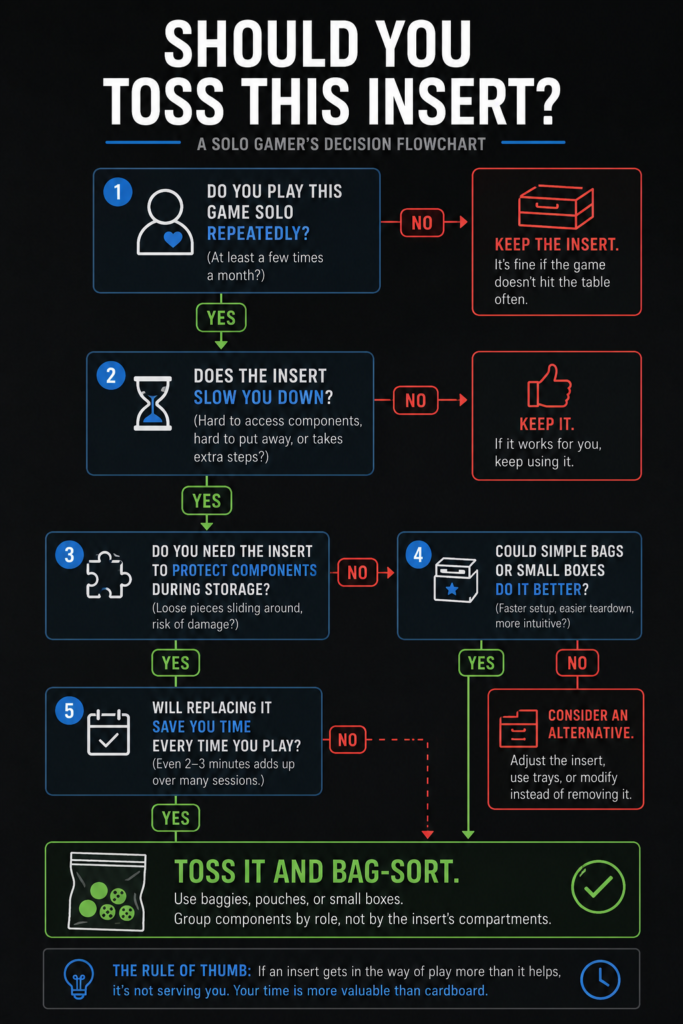
For games you play solo repeatedly — particularly anything with an Automa or complex token system — replacing the stock insert with bags, trays, and a little intentional sorting will cut your setup time significantly. This is especially true for Gloomhaven and its variants, where component management is already a known friction point.
Group by Phase or Faction, Not by Component Type
The organizing principle that speeds up setup most reliably is grouping components by when and how you use them in the game — not by what type of component they are.
For a game like Spirit Island, this means one bag for Dahan and presence discs, one for invader components, one for tokens. When setup begins, you pull three bags and distribute. There's no sorting phase. For Wingspan solo, separate the Automa deck and Automa reference into their own clearly labelled container so that the first thing you reach for when starting a solo game is immediately at hand.
This approach extends to Automa systems more broadly. If your solo opponent's components — their deck, their scoring reference, any special tokens — live in a dedicated bag or tuckbox inside the main box, swapping between Automa difficulty levels becomes a matter of picking a different packet rather than reconstructing decks from scratch.
The Dedicated Solo Kit
For games you consistently play solo but that were designed as multiplayer titles, consider building a dedicated solo kit: a separate small box or pouch that contains exactly what you need for a solo session. This might include the Automa deck, your player components, a simplified reference card, and any optional modules you reliably include.
The logic is that unpacking a four-player Wingspan setup to play a solo game means handling a lot of components you don't need — extra player trays, extra bird feeders, unused player mats. If your solo kit is a separate thing you grab alongside the box, you're staging only what you'll actually use.
Pre-Sorted Automa Packets
A particularly useful habit for Automa-heavy games: pre-sort the bot components and store them ready to deploy. This means the Automa deck is already shuffled, the reference card is face-up on top, and any setup-specific tokens are already counted out.
The time this saves over an entire gaming year is significant. More importantly, it removes the low-level friction that accumulates into "I don't feel like setting up tonight." If your Automa lives in three different zip-lock bags across two boxes, you're building a guaranteed fifteen-minute admin phase into every session before you take a single turn.
Setup Habits That Eliminate Dead Time
Organization is infrastructure. Setup habits are how you use that infrastructure efficiently. A few practices make a measurable difference.
Partial Pre-Setup
One of the most effective habits for solo gamers is partial pre-setup: staging components in advance, either during the previous session's teardown or the night before. Leave Spirit Island's island boards and fear/invader decks pre-grouped in their bags, ready to place. Keep Under Falling Skies' city boards pre-selected for your next run.
This works particularly well for campaign games where you're playing a series of connected sessions. The end of one session is the natural moment to stage the beginning of the next, when you already have all the components out and know exactly what the opening position needs to look like.
Turn-Sequence Aids
For games with complex or sequential turns — particularly titles you return to after a gap of a few weeks — a laminated turn-sequence card does more for your solo experience than almost any other accessory. Nemo's War, Mage Knight, and the Gloomhaven family all have turn structures where a wrong-order mistake can cascade through a scenario. Having that sequence visible at a glance means fewer rulebook interruptions and smoother solo flow.
A small token that moves along the sequence as a progress marker is a refinement worth adding. You spend zero mental energy tracking where you are in the turn, which frees up more processing for actual decisions.
Digital Helpers as Mental Storage
Apps like Board Game Stats and Scorepal, plus official companion apps for titles like Wingspan or Forgotten Waters, are best understood as storage for information that would otherwise live on paper or in your head. Tracking scores, managing AI logic, or handling rules lookups digitally keeps your physical table cleaner and your setup leaner.
The most useful framing: if you can offload any bookkeeping to an app, your physical setup can stay proportionally lighter. A solo session that started with a clean, minimal table and finished with accurate records is faster to reset than one where paper trackers and reference sheets have accumulated across the play surface.
Managing Long Campaigns
Campaign-style solo games — anything with persistent state, unlocks, or multi-session progression — require their own organizational layer on top of standard storage. The worst outcome is returning to a campaign after two weeks and spending the first forty minutes reverse-engineering what position you were in.
Campaign Envelopes and Folders
A small envelope or document wallet per campaign, labelled with the game name and campaign identifier, is a simple solution that works immediately. Store scenario cards, unlocked content, character sheets, and any persistent upgrades inside. When you return to the campaign, everything you need is in one place.
This is particularly valuable for Gloomhaven and its family of games, where city events, road events, character retirement, and unlocked content can accumulate substantially. A campaign folder means you never lose progress to a disorganized box.
Save-State Trays
Component trays make excellent save slots. At the end of a session, load each tray with all the tokens, markers, and cards relevant to a specific faction, character, or system — exactly as they stand at the end of the session. Stack the trays in sequence, and your next session starts by distributing pre-loaded trays rather than reconstructing a position from scratch.
For cooperative solo games where you control multiple factions — Spirit Island with two spirits, or Gloomhaven with a two-character party — one tray per spirit or character, pre-loaded at session end, is the fastest possible reset.
Session Logs and Photos
A quick photo of the game state at the end of a session costs thirty seconds and can save thirty minutes of reconstruction. This is particularly true for games where the board position is complex enough that "I'll remember this" is genuinely risky.
Paired with a brief written note — scenario name, turn number, current threat level, what you're planning to do next — a photo gives you everything you need to walk back into a session cold. The note app on your phone is sufficient. A dedicated gaming journal is better if you find you enjoy the reflection.
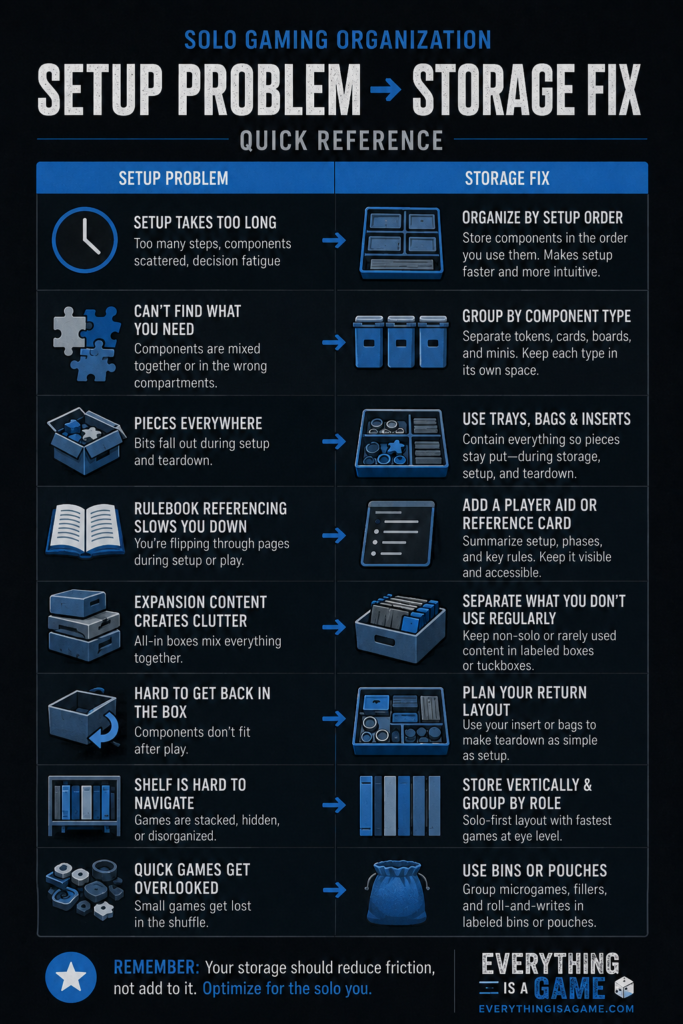
Quick Reference: Storage Solutions by Problem
Getting the Most Out of Your Setup
Solo gaming at its best is uninterrupted thinking — no negotiation, no waiting for other players, just you and the system in front of you. Every minute spent hunting for components or reconstructing a turn sequence is a minute subtracted from that.
The investment in organization pays back disproportionately, because solo players play the same games repeatedly. The same ten minutes of setup friction you accept today will happen again in three days, and again after that. Solve it once and you recover that time for every future session.
Start with the game you play most often. Toss the insert, build a bag system grouped by phase, pre-sort the Automa components, and laminate a turn-sequence card. Play the game twice and see whether setup feels different. It will. Then apply the same logic to the next one.
Your solo gaming collection deserves infrastructure that matches how much you actually use it.
Continue Your Journey
- Advanced Solo Gaming: Automa Strategy and AI Behaviour — once your setup is fast, get more from the Automa systems themselves
- Best Solo Board Games Under $50 — well-organized quick-setup titles worth adding to the workbench
- Gloomhaven Organization Guide: Storage Solutions That Work — deep storage guide for the most component-heavy solo experience
- Wingspan Solo Mode: Complete Strategy Guide — now your Automa kit is sorted, sharpen the strategy to match
- Your Favourite Multiplayer Board Game Probably Has a Solo Mode — find more candidates for the solo workbench
What's your biggest setup pain point — Automa organization, campaign management, or shelf chaos? Tell us in the comments and we'll tackle it directly.
Sign up for our newsletter for solo gaming strategy, storage solutions, and new game recommendations straight to your inbox.
15 pages on the best solo strategy games, setup tips, and how to build a solo shelf worth playing. Free when you join the newsletter.
- ✓ Advanced strategy breakdowns for new releases
- ✓ Monthly buying guides for different budgets
- ✓ First access to in-depth game reviews
- ✓ Exclusive tips from experienced players