
As an Amazon Associate I earn from qualifying purchases and sometimes recommend products from other sellers at no extra cost you. For more details see my disclosure policy and privacy policy.
You already own Eldritch Horror. You already know how the Doom Track works and you’ve argued with your table about whether to fail a check on purpose. The only question left is where your next twenty, thirty, or eighty pounds should go.
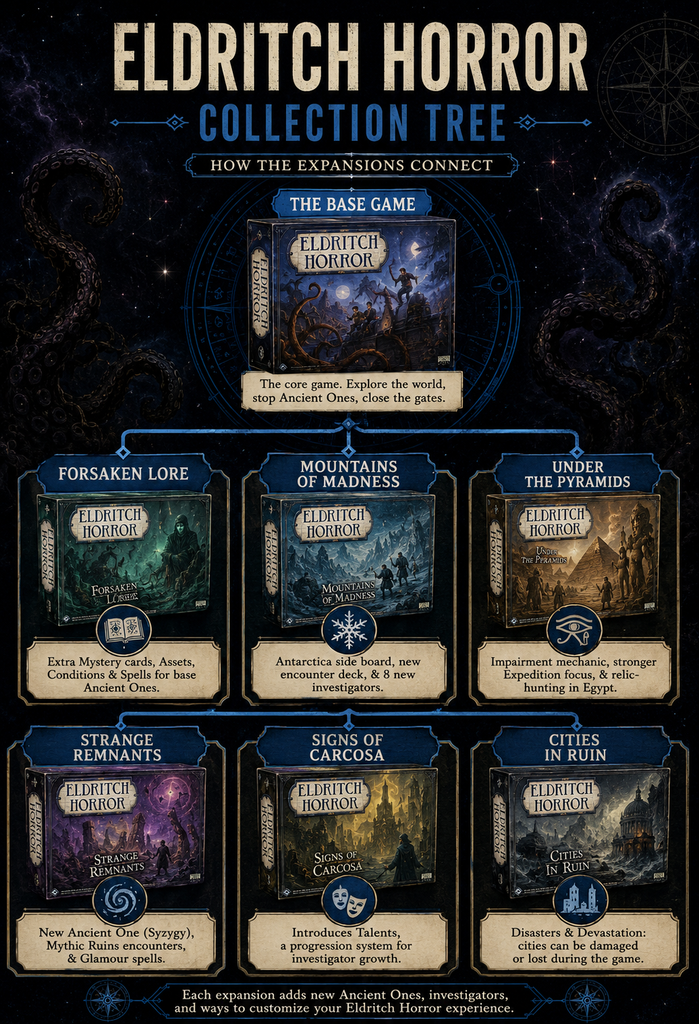
Six expansions currently exist for Eldritch Horror: Forsaken Lore, Mountains of Madness, Under the Pyramids, Strange Remnants, Signs of Carcosa, and Cities in Ruin. Each one adds new Ancient Ones, new investigators, and its own spin on the base game’s core loop. Not all of them earn their shelf space equally, so here’s what each one actually does for your games, and where to spend first.
🎴 Forsaken Lore: The Foundation Piece
Forsaken Lore is the smallest expansion in the line, and it works almost like an accessory rather than a standalone box. It adds extra Mystery cards for the Ancient Ones already in your base game, plus a handful of new Assets, Conditions, and Spells that slot straight into your existing decks.
Nothing here changes how the game plays. What it does is stretch the replay value of the Ancient Ones you already own, so a Cthulhu game in month six feels different from your first one. If you’re not sure where to start, this is the safe, low-cost first purchase that touches every game you already play.
🗺️ Mountains of Madness: New Board, New Cold
Mountains of Madness adds a full Antarctica side board alongside eight new investigators. Expeditions into the ice bring their own encounter deck and a slower, more attritional feel than the base map, since your investigators can freeze, run low on supplies, and struggle to get back to a populated space in time.
This is where Eldritch Horror starts to feel meaningfully bigger rather than just more populated. The new investigators are strong choices even outside Antarctica games, so this expansion earns its cost twice over: once for the new board, once for the character options.
🏺 Under the Pyramids: Attrition Gets Personal
Under the Pyramids sends your investigators after Nephren-Ka through Egypt’s ruins, and it introduces the impairment mechanic, which chips away at your stats over the course of a game rather than just costing you health or sanity outright. Combined with a heavier focus on Expeditions and Relic-hunting, this expansion makes long games feel genuinely gruelling.
It pairs particularly well with groups who already find the base game a little too forgiving. If your table wants Eldritch Horror to bite harder, this is where you’ll feel it.
🌌 Strange Remnants: The Cosmic Curveball
Strange Remnants introduces Syzygy, an Ancient One built around Mythic Ruins encounters and a structure that plays differently from anything in the base set. It’s also the expansion that first added Glamour spells, giving spellcasting investigators a new toolkit to build around.
This is a strong pick for groups who’ve played through the core Ancient Ones enough times to want a genuinely different puzzle, rather than a harder version of the same one.
🎭 Signs of Carcosa: New Systems, Not Just New Cards
Signs of Carcosa was the expansion that introduced Talents, a progression system that lets investigators specialise as a campaign goes on. That alone makes it feel more structural than most of the others on this list, since it changes how character growth works rather than just adding more content to existing systems.
If your group tends to play the same investigators across multiple sessions and wants that time invested to matter, Talents are the payoff.
🌆 Cities in Ruin: When the World Starts Losing
Cities in Ruin centres on Shudde M’ell and introduces Disasters and Devastation, a mechanic where the world’s major cities can be damaged or lost outright as the game goes on. It raises the stakes of the campaign as a whole rather than just the individual encounters, since a ruined city can close off options for the rest of the game.
This is best appreciated once you already have a few expansions in rotation, since the sense of a crumbling world lands harder when you’ve got more of the map to lose.
Where to Start and What to Pair
For a first purchase, Forsaken Lore is the easiest recommendation. It costs the least and improves every Ancient One you already own, which makes it good value regardless of which direction you take the collection afterwards. From there, Mountains of Madness is the strongest second buy, since the new investigators alone are worth the price even before you touch Antarctica.
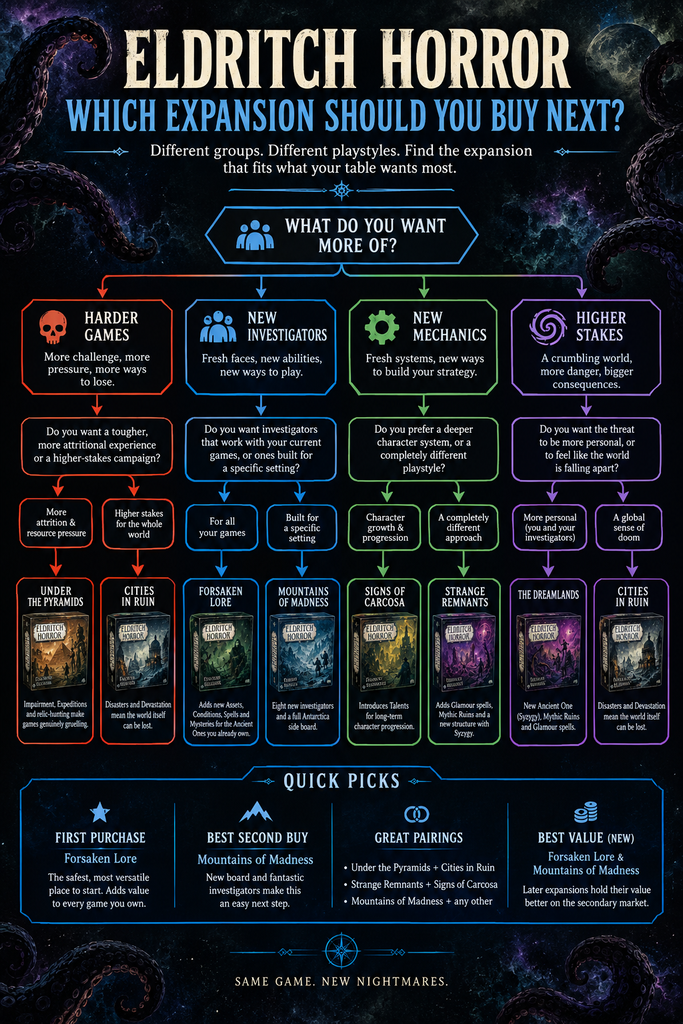
A few combinations that work especially well together:
- Under the Pyramids and Cities in Ruin, if your group wants a campaign that feels genuinely dangerous from start to finish
- Strange Remnants and Signs of Carcosa, for a more character-driven, mechanically fresh experience without leaning on attrition
- Mountains of Madness alongside any of the others, since its investigators are strong enough to carry into whichever Ancient One you’re facing
On price-to-value, Forsaken Lore and Mountains of Madness give you the most for your money if you’re buying new. The later expansions (Strange Remnants, Signs of Carcosa, Cities in Ruin) tend to hold their value on the secondary market better than they discount, so shop around rather than expecting a bargain if you’re buying second-hand. If you’re restocking a copy of the base game for a second group or a gift, the current edition is worth checking here before you commit to expansions on top of it.
If you want a refresher on how the core systems interact before diving into any of these, our Eldritch Horror strategy guide covering the Doom Track and Mythos deck is worth a re-read, and if new investigators from Mountains of Madness or Strange Remnants have you rethinking your usual pick, our guide to the best investigators for beginners still holds up for evaluating new additions.
None of these expansions are required reading. But if you’re going to add just one this year, start with the one that makes the games you already own better, not just longer.