
As an Amazon Associate I earn from qualifying purchases and sometimes recommend products from other sellers at no extra cost you. For more details see my disclosure policy and privacy policy.
You typed “Arkham Horror” into a search bar to buy a game for game night, and now you are staring at two completely different products that share a name, a logo style, and absolutely nothing else. One is a box of cards. One is a box the size of a suitcase with a folding map inside. Neither is an upgrade of the other, and picking the wrong one means an unhappy group of friends on Saturday night.
Here is the short version before we go any further: Arkham Horror: The Card Game is a deckbuilding LCG (a card game where you buy fixed expansion packs instead of random boosters) built around an ongoing narrative campaign for one or two people, most comfortably. The Arkham Horror board game (currently in its third edition) is a map exploration and dice based investigation game built for a full table of three to six friends. They are set in the same fictional universe, published by the same company, and that is where the similarity ends.
If you already know you love Lovecraftian board games and just want to see how the wider genre compares, our Arkham Horror vs. Eldritch Horror vs. Mansions of Madness comparison covers that ground in detail. This piece is answering a narrower, more common question: card game or board game, and which one actually fits how you play.
🃏 Two Games, One Name: Why the Confusion Happens
Fantasy Flight Games has built an entire “Arkham Horror Files” line around H.P. Lovecraft’s fictional Massachusetts town, and it now includes a board game, a card game, a miniatures game, and more, all sharing character names, artwork style, and the same brooding Miskatonic University backdrop. That shared branding is deliberate. It is also the reason so many first-time buyers assume they are looking at different editions of one product, especially when both boxes turn up side by side on the same retailer shelf or search results page.
They are not. Arkham Horror: The Card Game and the Arkham Horror board game are built by different design teams, run on entirely different rule sets, and cannot be combined at the table in any way. You cannot use board game components in the card game or vice versa. Buying one does not get you a “starter version” of the other.
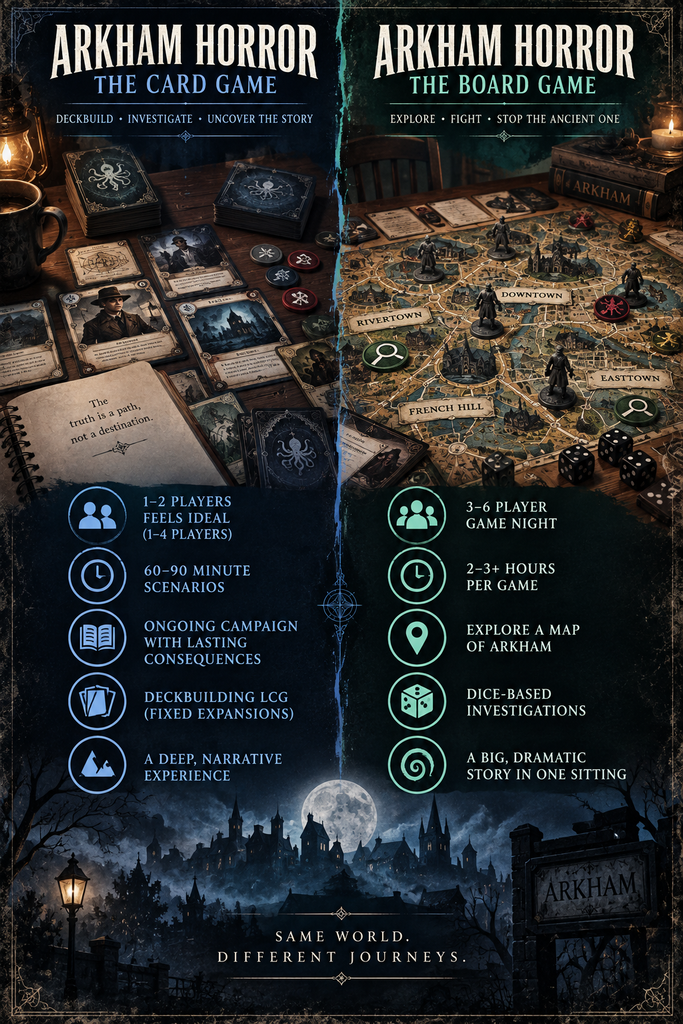
Once that is settled, the real decision is about what kind of game night you actually want to have. That comes down to five practical differences: how the game plays, how many people can join, how long a session runs, what it costs over time, and which kind of player each one rewards.
🎲 Core Gameplay: Deckbuilding Campaign vs. Map Exploration
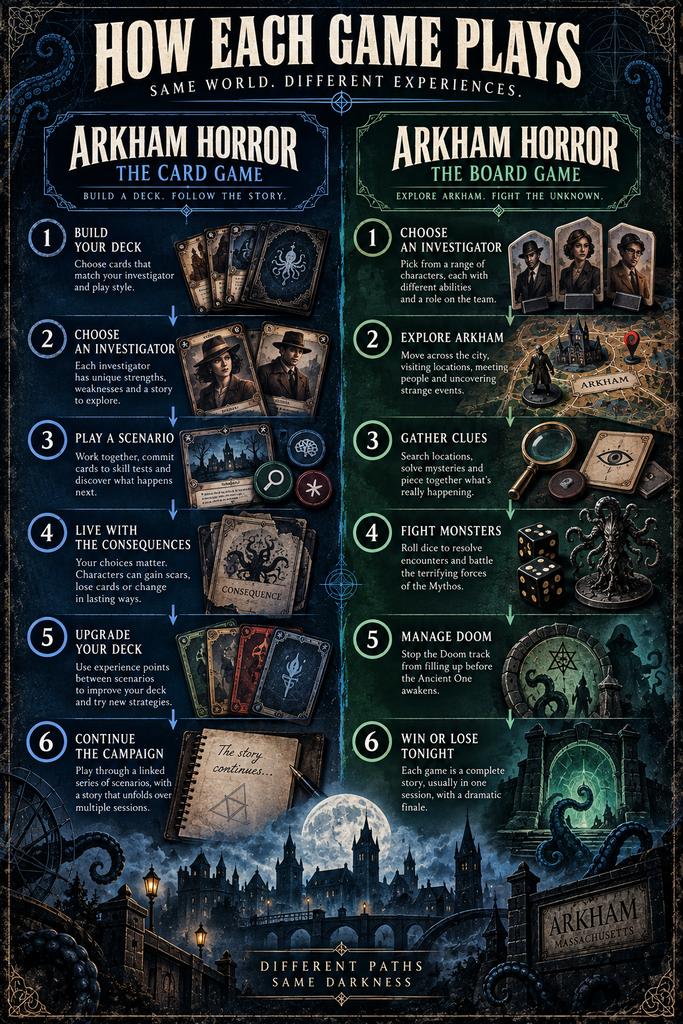
Arkham Horror: The Card Game is a cooperative LCG, short for Living Card Game, meaning every copy of an expansion contains the same fixed set of cards rather than random booster packs, so there is no gambling on pulling a good card and no secondary market to chase. You build a personal deck for your investigator, then play through a linked campaign of scenarios where your choices and card losses carry over from one session to the next. As of 2026, the game is on its “Chapter Two” core set, which replaced the 2021 Revised Core Set as the current entry point and introduces a new introductory campaign called Brethren of Ash.
Each scenario plays out through skill tests: you commit cards and resources to boost a stat, then flip a token from a bag to see whether you succeed. Between scenarios, your investigator’s story genuinely moves forward, sometimes permanently losing access to cards or gaining scars that change how future sessions play. That persistence is the game’s biggest selling point and also its biggest commitment, since skipping sessions can mean losing the thread of an ongoing story.
The Arkham Horror board game, now in its third edition from Fantasy Flight Games, plays very differently. Investigators move around a folding map of Arkham, visiting locations to gather clues, fight monsters with dice pools, and race against a rising Doom track (a shared countdown that ends the game if it fills up) before an Ancient One awakens. There is no deckbuilding, no card collection, and no long-term character memory carried between plays. Each game session is a mostly self-contained story rather than a serialised campaign, though the board game does support linked scenarios if you want them.
Put simply: the card game rewards players who enjoy building and refining a strategy over many sessions, in the way a role-playing campaign rewards showing up week after week. The board game rewards players who want a big, dramatic, dice-driven story that wraps up in one sitting, closer to a board game version of a disaster movie.
👥 Player Count and Session Length
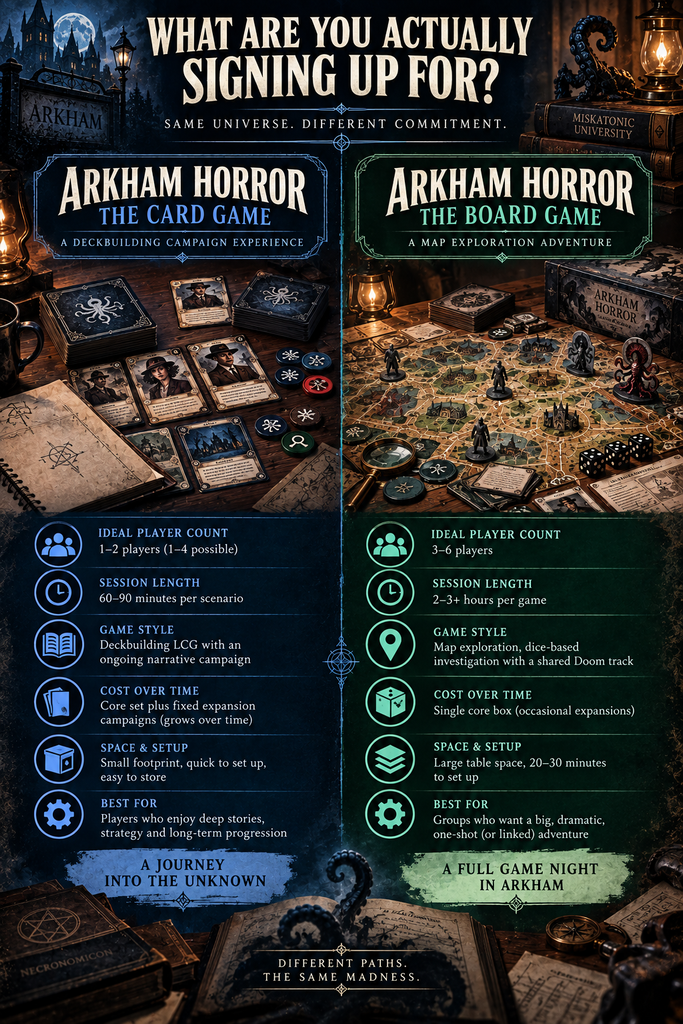
This is where the two products really diverge, and it is often the deciding factor on its own. Arkham Horror: The Card Game is built for one to four investigators, but it genuinely shines at one or two players, since the campaign structure and character development were designed with a small, consistent group in mind. A typical scenario runs roughly 60 to 90 minutes, and a full campaign unfolds across several sessions over weeks or months.
The Arkham Horror board game supports one to six players and is comfortable with a full table. A single game generally runs two to three hours, sometimes longer with more experienced groups pushing into the harder difficulty settings. It is a proper board game night commitment, not a quick after-dinner filler.
If your group is a rotating cast of three to six people who game together occasionally, the board game fits that rhythm, since it does not ask anyone to remember what happened last time or maintain a deck between sessions. If it is you and a regular co-op partner who wants to sink into a long story over the following months, the card game is the better match, but be honest with yourself about whether you will keep a standing weekly or fortnightly slot. A campaign that stalls halfway through loses momentum fast, since the whole appeal is built on continuity.
💳 Cost to Get Started and Ongoing Spend
Arkham Horror: The Card Game’s current Chapter Two core set retails at around 70 US dollars and gets you the rulebook, five investigators, and the Brethren of Ash introductory campaign. That is a reasonable entry price, but the LCG model means the game keeps growing through smaller scenario packs and larger deluxe expansions released on an ongoing schedule. Committed players who want the full card pool and every campaign will spend considerably more over a year or two than the core box alone suggests.
The Arkham Horror board game (3rd edition) has historically retailed for roughly 80 US dollars for the core box, which is a complete standalone game on its own. Fantasy Flight has released a smaller number of large expansion boxes for it rather than a constant drip of small packs, so the spending curve is flatter. You can play the base game indefinitely without buying anything else and still get a full, satisfying experience.
Neither model is objectively better. It is a straightforward trade between “pay a bit more upfront but stay complete” (board game) and “pay less to start but budget for ongoing releases if you get hooked” (card game). A useful rule of thumb: if you tend to finish what you start and enjoy following a hobby over years, the card game’s drip-fed content is a feature, not a cost trap. If you would rather buy once and be done, the board game’s self-contained box is the safer bet for your wallet.
🧭 Which Player Type Each Game Suits
Arkham Horror: The Card Game is the natural fit if you already enjoy deckbuilding games, like the idea of a character growing and changing across a long campaign, and mostly play solo or with one regular partner. It rewards optimisation, planning, and patience with a slower-burn narrative.
The Arkham Horror board game suits players who want group energy: a table full of people rolling dice, arguing over the map, and racing a shared doom clock. It is closer in spirit to games like Pandemic or Eldritch Horror than to any card game, and it plays best as a social event rather than a solitary hobby. If you already know you like that style of cooperative dice-and-map game but are not sure which specific title fits your group, our Eldritch Horror strategy guide is a useful next stop, since Eldritch Horror runs on a related engine with a similar table feel.
Neither game is more “hardcore” or more “casual” than the other. They simply ask different things of the people playing them. Someone who loves spreadsheets and optimising a build will likely gravitate to the card game, while someone who wants to laugh, argue over the map, and share a big collective win or loss will get more out of the board game.
📦 Table Space, Setup Time, and Storage
Worth a quick mention before you buy: these two games take up very different amounts of physical space. Arkham Horror: The Card Game needs little more than a coffee table, since it is mostly hands of cards and a small shared play area, and setup between scenarios takes a few minutes once you know the campaign log.
The Arkham Horror board game needs a proper dining table or larger, since the folding map, standees, dice, and multiple card decks take up real room, and a first-time setup can easily run 20 to 30 minutes. If you have limited space to store and set up games, that is worth weighing alongside the price and player count differences above.
🛒 Direct Recommendations by Buyer Scenario
If you are buying for yourself and one other person, and you both like the idea of a long-running story with characters that develop over time, buy Arkham Horror: The Card Game’s Chapter Two core set. It is built exactly for that use case.
If you are buying for a regular game night group of three or more people who want a big, dramatic cooperative experience that resolves in a single evening, buy the Arkham Horror board game (3rd edition). It scales to a crowd in a way the card game simply does not.
If you are not sure whether you like Lovecraftian cooperative games at all, start with the board game. It is a lower-commitment entry point since there is no deckbuilding to learn and no ongoing expansion habit to maintain, and it will tell you quickly whether the theme and mechanics click for your group. From there, our horror board game strategy guide can help you get more out of that first few plays, whichever cooperative horror title you land on.
If you want something adjacent but distinct from Arkham Horror itself while you decide, Eldritch Horror is worth a look. It shares the map-and-dice structure of the Arkham Horror board game but plays out on a world map instead of a single town, and it is a genuinely different game rather than a reskin. Our comparison of Arkham Horror, Eldritch Horror, and Mansions of Madness breaks down exactly how those three board games differ from each other, which is a useful next read once you have settled the card-game-versus-board-game question here.
Whichever one you choose, you are not making a mistake by picking “the wrong one” first. They serve different game nights, and plenty of Arkham Horror fans eventually own both. Just go in knowing you are buying two unrelated games, not two versions of the same one.