
As an Amazon Associate I earn from qualifying purchases and sometimes recommend products from other sellers at no extra cost you. For more details see my disclosure policy and privacy policy.
You sit down with a game you know well — one you’ve played a dozen times with friends. You set it up for solo, run the first few turns, and something feels off. The moves that usually work don’t land the same way. The blocking play you love is pointless. The negotiation angle you rely on doesn’t exist. You’re winning on paper but it feels like you’re missing half the game.
That feeling is the gap between solo and multiplayer strategy, and it’s bigger than most players expect. The core puzzle of a game might be identical whether you’re playing alone or with four others at the table, but the tactical layer sitting on top of that puzzle changes almost entirely. Understanding exactly what shifts — and why — makes you a sharper player in both contexts.
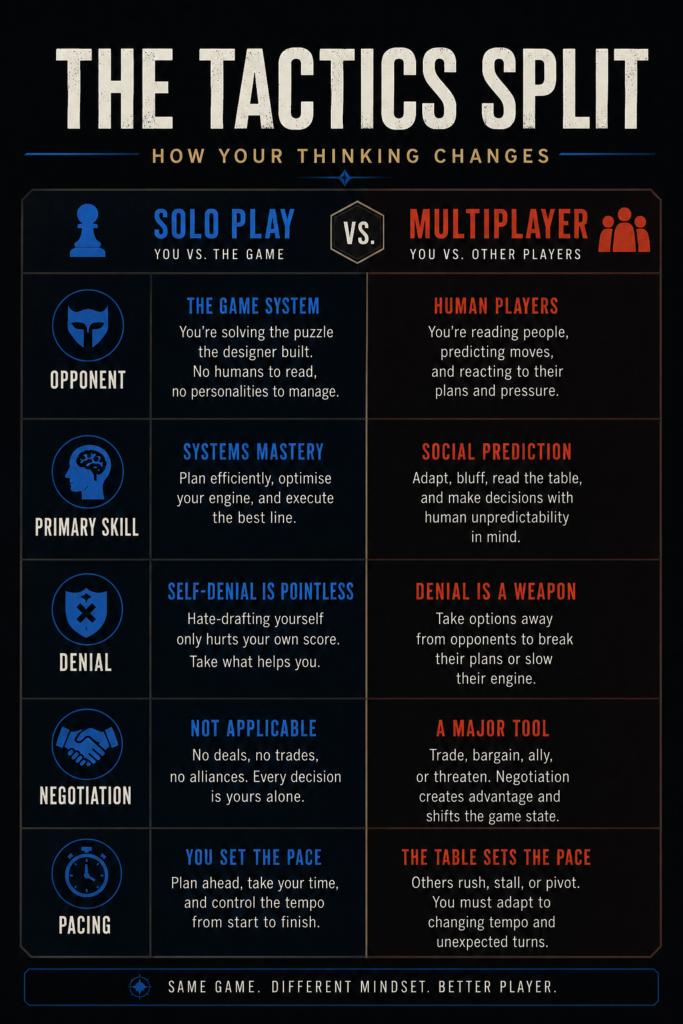
The Fundamental Divide: Systems vs. Humans
Every board game gives you two things to think about simultaneously: the game’s own systems (scoring paths, resource flows, timing windows) and the other players (their goals, their plans, their pressure on your plans). In multiplayer, you’re managing both at once. In solo, you’re managing only one of them.
This sounds like solo should be simpler. Often it isn’t.
When you remove human opponents, the game’s underlying system becomes the entire strategic surface. There’s nowhere to hide from inefficiency, no opponent error to exploit, no lucky negotiation to paper over a weak position. Solo strategy is systems mastery in its purest form — you against the design, trying to extract the maximum possible result from a fixed set of rules.
Multiplayer strategy is something different: it’s social prediction layered on top of systems knowledge. You still need to understand the game deeply, but you also need to read people, anticipate reactions, manage perception, and make decisions that account for human unpredictability. As one way to think about it: solo is the lab, multiplayer is the performance.
The Tactics That Vanish When You Play Alone
Kingmaking and Table Politics
In a competitive multiplayer game, one of the most important tactical decisions you make isn't about your own board — it's about who you attack, who you leave alone, and how you position yourself relative to the leader. Hitting someone too hard too early can make you a target. Letting someone run away with the game because you were busy racing another player is a classic mistake.
All of that evaporates in solo. There is no kingmaker problem, no threat assessment across multiple opponents, no political capital to spend or protect. If anything benefits your position, you take it. The entire layer of table management simply ceases to exist.
Negotiation and Trading
A huge number of multiplayer games involve deals — formal or informal. Trading resources in Catan, striking alliances in area control games, talking someone into attacking the leader instead of you. These moments are genuinely strategic: knowing when to make a deal, what to offer, when to bluff, and when to be straight with someone are real skills that affect outcomes.
Solo play has no equivalent. There's nobody to negotiate with, no bluff to run, no deal that creates value on both sides. If your multiplayer game relies heavily on this dimension — 7 Wonders' drafting table talk or the auction dynamics in economic games — the solo experience will feel noticeably flatter in comparison.
Hate-Drafting and Denial
Taking a card, tile, or space primarily to hurt another player's plan rather than to help your own is one of the most interesting tactical options in multiplayer strategy. It requires you to model what your opponents want, estimate how much it costs them, and weigh that against what you're giving up. Done well, denial play is elegant and effective.
In solo, hate-drafting yourself serves no purpose. If you're the only player, denying yourself a resource just means a weaker position for the only position that matters. This is one reason that games with heavy denial mechanics — Azul's floor line pressure, tight card drafts — can play very differently in solo modes, often becoming pure optimisation puzzles rather than adversarial tactical fights.
The Solo Toolkit: What Gets Amplified
Long-Term Planning Without Interruption
In multiplayer, your plans get disrupted constantly. Someone takes the spot you needed. An opponent denies a card you were counting on. A deal falls apart. Good multiplayer players learn to hold their plans loosely and adapt quickly.
Solo gives you something rare: uninterrupted planning time. You can think through five turns ahead without worrying that a human decision will invalidate your read. This makes solo strategy particularly rewarding for players who enjoy deep analysis — you can build and test theories about optimal lines in ways that multiplayer's chaos doesn't allow. Gloomhaven's solo play is a strong example of this: character card timing and ability sequencing become puzzles you can genuinely solve, rather than improvise around.
Pure Efficiency and Engine Optimisation
Without opponents injecting chaos, your score becomes entirely a function of how well you've built and executed your strategy. Every suboptimal move is yours alone. This makes solo play a demanding but fair test of whether you actually understand a game's scoring architecture.
High-score solo modes — common in engine-building games like Wingspan — are built around exactly this principle. The challenge isn't beating another player; it's finding and executing the most efficient combination of moves available in a given setup. Players who love this kind of puzzle find solo deeply satisfying. Players who enjoy the messiness of human interaction sometimes find it hollow.
Risk Management Against Automated Systems
In multiplayer, you hedge against human unpredictability. In solo, you hedge against systems: event decks, escalating bot scripts, timers, and cascading conditions that punish slow play.
This is a genuinely different skill. Predicting how an automa system will behave, identifying which automated events are catastrophic versus manageable, and building enough resilience to absorb scripted pressure — these require you to read the design rather than read people. Advanced automa strategy is its own discipline, and players who master it are often thinking in terms of system exploitation rather than opponent modelling.
How Different Solo Modes Shape Your Decisions
Not all solo play is the same. The type of solo mode a game offers determines which tactical skills it actually tests.
High-Score Puzzles
Games with pure high-score solo modes remove all simulation of opposition. Your task is simply to score as many points as possible with a given setup, which often means pursuing lines that would be reckless in multiplayer — overcommitting to a single scoring path, ignoring redundancy, taking every resource a single strategy needs even when it creates a lopsided board. These are exactly the "degenerate" lines you'd avoid against opponents because they leave you exposed. In solo, they're often correct.
Simulated Opponents: Bots and Automa
Games with bot or automa systems — where a scripted deck or decision tree plays a simulated opponent — introduce a middle ground. Your tactics need to account for the bot's behaviour, but because the bot operates on deterministic or semi-deterministic rules, you can learn to exploit it. Pattern recognition becomes central: understanding when the automa will escalate, what it prioritises, and where its scripted logic creates predictable gaps you can use.
This is meaningfully different from playing against humans, but it's also different from a pure puzzle. Games that bolt automa onto multiplayer systems often create interesting tactical challenges precisely because the simulation is imperfect — there are edges to find that wouldn't exist against experienced human opponents.
Cooperative Games Played Solo
Running a full co-op game solo is arguably the most tactically demanding solo format. You control multiple characters or roles simultaneously, planning synergies between them without the friction of miscommunication with real teammates. The challenge of co-op games like Gloomhaven played solo is partly logistical — keeping track of multiple hands and initiative orders — but mostly strategic: you're optimising cross-character interactions with complete information, which creates a kind of idealized version of co-op play.
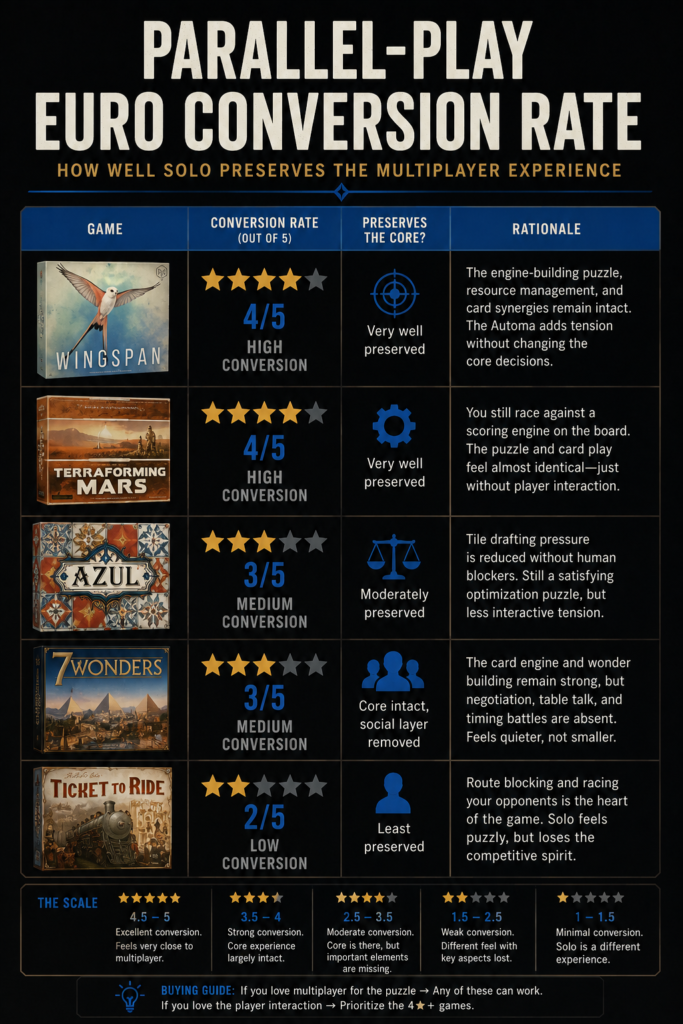
Why Parallel-Play Euros Convert So Naturally to Solo
Euro-style games have been moving toward what designers call "parallel play" for years — structures where players mostly develop their own engines with limited direct conflict. Think Wingspan, Terraforming Mars, or most engine-building games. Players share the same game space but largely pursue independent paths, with interaction coming primarily through resource scarcity rather than direct conflict.
These games often acquire solo modes with surprisingly minimal redesign. The reason is that much of the tension in the original game was already coming from the puzzle rather than from player interaction. If your multiplayer nights feel like everyone is solving their own optimisation problem in comfortable parallel, you're already halfway to solo — removing the other players mostly changes what you blame when the setup goes against you.
This is why the solo mode in a game like Wingspan feels authentic rather than tacked on. The core experience was already individual engine-building against a shared environment. The automa system recreates competitive pressure without needing to simulate much genuine strategic interaction.
Contrast this with games built around heavy direct interaction — negotiation games, area control, take-that mechanics — where solo modes have to work much harder to replace what's genuinely lost. The best designs acknowledge this honestly, building solo-specific win conditions and event systems that create their own form of pressure rather than pretending to replicate multiplayer dynamics.
Putting It Into Practice
The most practical application of understanding this divide is transfer learning: skills you sharpen in one context that make you better in the other.
Solo play builds systems literacy in a way that multiplayer sometimes doesn't. When you can't hide behind lucky negotiation or exploiting opponent mistakes, you're forced to genuinely understand the game's scoring architecture, resource timing, and decision trees. Players who log significant solo hours in a game tend to show up at multiplayer sessions with sharper reads on what the game actually rewards.
Multiplayer sharpens the ability to act under pressure and incomplete information. The 7 Wonders drafting table teaches you to make fast, good-enough decisions when thinking too long has its own cost. That skill comes back with you to solo — better instincts about when to commit versus when to stay flexible, even when nobody is rushing you.
The players who tend to be strongest across both contexts are the ones who recognise the context switch early and adjust their mental mode to match. Walking into a solo session still thinking about politics and denial is how you make decisions that don't serve the puzzle. Walking into a multiplayer session still thinking in pure optimisation is how you get outmanoeuvred socially and leave wondering why your efficient engine still lost.
The Takeaway
Solo and multiplayer strategy aren't opposites — they're variations on the same underlying game literacy, with different tactical layers foregrounded. Understanding which layer you're operating in at any given moment is the first move in both contexts.
The tactics that vanish in solo — politics, denial, negotiation — aren't weaknesses of solo play, they're features of multiplayer that deserve their own study. And the skills that solo amplifies — system mastery, efficiency, risk management against automated pressure — aren't compensations for absent opponents, they're their own genuine challenge.
Play both. Learn what each one teaches you. And notice how the games you thought you knew start looking different the moment you change who — or what — you're playing against.
Which do you find more challenging: optimising a solo puzzle to the highest score, or managing the human element at a competitive multiplayer table? Let us know in the comments.
Continue Your Journey
- Your Favourite Multiplayer Board Game Probably Has a Solo Mode — How to find and evaluate the solo experience in games you already own
- Advanced Solo Gaming: Automa Strategy and AI Behaviour — A closer look at how to read and exploit simulated opponents
- Gloomhaven Solo Play: Complete Setup and Strategy Guide — The solo experience in one of the most tactically rich campaign games
- Wingspan Solo Mode: Complete Strategy Guide — High-score optimisation in the definitive engine-building solo experience
- Solo Gaming Organisation: Storage and Setup Optimisation — Getting your solo sessions set up for focused, efficient play
Want more strategy content for solo and multiplayer gaming? Subscribe to our newsletter for new guides every week.
15 pages on the best solo strategy games, setup tips, and how to build a solo shelf worth playing. Free when you join the newsletter.
- ✓ Advanced strategy breakdowns for new releases
- ✓ Monthly buying guides for different budgets
- ✓ First access to in-depth game reviews
- ✓ Exclusive tips from experienced players