
As an Amazon Associate I earn from qualifying purchases and sometimes recommend products from other sellers at no extra cost you. For more details see my disclosure policy and privacy policy.
You are one Fear short of a card. The Invaders are about to Ravage your best land, and three spirits are all reaching for their power cards at once. Who acts first, and in which phase, matters more here than anything in your hand.
Most Spirit Island advice treats fear as a side objective that happens while you fight. On higher difficulties that mindset loses games. Fear is a tempo resource, and the round it lands in decides whether you reach the next Terror Level before the Invaders reach you.
This guide assumes you have already beaten the base game. If you want the fundamentals first, start with our Spirit Island Strategy Guide and come back.
⏱️Where Fear Cards Resolve in the Round
A turn runs Spirit Phase, Fast Power Phase, Invader Phase, Slow Power Phase, then Time Passes. Inside the Invader Phase the order is the Blighted Island effect, then Fear, then Ravage, Build and Explore, then the Invader Cards advance. If you play with the Event deck from Branch & Claw (more on that in our Spirit Island Expansions Guide), the Event step sits between the Blighted Island effect and Fear.
So Fear cards resolve before the Invaders do anything. Earned cards wait for the next Invader Phase, you flip the stack, and you resolve them in the order they were earned. You cannot reorder them.
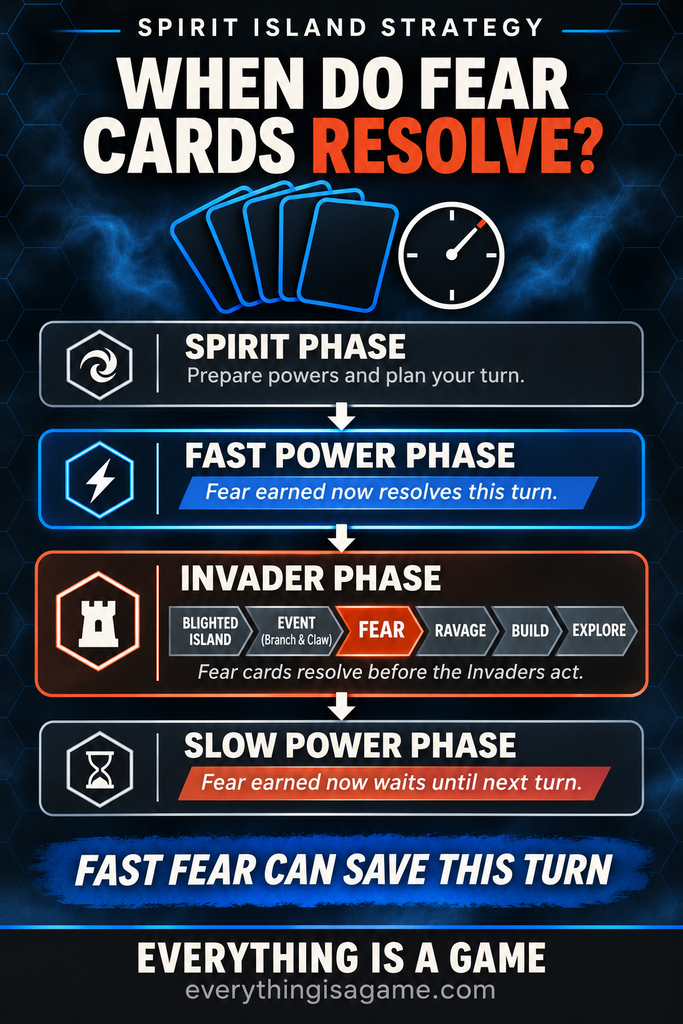
That one rule creates the whole timing puzzle. A card earned during the Spirit or Fast Power Phase resolves this turn, before Ravage. A card earned during the Slow Power Phase, or by anything that happens after the Fear step, waits a full turn.
Two more details matter for planning:
- Each card resolves at the Terror Level that is current when you resolve it, not the level it was earned at.
- If resolving a card earns another one, it goes on the bottom of the stack and still resolves this Invader Phase.
🧮Why When You Generate Fear Beats How Much
Think of every fear source as having a delivery date. Fast fear is a defensive tool for this turn. Slow fear is an investment that pays out next turn.
The mistake is judging a fear power only by its number. Two fear on a Slow power and one fear on a Fast power are not “three fear”. Only the Fast one can change what the Invaders do before they act.
My rule of thumb is simple. If the next card is close, find the missing Fear in the Fast Power Phase. If the card is far away, leave the fear for the Slow Power Phase, where it costs you nothing in defence.
Leftover Fear is never wasted. When a card is earned, extra Fear markers return to the Generated Fear area and count towards the next one. What you waste is the delivery date, not the Fear.
🚩Terror Levels as Pacing Checkpoints
Treat each Terror Level as a deadline for the Invaders, not a bonus for you. At Terror Level 1 you win by clearing all Invaders. At Terror Level 2 you only need no Towns or Cities. At Terror Level 3 you only need no Cities.
Each step down in the victory condition is a step towards a game you can actually finish. Your board should be shaped to meet the next condition, not the current one.
There is a timing detail here that catches experienced players. The Terror Level changes the moment the earn reveals a divider, and the new victory condition applies immediately. You win the instant the current condition is met, in any phase.
The last Fear card works the same way. Earn it and you win straight away, whatever is printed on it. Earning it in the Fast Power Phase means the Invaders never get their turn.
Before every Fast Power Phase, ask two questions:
- How many Fear are we from the next divider?
- If we cross it this phase, are we one clear-out away from the new victory condition?
If both answers are close, you are in a win window. Spend the Fast phase on it.
🎛️Shaping Your Fear Generation
You cannot reach into the Fear Deck and reorder it, so do not plan as if you can. What you control is when Fear arrives and which Terror Level the cards meet when they resolve. That second part is the real lever.
Because a card resolves at the current level, cards sitting in the Earned stack get stronger if you cross a divider before the Fear step. Earning a divider card in the Fast Power Phase upgrades every card already waiting. Earning it in the Slow Power Phase upgrades them for next turn instead.
Here is how I plan it:
- Label your fear sources as Fast or Slow. Do it at the start of the game, not mid-turn.
- Cross dividers in the Fast phase when you can. If a Fast power and a Slow power could both cover the gap, spend the Fast one and keep the Slow one for the following card.
- Save big fear plays for the Fast phase when the Ravage is dangerous. Your Fast phase is where fear acts as defence.
- Use Slow fear to stock the next turn. It is cheap tempo because it never competes with defence.
Fear also comes from destroying Towns and Cities, which means your normal defensive plays already feed the track. Do not duplicate that with a dedicated fear play unless you are within reach of a divider.
🤝Turn Order Between Spirits
There is no player order inside a phase. Players act simultaneously and confer as they wish, so the “order” you manage is the order of phases and the order you resolve powers inside them.
That makes fear a coordination problem. Everybody resolves their Fast powers before the Invader Phase, and nobody can delay them. The group needs to know, before anyone moves, who is expected to push the count over the line.
I use a quick fear call at the start of every Fast Power Phase. One person states the gap to the next card and which spirit is the crossing player. Everyone else resolves their other powers first, so the crossing player can see exactly how short the group is.
Do not leave the crossing to chance. If two spirits both generate a little Fear, the table will happily resolve them in whichever order feels natural. That is how you end up one Fear short while a perfectly good Slow power sits in hand.
⚖️Fear as a Win Route and a Pressure Valve
Fear has two jobs, and they pull in different directions. As a win route, it lowers the bar for victory. As a pressure valve, its card effects resolve before Invader actions, so they can blunt a bad turn.
The cost is that every action spent on fear is not spent on defence. Blight running out is a loss, and so is losing a spirit. A fear plan has to leave enough defence to avoid both.
My recommendation for higher difficulty is to commit to the fear route only when two things are true. You can see the next divider within about two turns, and your board can reach the next victory condition shortly after. If either is missing, defend and let fear accumulate from normal play.
On the hardest settings, ask which adversary you are facing. Our Spirit Island Adversaries Ranked post covers how they pressure the island, and that tells you how much defence you can afford to give up.
⚠️Common Timing Mistakes
These are the errors I see most often at the table:
- Counting Slow fear as protection. A card earned in the Slow phase does nothing about this turn’s Ravage.
- Crossing a divider in Slow when Fast was available. You gave up a whole turn of upgraded cards.
- Assuming a card resolves at its earned level. It resolves at the current one, so check the level before you decide what to hold.
- Forgetting the Event step. If you use Events, they resolve before Fear, so plan around the board after the Event, not before it.
- Chasing fear while Blight drains. A win route is worthless if the Blight pool empties first.
- Letting the table resolve in the wrong order. Without a fear call, the crossing play happens by accident.
🧪Worked Example: A Mid-Game Turn
This is an illustration, not a real game record. Three spirits, mid-game, Terror Level 2. One Fear card is already waiting in the Earned stack from last turn’s Slow phase. The group is one Fear short of the next card, and that card would reveal the Terror Level 3 divider.
The Invader track shows a Ravage that will hurt a land with a City. One spirit has a Slow power worth two Fear. Another has a Fast power worth one Fear.
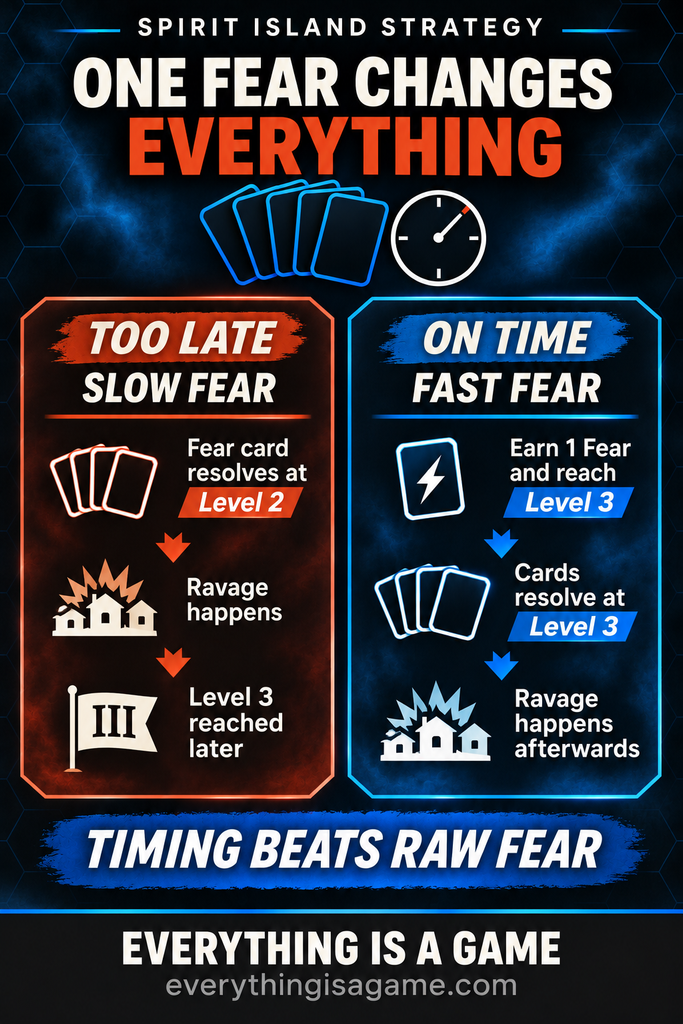
The weak line is to play the Slow power in the Slow Power Phase. The waiting card resolves in this Invader Phase at Terror Level 2, and the Ravage lands. Only afterwards does the new card get earned, revealing the divider a turn late.
The strong line is to resolve the one-Fear Fast power first. The new card is earned in the Fast phase, the divider is revealed, and the table is at Terror Level 3 immediately. In the Invader Phase, both cards resolve at Terror Level 3, and the Ravage comes after them.
The Slow power then still produces its two Fear, which carry over towards the next card. Nothing was lost, and the Invaders faced a stronger fear effect before they acted. If the board had also been clear of Cities, the crossing would have won on the spot.
✅Your Fear Timing Checklist
Run this before every Fast Power Phase:
- Count the Fear to the next card and the next divider.
- Name the crossing spirit.
- Check whether crossing now upgrades cards already waiting.
- Check whether the new victory condition is within one clear-out.
- Send the remaining fear to the Slow phase.
Fear rewards the group that treats the clock as a resource. If you want to push your difficulty further, our beginner’s guide to choosing a first spirit is a useful refresher to share with new players, and our co-op comparison of Pandemic, Spirit Island and Gloomhaven shows how its pacing differs. If your table wants more of the theme, Horror Board Game Strategy: Managing Fear and Cooperation pairs well.
Own the Spirit Island base game and want to test this? Make the fear call out loud for one whole game. It changes how the whole table sees the round.