
As an Amazon Associate I earn from qualifying purchases and sometimes recommend products from other sellers at no extra cost you. For more details see my disclosure policy and privacy policy.
You’ve been climbing the MTG Arena ranked ladder for months. You know your deck, you know the format, and clicking “concede” no longer stings the way it used to.
Then a friend mentions their local game store’s Friday Night Magic, and suddenly you’re nervous again, like it’s your first round all over again. Here’s the truth: you already know how to play Magic. What FNM adds is paper mechanics, in-person etiquette, and a slightly different rulebook around deck legality and match structure.
This guide covers exactly that gap, so you can walk into your first Friday Night Magic ready instead of rattled.
🃏 What Friday Night Magic Actually Is
Friday Night Magic is a weekly tournament run through Wizards Play Network at local game stores worldwide. It’s organised at Regular Rules Enforcement Level (REL), the most forgiving tier Wizards offers. That matters more than it sounds.
At Regular REL, judges and opponents are expected to help fix mistakes rather than punish them. A missed trigger or a misremembered rule becomes a quick correction, not a game loss.
Expect three or four rounds of Swiss pairings, with rounds running around fifty minutes and matches played best two games out of three. Entry usually runs five to fifteen dollars, and prizes come as booster packs or store credit rather than cash.
Walk in fifteen or twenty minutes early to register. Most FNM crowds are there for the games and the company, not for glory, so don’t worry about finishing top four.
📋 Deck Legality: What’s Different From Arena
This is where Arena habits can trip you up. Arena curates its card pool automatically, and the client won’t let you build an illegal deck even if you tried. Paper Magic doesn’t have that safety net.
Before you sleeve up, confirm your deck matches the format being played that night, commonly Standard, Pioneer, or Modern depending on your store. Note that 2026 is a transition year with no Standard rotation, so the format currently holds around seventeen legal sets stretching back to late 2023. The next rotation isn’t until January 2027, so a deck you build now has real staying power.
Proxies (unofficial stand-in cards) aren’t tournament legal at FNM the way they might be in a casual pod at home. Every card in your deck needs to be the genuine article.
If you’re not sure whether your Arena deck translates cleanly to paper, our guide on testing your paper deck on MTG Arena before you buy walks through exactly how to check legality and playtest before spending real money on cardboard. And if you’re deciding which format to commit to first, our breakdown of MTG Arena’s formats is a useful reference even though it’s framed around Arena, since the format fundamentals like Standard’s card pool and Pioneer’s non-rotating base carry over directly.
🎒 What to Bring to Your First FNM
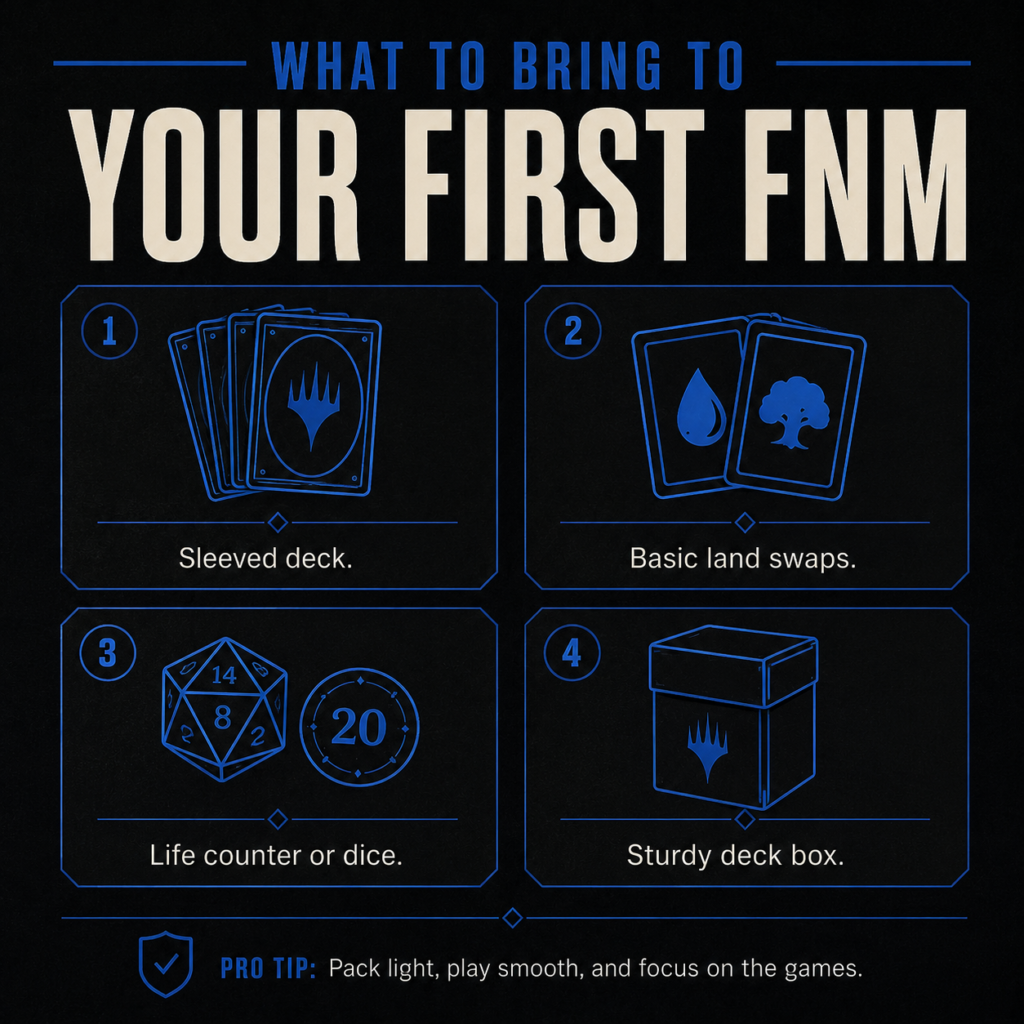
Pack light but pack right. A sleeved deck is the baseline. Sleeves protect your cards and keep shuffling smooth, and most stores expect them as standard practice.
Bring basic land swaps too. If your deck needs specific dual lands or fetches you don’t own yet, whatever substitutes keep your manabase functional will do for a first night.
You’ll also want a life counter or dice, since your phone works in a pinch but a dedicated counter or a stack of d10s is faster and less distracting. Round it out with a deck box sturdy enough to survive a backpack.
If you’re building out your paper kit from scratch, our guide to sleeves, storage, and deck boxes covers what actually holds up as your collection grows, rather than what looks good on a shelf.
🤝 Etiquette: How to Be a Great Opponent
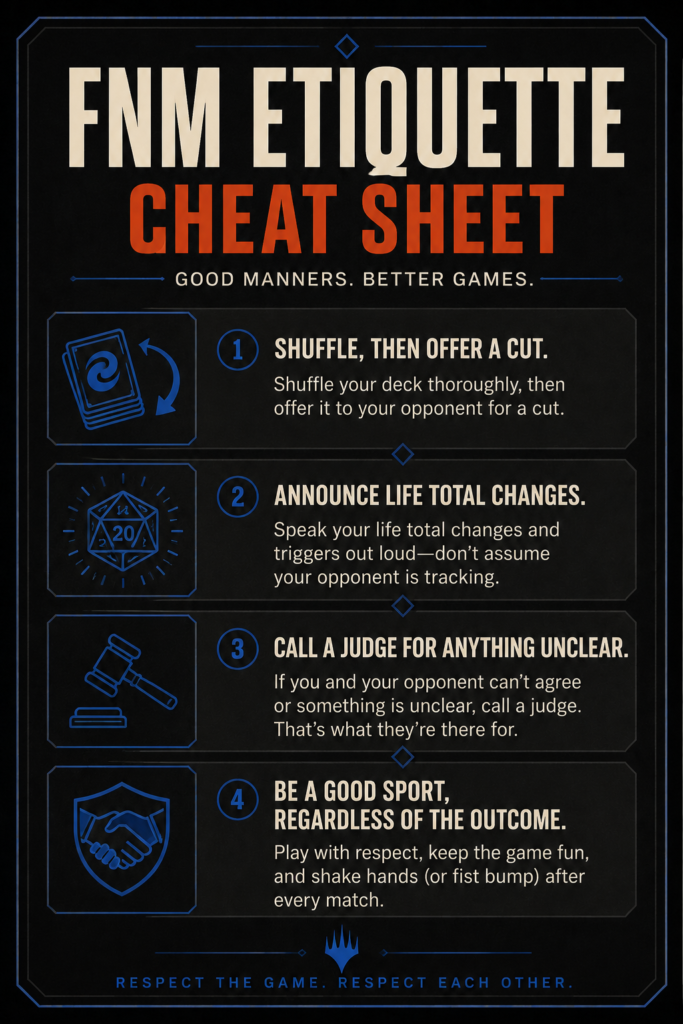
Paper Magic runs on a few social conventions Arena handles invisibly. Shuffle your own deck thoroughly, then offer it to your opponent for a cut, never a full reshuffle unless something’s clearly wrong.
Announce your life total changes out loud rather than assuming your opponent is tracking them. The same goes for triggers you control: state them, don’t just resolve them silently.
Good sportsmanship matters more at Regular REL than almost anywhere else in competitive Magic. Answer questions about your board state honestly, don’t stall to run out the clock, and shake hands or bump fists at the end of a match regardless of the result.
If you’ve been to a paper prerelease before, a lot of this etiquette will already feel familiar. If you haven’t, our guide on drafting a paper prerelease covers the same in-person conventions from a different angle and is worth a skim before Friday.
⚖️ Judge Basics: When and How to Call a Judge
Most FNM events run without a certified judge on site, but there’s always a floor judge, often the store owner or a trusted regular, who can make rulings. Call them over for anything you and your opponent can’t resolve together.
That includes unclear card interactions, a missed trigger you’re not sure how to fix, or a dispute about game state. Don’t worry about looking inexperienced. At Regular REL, calling a judge is expected behaviour, not a sign you don’t know what you’re doing.
Common newcomer questions cover how stack interactions resolve, whether a specific ability triggers automatically, and how to fix a mulligan gone wrong. Judges at this level are there to teach as much as to rule.
🎲 Bo1 vs Bo3: Why Paper Plays Differently Than Arena
If you’ve spent your Arena time in Standard ranked, you’ve probably lived almost entirely in Bo1. FNM flips that. Matches are Bo3 by default, best two games out of three, which changes how you should think about deckbuilding and in-match decisions.
The biggest shift is sideboarding. Between games one and two, you get a short window to swap up to fifteen cards from your sideboard into your main deck, adjusting for whatever your opponent just showed you. That’s a skill Arena’s Bo1-heavy Standard ladder rarely asks you to build.
Our full comparison of Bo1 vs Bo3 on MTG Arena breaks down the strategic differences in more depth, and most of it applies directly to paper, since the underlying match structure is identical.
🚀 Your Game Plan for Match One
Show up early, get your deck checked if your store offers it, and treat round one like practice even if it counts. You’ll misremember a rule, you’ll probably lose a game to something Arena never would have let happen, and that’s completely normal.
If you’re building your first paper deck on a budget, several of our budget Standard deck lists translate well from Arena to paper with minimal substitutions. Once you’ve got a few FNMs under your belt, our guide to upgrading your deck without wasting resources applies the same wildcard-efficient thinking to paper card purchases.
Many stores also run Commander pods alongside their Standard FNM. If singleton multiplayer sounds more your speed, Commander deckbuilding 101 is worth a read before you show up.
You already know how to play. Friday night is just paper, dice, and a slightly friendlier rulebook. Go build your sideboard.
🧭 Continue Your Journey
- Testing Your Paper Deck on MTG Arena Before You Buy
- MTG Arena in 2026: Which Format Should You Actually Be Playing?
- Sleeves, Storage, and Deck Boxes
- Drafting a MTG Paper Prerelease: What First-Timers Get Wrong
- Bo1 vs Bo3 on MTG Arena
- 5 Budget Standard Decks for MTG Arena
- From Budget to Meta: Upgrade Your MTG Arena Deck
- Commander Deckbuilding 101