
As an Amazon Associate I earn from qualifying purchases and sometimes recommend products from other sellers at no extra cost you. For more details see my disclosure policy and privacy policy.
You’re not short on wildcards. You’re short on a plan.
That’s the honest diagnosis for most free-to-play Arena players who feel perpetually stuck — grinding daily quests, opening packs, watching their wildcard count inch upward, and still feeling like they’re one deck behind the curve. The problem isn’t the economy. The problem is that wildcard decisions are a genuine strategic puzzle, and most Arena content treats them like an afterthought.
If you’ve already built one of the budget Standard decks we covered earlier and you’re ready to push toward something more competitive, this guide is the one you’ve been missing. We’re going to treat wildcard management the way a strategy game treats resource allocation — because that’s exactly what it is.
Why Wildcard Decisions Matter More Than You’d Think
Free-to-play Arena is built around scarcity. Rare wildcards are the scarcest resource in the system — a player completing daily quests and opening one pack per day earns roughly one rare wildcard every six days. A fully tuned meta deck typically requires twenty to thirty rares. Do the maths and you’re looking at weeks, sometimes months, of accumulation before that deck is playable.
The real trap isn’t the grind — it’s the mis-craft. Unlike most games with collection systems, Arena doesn’t let you recycle cards. Once a wildcard is spent, the decision is permanent. A rare spent on a narrow pet card today is a rare that isn’t going toward a cross-deck staple next week, and that delay compounds over time in ways that are easy to underestimate.
Think of it like building an engine in a Eurogame where you only receive one premium resource token every few turns and can never reassign it. You don’t spend those tokens on situational plays. You spend them on the tile that slots into five different engine configurations. That’s the mental model worth carrying into every wildcard decision you make.
Most mainstream Arena content sidesteps this entirely. It assumes you can simply “craft the list” — which helps nobody grinding F2P. The actual skill is deciding which cards to craft, in which order, so your win rate improves with every single wildcard spent.
The Three-Point Framework for Evaluating Any Craft
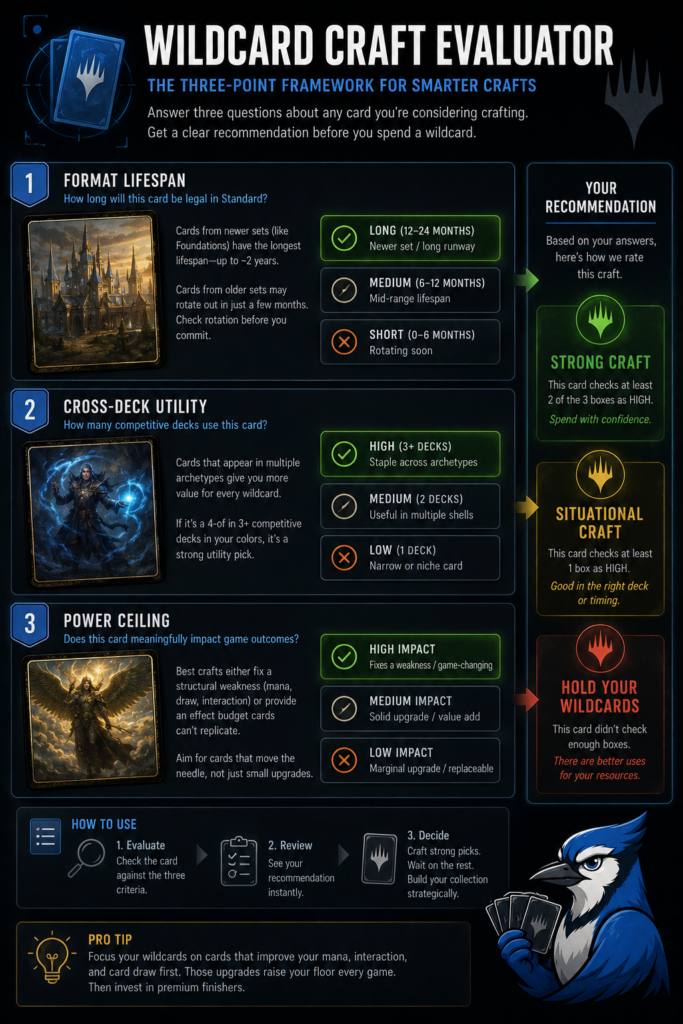
Before spending a rare or mythic wildcard, every potential craft should clear at least two of three criteria: format lifespan, cross-deck utility, and power ceiling. Running through this checklist takes about sixty seconds and eliminates the majority of regrettable crafts.
Format Lifespan
Standard cards rotate on an annual cycle, typically in autumn. Cards from recently released sets have the longest possible Standard lifespan — often close to two full years. Cards from older sets already in the format may have only a few months remaining before rotation removes them from the legal card pool.
The practical question is straightforward: will you still be playing this card in twelve to eighteen months? If a card is from a set leaving Standard in the next rotation window, its wildcard value drops dramatically unless you plan to grind heavily with it in the near term. Cards in sets like Foundations, which are designed as evergreen-adjacent anchors, tend to be among the safest long-term crafts in the format. Check rotation dates before committing — MTG Arena enforces legality automatically, and the client clearly shows which sets are currently legal in each format.
Cross-Deck Utility
A card that appears across multiple archetypes offers fundamentally better wildcard return than a card locked into a single strategy. This is the principle that separates experienced Arena players from those who perpetually feel behind: the best crafts aren’t the most powerful card in one deck — they’re the most useful card across many decks.
The highest-utility crafts typically fall into a few categories. Dual lands and tri-lands in your primary colours belong here, because mana fixing carries over into virtually every list you build in those colours. Cheap interaction — two-mana removal spells, one-to-two mana counterspells — appears across control, tempo, and midrange shells alike. Generic card advantage pieces, the kind that generate value without requiring a specific archetype to function, belong in this tier as well.
A practical rule worth writing down: if a card appears as a four-of in three or more competitive decks that share its colours, it’s almost certainly a strong wildcard craft regardless of the specific deck you’re building right now.
Power Ceiling
The third filter is the hardest to assess, but also the most important. You’re asking whether this card meaningfully changes game outcomes, or whether it’s a marginal upgrade to something you could already approximate with commons and uncommons.
The best crafts do one of two things: they fix a genuine structural weakness in your deck — usually the mana base, card draw, or lack of interaction — or they provide an effect that a budget substitute simply cannot replicate. This connects directly to the budget Standard deck upgrade philosophy of prioritising mana first, engine second, and premium payoffs last. That sequencing is a power-ceiling heuristic in practice. Smooth mana raises the floor of every game you play; a flashy mythic finisher raises the ceiling of a smaller percentage of games. Floors tend to matter more than ceilings when you’re incrementally building a collection.
Finding High-Efficiency Crafts: Becoming a Metagame Analyst
The difference between a player who crafts efficiently and one who doesn’t usually comes down to whether they approach the meta as an analyst or as a net-decker. Net-deckers copy a single list and craft it top to bottom. Analysts identify patterns across multiple lists and prioritise the cards that appear in the highest overlap.
Step One: Start from Archetypes, Not Single Decks
Pick three to five archetypes you genuinely enjoy playing. This matters because enthusiasm sustains playtime, and playtime is how you earn the wildcards to complete those decks in the first place. Pull up a current tier list — MTG Arena Zone and Untapped.gg both publish reliable data — and find all the competitive lists within your preferred colours and playstyles.
Step Two: Map the Overlaps
Look across those three to five archetypes and identify what they share. Lands that appear in multiple lists are almost always your first crafts. Shared removal or counterspells come next. Engine pieces that appear across archetypes — card advantage permanents, early threats that slot into different contexts — follow after that.
A simple method: list card names in one column, then put each archetype in subsequent columns, marking where each card appears. The cards with the most marks across your archetypes are your highest-priority crafts. This is literally set collection optimisation — you’re maximising wildcard utility across several engines, not maximising the individual power of a single deck.
Step Three: Check Your Current Collection
Arena’s built-in tools are underused for this. The “Not Collected” filter shows you exactly which cards you’re missing, and importing a net deck via the deck builder highlights all the gaps in one view. External tools that sync your collection — sites like AetherHub and MTGDecks.net — let you compare your current holdings against multiple archetypes simultaneously and estimate how many wildcards each completion would require. Use these before you commit to anything.
Upgrade Order for the Three Core Archetypes
If you’ve been working through the aggro, tempo, and engine archetypes — the three strategic pillars covered in the control, aggro, and midrange guides on this site — here’s how to think about upgrade sequencing for each.
Aggro Upgrade Order
Start with premium one- and two-drops — rare threats at the bottom of your curve that either hit harder than the commons they replace or provide resilience through keywords like ward, protection, or card draw on attack. These crafts raise the consistency of your fastest draws, which is where aggro decks win or lose.
After your low curve is strong, move to your anthem and burn suite: the payoffs that scale your entire board or provide reach to close out games your commons can’t finish. Creature-lands and utility lands come next, followed by sideboard rares for common matchups. Mythic finishers are genuinely your last crafts in aggro — your win rate improves far more from smoothing your early curve than from adding a powerful five-drop.
Tempo and Spells Upgrade Order
Tempo decks live and die by their interaction suite. Start with cheap counters, bounce spells, and removal that let you hold up mana without wasting turns. These crafts directly enable the core game plan before you’ve added a single premium threat.
Flash threats with built-in protection come next — rares you can deploy at instant speed without telegraphing your intentions or walking into removal. After your interaction and threats are set, upgrade the mana base with rare duals and any spell-lands that add flexibility. Narrower engine cards, the ones that are powerful but deck-specific, should be your final crafts once the foundation is stable.
Engine and Enchantments Upgrade Order
Start with the core payoff rares — the cards that trigger on every landfall, enchantment cast, or relevant game action. Avoid crafting the rares that require fragile setups to function; go for the ones that generate value consistently throughout the game.
Utility lands and value engines follow: permanents that convert your resources into incremental advantage across multiple turns. Resilient mythic finishers — the top-end cards that close out games once your engine is online — are your final crafts here. The engine enables the finisher; the finisher alone doesn’t win without the engine underneath it.
The table below captures the sequencing at a glance:
| Archetype | First Crafts | Second Crafts | Last Crafts |
|---|---|---|---|
| Aggro | Premium 1–2 drops | Anthems / burn suite | Big mythic finishers |
| Tempo / Spells | Cheap interaction | Flash / protected threats | Narrow engines / top-end spells |
| Engine / Combo | Core payoff rares | Utility lands and value engines | Mythic finishers |
When to Go Full Meta vs. Keep Iterating Budget
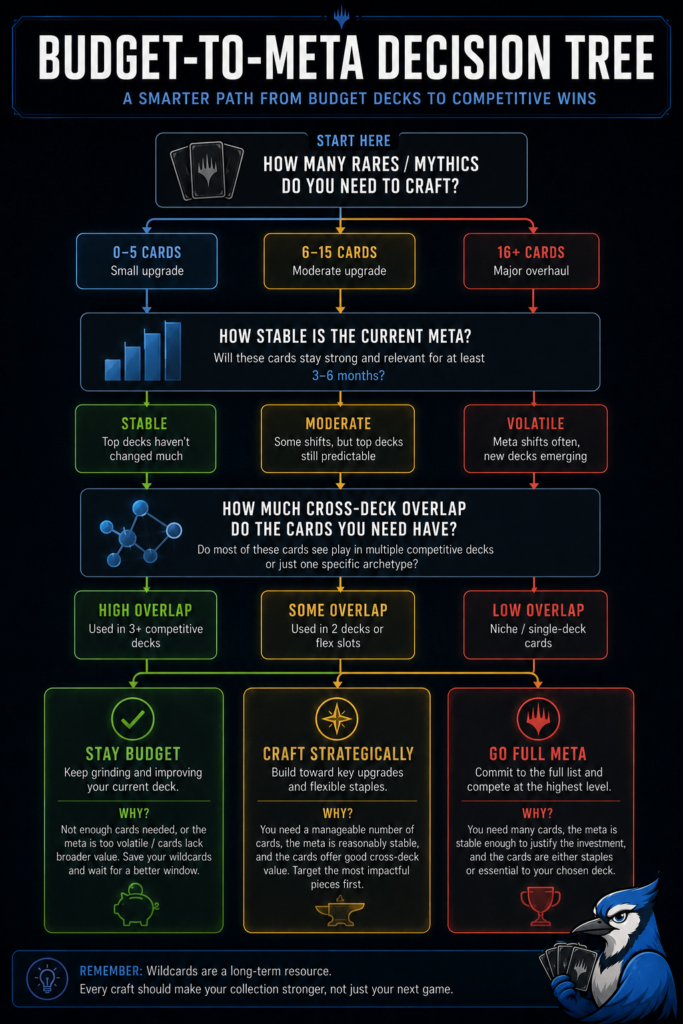
This is the question most guides avoid, so let’s make it concrete. Staying on a budget shell makes sense in three situations.
You’re still learning the archetype. Budget decks in lower-stakes queues are a testing environment, and twenty to thirty games often reveals whether your losses stem from the deck’s actual power ceiling or from unfamiliarity with the play patterns. Solve that question before spending wildcards.
Your wildcard bank is low. Crafting half a meta deck frequently produces a weaker, more inconsistent result than the budget shell you started with. If you can’t realistically complete all the key rares and mythics within two to three weeks of normal play, wait until your stockpile can support the full upgrade rather than an awkward hybrid.
The meta is in flux. After major set releases or ban announcements, the tier list can shift dramatically within days. An adaptable budget shell often performs better in volatile metas than a half-built deck tuned to a snapshot that’s already obsolete.
Moving into a full meta deck makes sense when you can complete all the key rares and mythics in one or two crafting sessions — where “key” means the lands, engine pieces, and core threats, not the sideboard upgrades. It also makes sense when the archetype overlaps heavily with future decks you want to build. White aggro staples commonly carry into Orzhov midrange or Azorius tempo; red burn effects cross over into Izzet spells shells. The more your target deck shares with other archetypes in your colours, the better the wildcard investment looks. A useful decision rule: if a deck requires more than fifteen rare or mythic crafts you don’t own, and fewer than sixty percent of those cards appear in other top lists you want to play, keep stockpiling and stay on the budget build.
Tracking Your Collection Like a Strategist
The final piece is treating your Arena account as a long-term engine-building project rather than a series of one-off decisions. This is exactly the strategic mindset that carries over from complex board games into digital card games — the ability to model a system over time rather than optimise for the immediate state.
Understanding Your Wildcard Income
Arena’s wildcard economy follows predictable patterns. The rare wildcard track awards one rare wildcard for every six packs opened. The mythic wildcard track produces approximately one mythic per twenty-four packs via the mythic track progression. The Vault — which fills as you open duplicate commons and uncommons — yields one mythic, two rares, and three uncommon wildcards when completed.
From these numbers, a player opening one pack daily from quest gold earns roughly one rare wildcard every six days. Knowing your income rate helps you set realistic timelines for completing upgrade targets and prevents the trap of treating wildcards as a renewable resource that will “come eventually.”
The Vault Acceleration Trick
One underused technique: spend common and uncommon wildcards to complete your common and uncommon playsets from a new set before opening packs. Every card you collect through wildcards rather than pack openings pushes more of your actual pack openings into the duplicate bucket, which accelerates Vault progress. Depending on your pack volume per set cycle, this can yield an additional four to six rare and one to three mythic wildcards — a meaningful gain for free-to-play players.
A Weekly Tracking Routine
Keep a simple log, updated once a week: your current rare and mythic wildcard counts, which packs you’ve opened from your primary Standard sets, and which staples you still need for your key colour combinations. Maintain a “next ten crafts” list and stick to it unless the meta changes significantly.
The discipline of having a concrete upgrade queue does two things. It prevents impulsive crafts driven by whatever deck you just lost to in ranked. And it gives you a clear picture of how long until your target deck is complete, which makes the grind feel like progress rather than treading water.
Wildcard Management Is Standard’s Hidden Strategy Layer
Most Arena players treat wildcards as a currency. The better framing is that they’re a scarce, non-renewable resource in a long-horizon strategy game — and decisions you make now about how to deploy them will determine which archetypes you can pilot competitively six months from now.
The framework here — lifespan, cross-deck utility, power ceiling — gives you a repeatable decision process rather than a one-time shopping list. The upgrade sequencing for each archetype gives you a priority order that improves your win rate incrementally rather than all at once. And the collection tracking habits turn the whole process into something you can actually manage deliberately rather than just hoping the wildcards accumulate fast enough.
Apply this as a strategic resource management problem, and the Arena economy stops feeling like an obstacle. It becomes the game inside the game.
Continue Your Journey
- 5 Budget Standard Decks for MTG Arena (5 Rares or Fewer) — the foundation before the upgrades
- Control on MTG Arena: How to Actually Win — upgrade pathing for the control archetype
- Aggro on MTG Arena: Why Fast Decks Reward Strategic Thinking — the complete aggro guide
- How to Play Midrange on MTG Arena — for players upgrading engine-based decks
- MTG Arena in 2026: Which Format Should You Actually Be Playing? — format context for every wildcard decision
What’s your current wildcard situation — are you building toward a specific archetype, or still figuring out which upgrade path makes the most sense for your collection? Let us know in the comments below.
Want a free guide covering formats, wildcards, and how to approach your first ranked season on Arena? Sign up below and we’ll send it straight to you.