
As an Amazon Associate I earn from qualifying purchases and sometimes recommend products from other sellers at no extra cost you. For more details see my disclosure policy and privacy policy.
You are about to open the box, the table is buzzing, and someone has just said the sentence that derails every first game: “I’ll just pick whoever looks cool.” Three turns later, your whole party is great at fighting, hopeless at everything else, and staring at a clue count that refuses to move. Arkham Horror is a cooperative game, so the investigators you pick matter far more as a group than they ever do alone.
This guide is about pairing and grouping investigators in Arkham Horror (Third Edition) so that one player’s weak spot is another player’s strong suit. It covers the core-box investigators only, and it assumes you are still working out the basics.
If you want the turn-by-turn mechanics first, our plain-English Third Edition rules guide is the place to start. Come back here once you can name the four phases of a round.
🧩 What “Combo” Means in This Game
In a deck-builder, a combo is two cards that break the game. Here it is gentler and far more useful: a combo is a group of investigators whose strengths cover each other’s gaps. You are not hunting for a loophole, you are building a team with no obvious hole in it.
Every investigator in the core box has five stats: Knowledge, Influence, Observation, Strength and Will. Each also has a Stamina and Spirit pool, one or two role tags, and a single signature ability. When you read a character card, ask three questions: what are they good at, what are they bad at, and who else at the table fixes that?
The game asks your party to do three broad jobs, and a good first group covers all of them.
- Clue gathering: finding the clues that push a scenario forward, which leans on Observation and Knowledge.
- Combat: dealing with monsters before they grind the group down, which leans on Strength.
- Horror cover: surviving fear and weird encounters, which leans on Will and a healthy Spirit pool.
Influence sits slightly apart, because it is mostly about money, allies and favours. It is easy to ignore until you need it, which is exactly why a party with nobody strong in it feels stuck.
One housekeeping note: this post covers the Third Edition only, and every investigator named here comes from the core box.
🎲 How to Pick a Party by Player Count
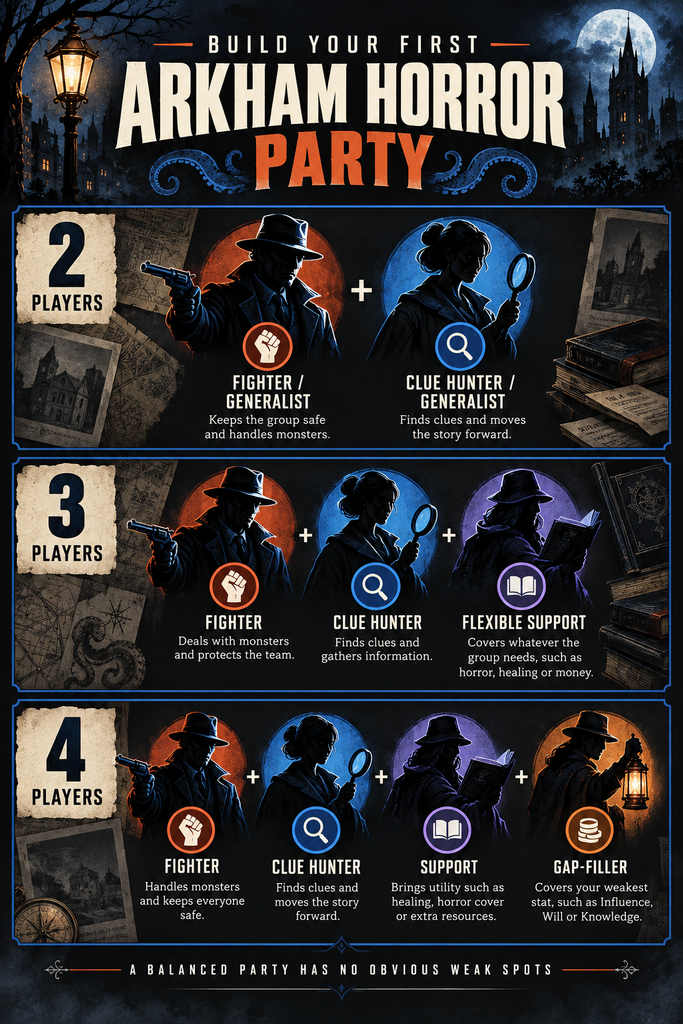
The right amount of coverage changes with the number of people at the table. Fewer investigators means each one has to be a little more rounded, because there is nobody else to lean on. Bigger groups can afford specialists.
One or Two Players
Choose sturdy generalists with no stat at the bottom of the scale. In a two-player game, aim for each investigator to be competent at everything and brilliant at one thing, and make sure the two “brilliant” things are different. A solo player running two investigators should think of them as a single party with a front-line character and a clue hunter.
If you are playing completely alone, our look at how solo play changes strategy explains why generalists beat specialists when nobody can cover for you.
Three Players
Three is the sweet spot for a first game. You can have one fighter, one clue hunter and one flexible player who patches whatever goes wrong. Aim for the three jobs above and let each person own one of them.
Four Players
With four, you can afford a specialist in each corner plus a fourth player who fills the stat your group is shortest of. The danger at four is not weakness but duplication. Two people chasing the same job means two others are quietly doing nothing useful.
🛡️ Five Beginner Pairings and Parties That Work
All of these use only core-box investigators. Role tags and abilities are summarised below, and each entry explains why the group works and what it costs you. Check the card in your own box before you commit, since the card is the final word.
Tommy Muldoon and Minh Thi Phan: The Steady Duo
Tommy Muldoon is a Guardian and Survivor whose ability lets him step in when a monster would engage another investigator in his space. Minh Thi Phan is an Observer and Survivor who can reroll dice, up to the number of clues in her area, for herself or an investigator sharing her space.
Why it works: Tommy soaks up the monsters while Minh turns clues into reliable successes. Neither character has a glaring weak stat, which is exactly what you want in a two-player first game.
The trade-off: neither is a standout specialist, so you will win by steadiness rather than spectacle. Expect a lower ceiling, but also far fewer disasters.
Michael McGlen and Norman Withers: The Brawler and the Brain
Michael McGlen is an Outlaw and Guardian with the highest Strength of the core group, and he recovers Sanity or channels an ability after defeating a monster with an attack. Norman Withers is an Explorer and Mystic with strong Will, Knowledge and Observation, who can take a Horror to study a clue after removing Doom.
Why it works: this is the cleanest example of mirrored weaknesses in the box. Michael is weak in Observation, which is Norman’s strength, while Norman is weak in Influence, which is Michael’s strength.
The trade-off: both are relatively light on Influence-style tools compared with a dedicated money character. Norman also takes Horror to power his ability, so he needs Michael standing in front of the scary things.
Tommy Muldoon, Agnes Baker and Marie Lambeau: The Three-Player Anchor
Tommy is your shield. Agnes Baker is a Mystic and Guardian with strong Knowledge who can take damage instead of Fear when casting spells. Marie Lambeau is a Mystic and Survivor with strong Influence whose ability lets another investigator copy an action she has just taken.
Why it works: you get one front-liner, one spell-slinger with a defensive streak, and one support character who makes the whole table more efficient. Marie’s ability rewards a table that talks, which makes it a lovely first-game teacher.
The trade-off: two of the three are Mystics, so your Strength is thin. Tommy has to do the heavy lifting in combat, and Marie works best when you plan her action with the group first.
Michael McGlen, Minh Thi Phan, Dexter Drake and Jenny Barnes: The Four-Player Table
Michael is the fighter and Minh is the clue engine. Dexter Drake is a Mystic magician with the highest Knowledge in this group, who can reroll one or all dice once per round when testing Knowledge. Jenny Barnes is an Outlaw with strong Influence whose action gives her money when she is short.
Why it works: Jenny is weak in Knowledge, which Dexter covers, and Michael is weak in Observation, which Minh covers. Dexter is soft in combat, and Michael is the answer. Everybody has a clear job from turn one.
The trade-off: Will is not the group’s strength, so fear-based tests can sting. If your table is nervous about the horror side, swap Jenny for Norman Withers.
Wendy Adams and Daniela Reyes: The Mirror Pair
Wendy Adams is a Survivor and Observer with the best Observation in the box, and she can move up to two hexes for free around an Evasive action to slip away from enemies. Daniela Reyes is an Outlaw and Survivor with a sturdy Stamina pool, whose ability lets her focus an ability of her choice after Gather Resources.
Why it works: Wendy is fragile but sees everything, and Daniela is tough but misses things. Each is weak exactly where the other is strong, and both are Survivors, so they keep each other alive.
The trade-off: Wendy’s movement trick takes a moment to grasp, so this duo suits players who like a small puzzle. Neither is a pure fighter, so combat will be about avoidance rather than brute force.
⚠️ Combos to Avoid on a First Play
The most common mistake is overlapping weaknesses. If two investigators are both poor at the same stat, the party has a hole that nobody can plug. Watch for these.
- Norman Withers with Wendy Adams: both are weak in Influence, and both have low Stamina. One bad monster encounter and you have two fragile characters and no money to fix it.
- Four low-Stamina casters: stacking Norman, Dexter, Marie and Wendy gives you terrific clue skills and almost no staying power. The first couple of fights will flatten you.
- Two characters who both need setup: Calvin Wright’s ability trades health and sanity with another investigator or ally, and Wendy’s movement trick takes practice. Put both in one new party and every turn becomes a puzzle.
- Rex Murphy in a first game: his ability means only a 6 counts as a success on his tests, which is a very different feel from the rest of the box. Save him for a second playthrough.
None of these is unplayable, and experienced groups enjoy the risk. They are simply a poor use of a first evening.
For a wider view of how cooperative games punish lopsided teams, our horror board game strategy guide covers managing fear across a group.
🗣️ Fast Table Advice: Who Takes Which Role
New players freeze when they are handed twelve cards and told to choose. Give them a job, not a menu. Ask “who wants to be the one who fights, the one who finds clues, or the one who keeps everyone sane?” and let people claim a role before they look at names.
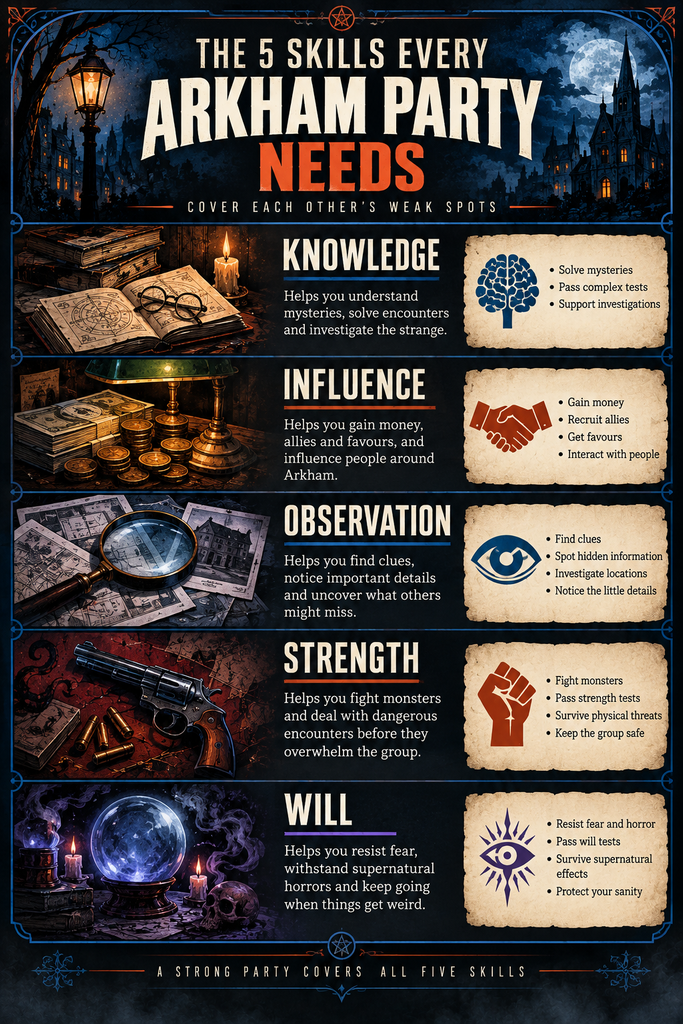
Then match the role to the investigator. Fighters look at Strength and the Guardian tag, and clue hunters look at Observation and Knowledge. Support players look at Influence and abilities that help others.
If the group genuinely cannot decide, use one of these tricks.
- Role first, face second: each player picks a job, then picks any investigator who fits it.
- Deal and swap: deal each player two investigators at random, let them keep one, and allow swaps with neighbours.
- Pick a template: choose one of the five parties above and let people pick which character they want within it.
Keep an eye on one thing as you go. A confident player can end up making every decision for everyone, which is the classic alpha player problem in co-op games. Let the person who owns an investigator decide what that investigator does.
Good role assignment also helps once the game starts. Our guide to communication and role assignment in cooperative games goes deeper on keeping a table talking without anyone taking over.
🔄 When to Swap Investigators
After three or four games, you will start to feel which parts of the game keep catching you out. That is your cue to swap. Do not change everyone at once, because you want to learn what the change actually does.
A few signs it is time:
- You keep running out of money, so add or promote an Influence-heavy character.
- Fear is eating your group, so bring in a high-Will investigator.
- Combat is dragging, so swap in someone with a higher Strength and a strong defensive ability.
- A particular character feels dull, so try one of the trickier investigators such as Calvin or Rex.
This is also the moment to try the more demanding characters you avoided on night one. If you enjoy learning how cooperative games scale, our look at cooperative games by difficulty level shows where Arkham Horror sits on the ladder.
If you are building a bigger party-management habit across games, the thinking in our Gloomhaven character synergy guide transfers surprisingly well. The principle is the same: cover each other’s gaps first, then chase your favourite builds.
🏁 Final Thoughts
Good Arkham Horror parties are built on coverage. Make sure someone can fight, someone can find clues, someone can keep their head, and nobody shares a hole with their neighbour. If you remember only one rule, make it this: pick the investigators whose weak stats are your friends’ strong ones.
Start with one of the five parties above, play a scenario or two, and then start swapping. If you are still deciding whether the game suits your group, our Arkham Horror vs Eldritch Horror vs Mansions of Madness comparison will help. If you want to see how the same idea plays out in another Lovecraftian box, try our Eldritch Horror beginner investigators guide.
When you are ready for a fresh copy, you can pick up the Third Edition core box here and start building your first party.
🧭 Continue Your Journey
- Arkham Horror Board Game Rules: A Plain-English Guide to Third Edition
- Best Eldritch Horror Investigators for Beginners
- Horror Board Game Strategy: Managing Fear and Cooperation
- Cooperative Strategy Guide: Communication and Role Assignment
- Best Cooperative Games by Difficulty Level
- Best Horror Board Games for Every Scare Tolerance Level