
As an Amazon Associate I earn from qualifying purchases and sometimes recommend products from other sellers at no extra cost you. For more details see my disclosure policy and privacy policy.
Release week for a new Magic set is not one event. It is two, running on different calendars, with different crowds, different currencies and a different kind of energy.
On Arena, the new cards simply appear one morning and the queue fills up. At your local store, the same set shows up as a Friday night prerelease, a stack of booster boxes behind the counter and a table of people trading rumours about which rare is going to be a bomb.
If you play in both places, the interesting question is not which is better. It is what actually changes in each one on release week, and where your time is best spent.
This post uses the most recent set as the worked example: Magic: The Gathering | Star Trek, which has just gone through its launch. Every date and event below comes from Wizards of the Coast’s own announcements, and I have flagged where something could not be confirmed.
📅 One Release, Two Calendars
The first thing to notice is that the two launches do not start on the same day. For Star Trek, Wizards listed the paper prerelease as 6 to 12 November 2026, Arena going live on 10 November, and the global tabletop release on 13 November.
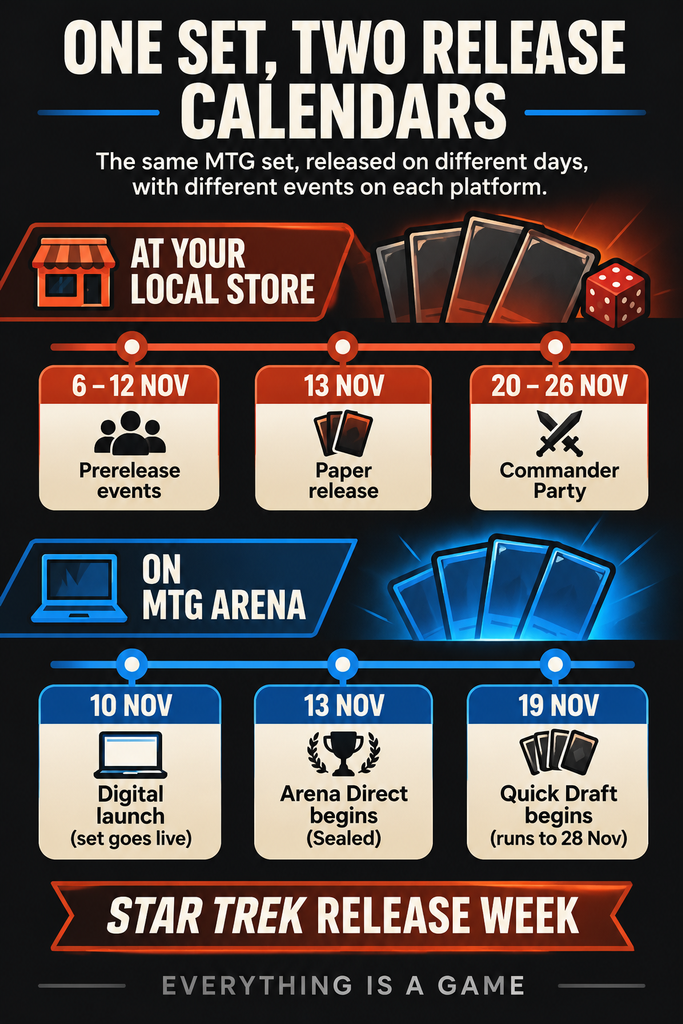
That means Arena players got their hands on the set in the middle of prerelease week, and three days before the paper release. If you went to a prerelease on the first weekend, you were playing the cards on paper before they were on Arena, and by the time you got home they were live.
| Date (2026) | At the store | On Arena |
|---|---|---|
| 6 to 9 November | Prerelease events | Not yet live |
| 10 November | Prerelease events continue to 12 November | Set goes live |
| 13 November | Global tabletop release | Arena Direct Sealed entries open |
Not every set lines up this way, and Wizards sometimes shifts the order. Treat this as the pattern for one release, then check the announcement for the next one.
💻 What Changes on Arena Day One
On Arena, day one means the new cards enter the game, set packs become available to open, and a new round of rewards and events begins. It is fast, it is available from your sofa, and it is gated by the in-game currencies rather than by who lives near a store.
For Star Trek, Wizards also launched a Set Mastery track, set achievements and a run of event offerings from the first day. If you want to understand how gold, gems and wildcards turn packs into playable decks, our Arena wildcard economy guide covers it, so I will not repeat it here.
Which Events Are Live on Day One
According to Wizards’ event schedule, several Limited events started on 10 November and run to early 2027: Premier Draft, Traditional Draft and Pick-Two Draft, all running until 2 February. Star Trek Sealed also began on day one, with Traditional Sealed running until 24 November.
Quick Draft did not start with the set. Wizards’ schedule shows Star Trek Quick Draft running from 19 November to 28 November, after another set’s Quick Draft run finishes.
If you are not sure which draft mode suits you, our breakdown of Traditional, Quick and Premier Draft explains the differences.
Extras Worth Knowing About
Arena Direct is a Sealed event where the top prize is physical product. For Star Trek, the Wizards page lists Best-of-One Sealed from 13 November, with a Star Trek Collector Booster box for seven wins, while supplies last.
Wizards also ran preorder bundles on Arena before launch, and a series of Sealed qualifier days for competitive players. I could not confirm from Wizards whether the set includes any digital-only cards or Alchemy additions, so check the release notes if that matters to you.
🏪 What Changes at Your Local Store
At the store, release week is about people, tables and a physical product you can touch. The star of the week is the prerelease, where you open a pack, build a deck on the spot and play it that evening.
For Star Trek, Wizards listed a Prerelease Pack containing 6 Play Boosters, a traditional foil rare or mythic rare, a deck box and a spindown die. Our guide to drafting at a paper prerelease covers what first-timers get wrong, so I will leave the format advice there.
Release Weekend and Beyond
After the prerelease, many stores run Draft and Sealed events around the paper release date, and some run casual Commander nights. For Star Trek, Wizards also listed a Commander Party round from 20 to 26 November, so ask your store whether they are taking part.
If you have never been to a Friday night event, our first FNM guide will help you walk in without nerves.
Products and Promos
The product range is a big part of what changes in the store. Wizards listed Play Boosters, Collector Boosters, a Bundle, a Draft Night box and a Beam Me Up Bundle that includes promo cards, among other products.
If you pick up a few boosters, a pack of card sleeves is handy for protecting anything you plan to play, and a trading binder keeps promos and foils tidy. Some stock may arrive late in certain regions, so ask your local store what they have before you travel.
🔍 Release Week at a Glance
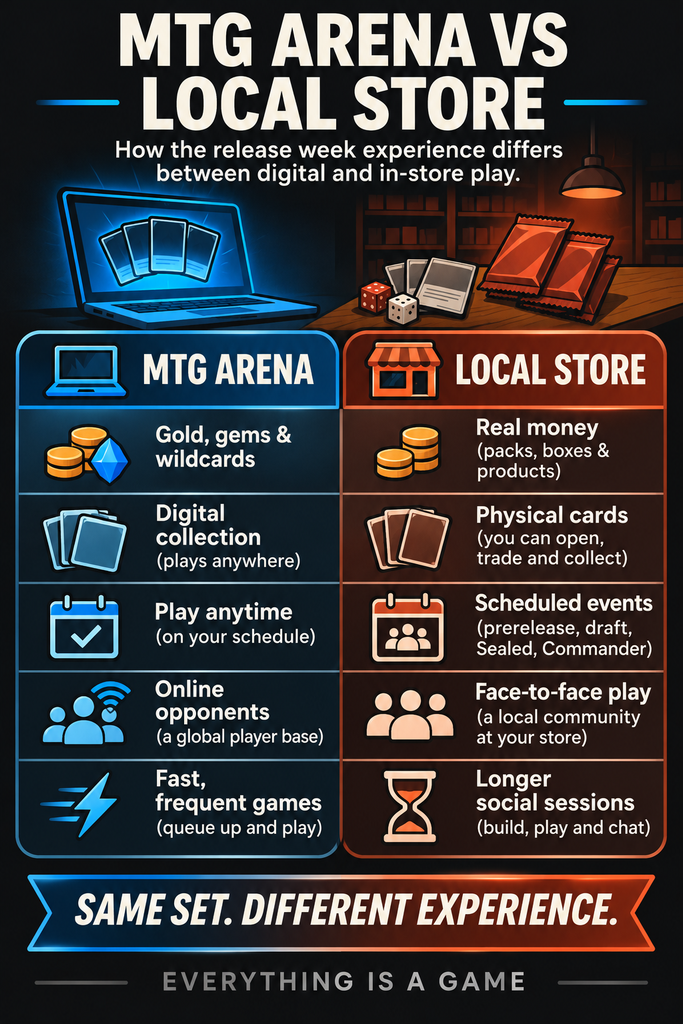
Here is the whole comparison in one place, so you can see where the two experiences genuinely differ.
| Arena | Local store | |
|---|---|---|
| How you get the cards | Open packs with in-game currency, or spend real money in the client | Buy product or singles, or receive a Prerelease Pack |
| When it starts | Set live on 10 November | Prerelease from 6 November, release on 13 November |
| How you play | Queue any time of day | Scheduled events at set times |
| Who you play | Strangers online | People in the room |
| What you keep | A digital collection | Cards in your hands |
The table hides one more difference, which is pace. Arena lets you play many short games in an evening, while a prerelease gives you a handful of long, chatty rounds with the same people.
Neither pace is better. They scratch different itches, and knowing which one you want on a given week is half the decision.
What Does Not Change
Some things stay the same whichever side you play. The cards are the same cards, the set’s mechanics and themes are the same, and the first week is still a time of high uncertainty about what is actually good.
That uncertainty is worth respecting. Early opinions about a new set are often revised once enough games have been played, so it is fine to hold your judgement loosely for a week or two.
💰 Cost and Access: Two Different Currencies
The biggest practical difference between the two is how you pay and what you get for it. On Arena you spend gold, gems and wildcards, and you build up a collection that exists only in the app.
In a store you spend real money on product or singles, and you leave with cards you can hold, trade and sell. Wizards lists the US recommended price for a Star Trek Play Booster at $6.99, though your local store sets its own prices.
Neither side has a monopoly on value. Arena gives you the convenience of playing whenever you like, and the store gives you cards that live outside the app.
Singles Prices Around Launch
Prices for individual cards often move quickly in the first days after a release. Early hype, early tournament results and the number of boosters opened can all push a card up or down.
That is a reason to be patient about singles rather than a rule. Our piece on trading cards in paper Magic explains how to read what a card is worth without getting swept up in launch week excitement.
Testing Before You Buy
One bridge between the two worlds is that Arena lets you try a deck before committing to cardboard. Our guide to testing a paper deck on MTG Arena shows how to do it, which is especially useful when you are weighing up whether a new archetype is worth buying into.
⚔️ Format Effects: Arena Standard vs the Store Table
A new set changes which cards are available in the formats you play, but not always at the same moment. Wizards’ collecting article describes the main Star Trek set as legal in all formats, while Arena keeps its own list of formats and its own schedule.
Rotation dates can differ between paper and Arena, so do not assume the two calendars match. Check Wizards’ announcement for the date that applies to the platform you are playing on.
For a look at how a set reshapes Standard on Arena, our write-up on how Secrets of Strixhaven changed Standard is a good model for what to watch. If you are comparing how the same deck plays on each platform, MTG Paper vs Arena: Why Your Deck Plays Differently goes into the gameplay side, which this post deliberately leaves alone.
🎯 If You Only Do One Thing on Release Week
There is no single right answer here, because it depends on how you play and where your friends are. These are the questions I would ask, depending on which camp you are in.
If You Are Arena-First
Ask whether you want to draft or build a Standard deck first, because the two paths use your gold and gems differently. Premier and Traditional Draft were live from day one for Star Trek, so you could learn the set on Arena before the paper release.
If you are not sure which format to play, our guide to which MTG Arena format to play in 2026 will help you decide.
If You Are Paper-First
Ask whether the prerelease or the release weekend fits your schedule better. The prerelease gives you the first look at the set with a pack in hand, while the release weekend can be quieter and easier to find a seat.
Either way, check with your store about their event schedule and entry fees, because they set these themselves.
If your local store is busy that weekend, it is worth asking whether they take sign-ups in advance. A seat is the one thing you cannot add later.
If You Play Both
Ask which one gives you more of what you want this week: a social night out, or a lot of repetitions on Arena. A prerelease on paper can teach you the cards, and a few Arena drafts afterwards can tighten that knowledge.
Because the two calendars overlap, you do not have to pick one. The only real cost is your time and attention across a busy week.
🏁 Final Thoughts: Same Set, Different Week
Arena rewards speed and volume, and the store rewards presence and people. Neither is the correct way to play release week, and plenty of players happily do both.
The best habit is to check the announcement for the next set as soon as it lands, so you know how the two calendars line up before the week begins. If you are new to the game altogether, our beginner’s guide to Magic: The Gathering is the place to start.
How do you spend release week, Arena, store or both? Let us know in the comments.
🧭 Continue Your Journey
- Arena Wildcard Economy: Gold, Gems, and Wildcards Explained for New Players
- Traditional Draft vs. Quick Draft vs. Premier Draft: Which Arena Limited Mode Should You Play?
- Drafting a MTG Paper Prerelease: What First-Timers Get Wrong
- MTG Paper vs Arena: Why Your Deck Plays Differently
- Playing Your First FNM: A Nervous Newcomer’s Guide
- Testing Your Paper Deck on MTG Arena Before You Buy: A Practical Guide
- Sleeves, Storage, and Deck Boxes: Protecting a Paper Collection That Actually Grows