
As an Amazon Associate I earn from qualifying purchases and sometimes recommend products from other sellers at no extra cost you. For more details see my disclosure policy and privacy policy.
You’ve decided you want to spend an evening fighting cosmic horrors, losing your sanity, and probably failing to save the world. Solid choice. The problem is that Fantasy Flight Games has given you three distinct ways to do it — and the differences between Arkham Horror, Eldritch Horror, and Mansions of Madness run far deeper than theme.
Same Lovecraftian universe, same Ancient One threats, same doomed investigators. But the experience at the table is completely different depending on which box you open. This comparison breaks down exactly where each game excels, where it struggles, and which one belongs in your collection based on how you actually want to play.
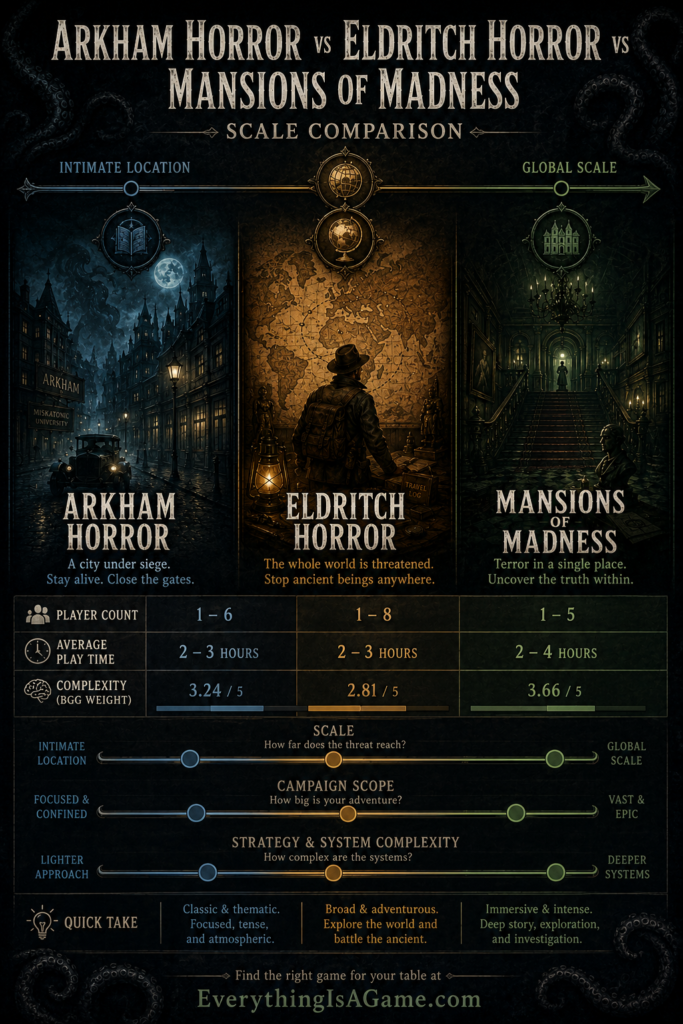
The Core Difference: Scale and Scope
The most useful way to think about these three games is through the lens of geography. Each one frames its horror at a completely different level, and that single design decision shapes everything else about the experience.
Mansions of Madness puts you inside one building. A mansion, an asylum, a museum — the location changes per scenario, but the focus stays tight. You’re following clues room by room, solving slide puzzles, discovering what’s lurking around the next corner. It’s an intimate, claustrophobic kind of horror.
Arkham Horror pulls back to show you an entire city. You’re racing across Arkham itself — the streets, the diner, the university, the woods — trying to close gates before the Ancient One awakens. The horror is still local, but it has room to breathe across a full neighbourhood.
Eldritch Horror takes it global. Your investigators travel by steamship and rail from Istanbul to Buenos Aires, from Cairo to the frozen Antarctic. The Ancient Ones here are threatening the entire world, not just one Massachusetts town. It’s the same game in spirit, but the narrative stakes feel genuinely enormous.
Why Scale Matters Strategically
This isn’t just a thematic difference — it fundamentally changes how you make decisions. In Mansions of Madness, your choices are hyper-local: which door to open, whether to investigate this clue now or keep moving. In Eldritch Horror, you’re managing a global network of investigators, deciding who goes where and accepting that some threats will simply go unaddressed because you can’t be everywhere. The strategic texture of each game is completely different as a result.
Mansions of Madness: The App-Driven Experience
Mansions of Madness Second Edition is the most approachable of the three, and it’s also the most unusual — because the app does a lot of the heavy lifting. Scenario setup, monster behaviour, narrative events, and even some puzzle mechanics are handled digitally, leaving the players free to focus on the story unfolding in front of them.
The app integration is genuinely clever. It handles the game master role that the first edition required a dedicated player to fill, which means everyone at the table is playing cooperatively against the game itself. If you’ve ever tried to run a dungeon-crawl-style game where one person controls all the monsters, you’ll appreciate how much smoother this makes things.
What Mansions Does Best
The production quality is exceptional. Pre-painted miniatures, detailed room tiles, and atmospheric props combine with the app’s narration to create something that feels more like an interactive thriller than a traditional board game. For players who love story-driven experiences — or who’ve been curious about this style of game but are put off by heavy rulebooks — Mansions of Madness is the easiest entry point in the Fantasy Flight horror range.
The puzzle-solving elements add a dimension the other two games don’t have. Slide puzzles, lock combinations, and coded messages appear in scenarios, and while some players find these fiddly, they add genuine variety to what might otherwise be a straightforward investigation loop.
Where Mansions Falls Short
The app dependency is a genuine constraint. Without it, the game doesn’t function — and if Fantasy Flight ever discontinues support, that’s a problem. The replayability is also more limited than the other two games, because scenarios have fixed resolutions that become familiar after a couple of plays. Once you know what’s in the library, the mystery is harder to recapture.
For players who want the kind of solo gaming experience where they’re battling an emergent, unpredictable system, Mansions of Madness is a little more on rails than the alternatives.
Eldritch Horror: The Epic Cooperative Experience
Eldritch Horror is the streamlined successor to the original Arkham Horror, and it improves on its predecessor in almost every mechanical way. The turn structure is cleaner: every investigator completes their actions, then every investigator resolves their encounters, keeping players engaged rather than waiting. Health and sanity recovery is simple — you take a rest action — instead of requiring you to navigate halfway across the board to find a hospital.
The game also has a defined endpoint. The mythos deck establishes the maximum number of rounds from the start, so you always know how long you have and can plan accordingly. That’s a significant quality-of-life improvement over open-ended games where sessions can balloon unpredictably.
What Eldritch Does Best
The global scope gives Eldritch Horror a genuinely epic feeling that the other two games can’t match. When one investigator is in Siberia trying to close a gate while another is in Buenos Aires chasing a lead and a third is in Shanghai about to be devoured by a Shoggoth, the coordination required is thrilling. It scales beautifully, too — the 1–8 player count means it works for almost any group, making it an excellent choice if you’re looking for something for larger gatherings.
The Ancient One variety is impressive, and each one creates a meaningfully different game. Some push you toward closing gates aggressively; others punish specific types of failure. The expansions add even more scope — continents, additional investigators, and thematic content tied to specific Lovecraft stories.
Where Eldritch Falls Short
The abstraction that makes the global scale work also dilutes the local atmosphere. You’re moving cubes around a world map, not walking down a street in Arkham. Players who love location-specific flavour — the kind of detail that makes a city feel like a real place — may find Eldritch Horror a bit thin on texture compared to Arkham Horror or Mansions of Madness.
Eldritch Horror is also still a long game. A full session with a large group can push five hours, and if the dice aren’t kind, that time investment can feel punishing. The game has a reputation for brutal difficulty, particularly against certain Ancient Ones.
Arkham Horror: The Deep Tactical Game
The Third Edition of Arkham Horror rebuilt the game from the ground up, keeping the city-scale setting while tightening the mechanics significantly. Gone are the fiddly street symbols that governed monster movement in earlier editions; the new action system is more focused and the investigator phase runs much more smoothly.
What Arkham Horror offers that the others don’t is the richest sense of place. Arkham itself is rendered in genuine detail — specific shops, streets, and locations each have flavour text and encounter decks. When your investigator collapses outside the Silver Twilight Lodge after a particularly harrowing evening, the city feels like it has a personality. This is the kind of atmospheric game that fans of horror gaming tend to return to season after season.
What Arkham Does Best
The card-driven encounter system gives every location a life of its own. Drawing a street encounter in the Merchant District feels different from drawing one in Uptown, and the variety across the full investigator roster means that even repeat plays of the same scenario can produce wildly different story beats.
The tactical depth is the highest of the three games. Monster movement patterns, gate mechanics, and investigator positioning all require genuine strategic thinking. If you enjoy games that reward close attention to board state and careful planning, Arkham Horror is the most mentally demanding of the trio.
Where Arkham Falls Short
Arkham Horror has a steeper learning curve than the other two. The rulebook is dense, the first session will involve a lot of rule-checking, and the sheer number of tokens and components can make setup and teardown feel like a project. It’s not the right introduction for someone who’s never played a Fantasy Flight investigation game before.
The rules for recovering health also create some frustrating stretches. Unlike Eldritch Horror’s simple rest action, Arkham requires physically travelling to specific city locations — a hospital visit might take two or three turns when you’d rather be closing a gate. Experienced players appreciate this as a meaningful resource constraint; newcomers often find it maddening.
Head-to-Head: How the Games Compare
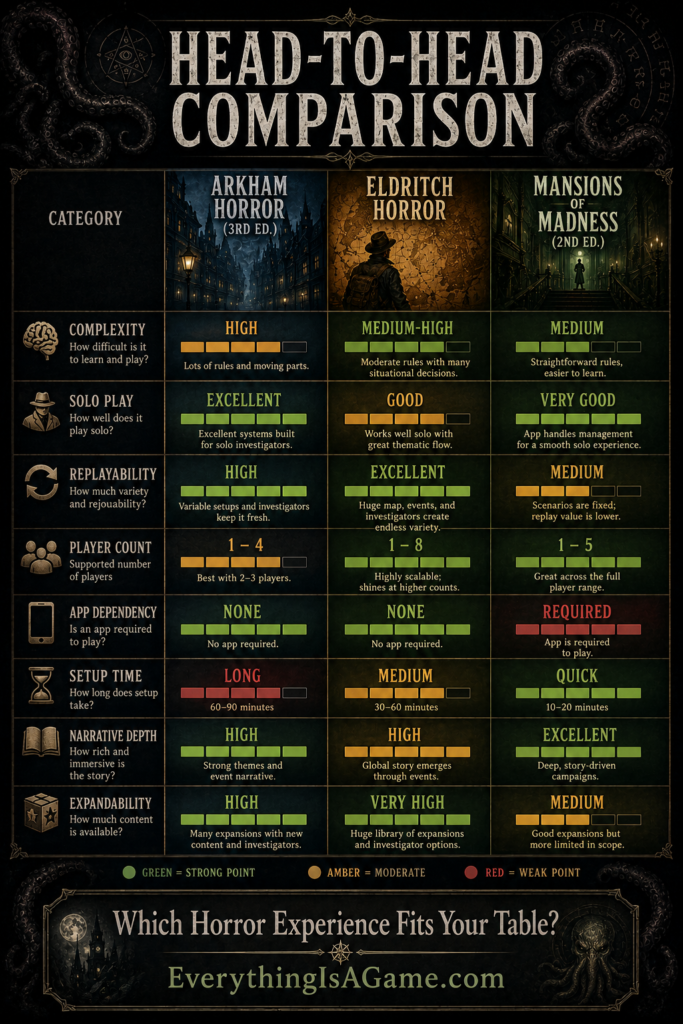
Complexity and Learning Curve
Mansions of Madness wins this category without question. The app handles the most opaque parts of the ruleset, leaving players to focus on decisions rather than administration. Eldritch Horror sits in the middle — it’s not simple, but the streamlined turn structure means the rulebook covers less ground than Arkham Horror’s. Arkham Horror Third Edition requires the most rules investment upfront, though it rewards that investment with the most mechanically satisfying experience once you’re comfortable.
Atmosphere and Narrative
Mansions of Madness delivers the most personal narrative — the app creates actual story beats that respond to what the investigators do, and the miniatures and room tiles make the physical space feel inhabited. Arkham Horror produces the richest location-based flavour. Eldritch Horror tells the grandest story but sacrifices some atmospheric detail to do it.
Replayability
Eldritch Horror has the highest replayability of the three. The combination of random Ancient One selection, investigator variety, and encounter card shuffling means no two campaigns feel identical. Arkham Horror is close behind, particularly with expansions. Mansions of Madness is the weakest here — scenarios have fixed narratives that lose their mystery once you know them, though the scenario catalogue has grown substantially with expansions.
Solo Play
All three games support solo play, but the experience varies. Mansions of Madness works well solo thanks to the app’s management — the administrative overhead is low, and the story-driven structure doesn’t depend on player interaction. Eldritch Horror is manageable solo but designed around investigator coordination, so some of its best mechanics feel muted with a single player. Arkham Horror Third Edition has a well-developed solo ruleset and is considered one of the stronger solo gaming experiences in the cooperative game genre.
Value and Expandability
All three are premium-priced games with extensive expansion ranges. Mansions of Madness requires the most investment to build out the scenario library. Eldritch Horror and Arkham Horror both have large expansion catalogues that add significant content. If you want a single core box experience that stands on its own, Eldritch Horror offers the most complete game out of the box.
Which Game Should You Choose?
The decision usually comes down to what kind of experience you’re optimising for.
Choose Mansions of Madness if you want a narrative adventure that plays like an interactive story, you’re introducing new players to this style of game, or you want something that creates a cinematic experience without demanding a heavy rules investment. It’s also the best choice for groups who want to feel like they’re starring in a Lovecraft film rather than executing a strategy.
Choose Eldritch Horror if you want epic cooperative gameplay at larger player counts, you’re interested in a global-scale adventure with high replayability, or you want to feel the pressure of managing a worldwide crisis with limited resources. It’s the best all-round choice for regular gaming groups who’ll play it repeatedly over time.
Choose Arkham Horror if you want the deepest tactical experience, the richest sense of place, and the most mechanically rewarding challenge. It’s the game for players who love complex strategy and are willing to invest the time to master it.
The good news: none of these is a bad choice. All three are excellent games in a beloved thematic universe. The question isn’t which game is best — it’s which experience you want to have tonight.
What draws you to Lovecraftian board games — the atmosphere, the cooperative mechanics, or the punishing difficulty? And if you’ve played all three, which one keeps making it back to the table? Let us know in the comments.
Want to stay up to date with new game releases and strategy content? Subscribe to the Everything Is A Game newsletter for the latest.
Continue Your Journey
- The Scariest Board Games You Can Buy Right Now — Horror gaming ranked by genuine dread factor
- Eldritch Horror: Rules Explained for New Players — A clear walkthrough of the core ruleset
- Best Cooperative Strategy Games — More team-based games worth adding to your shelf
- Best Solo Board Games — Great options for playing alone, including several in this genre
- Best Halloween Board Games — Themed picks for your next horror game night