
As an Amazon Associate I earn from qualifying purchases and sometimes recommend products from other sellers at no extra cost you. For more details see my disclosure policy and privacy policy.
You’ve opened forty packs, your collection is a pile of commons you’ll never play, and the one card your deck actually needs still hasn’t shown up. Welcome to the moment every MTG Arena player hits eventually, where Gold, Gems, and Wildcards stop being background numbers and start feeling like a system you’re expected to understand without anyone explaining it. Here’s that explanation, in plain terms, with the actual decisions that matter once you know how it works.
🃏 Gold, Gems, and Why They’re Not the Same Thing
If you’ve been playing MTG Arena for a few weeks, you’ve probably noticed two currencies sitting in your top bar and wondered why the game bothers with both. Gold is your grind currency. Gems are your convenience currency, and only one of those two can be bought with real money.
Gold comes from playing the game. Daily quests hand you 500 to 750 Gold for hitting simple targets (cast a certain number of spells, win with a colour, that sort of thing), and your first four wins of the day each pay out Gold on a shrinking scale. String enough of those together and Gold funds entire draft queues without you spending a cent.
Gems are different. You can earn a trickle of them from strong event finishes, but the bulk of most players’ Gem balance comes from buying them outright. Gems are what you’d spend on cosmetics, on entering premium events like traditional Draft, or on Wildcard Bundles in the Store. Treat any real-money Gem purchase as buying convenience, not as an investment, since nothing in Arena is designed to appreciate in value.
🎴 The Four Wildcards, and the Track That Guarantees Them
Every card in Standard exists at one of four rarities: Common, Uncommon, Rare, or Mythic Rare. Wildcards mirror those same four tiers, and a Wildcard of a given rarity can be traded in for any single card of that same rarity, no matter which set it’s from. That’s the entire system in one sentence: match the wildcard tier to the card tier and craft whatever you’re missing.
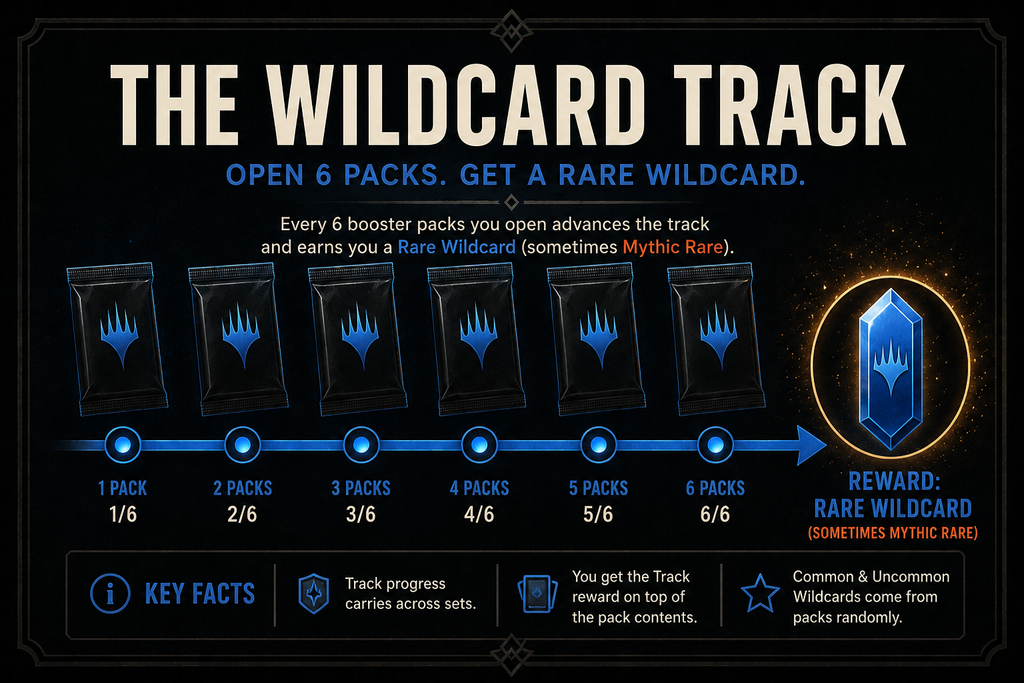
The Wildcard Track is what makes this reliable instead of pure luck. Every six booster packs you open count as one step, and each step guarantees you a Rare Wildcard, with an occasional step upgrading to a Mythic Rare Wildcard instead. You don’t need to pull a rare from the pack itself. The Track hands you one regardless, on top of whatever the pack actually contained.
Common and Uncommon Wildcards show up more loosely inside packs themselves, replacing a normal card slot at random. They’re far more plentiful than Rares and Mythics, which is exactly why new players tend to hoard the wrong ones. Save your patience for Rares and Mythics. Commons and Uncommons will pile up on their own.
💰 Crack Packs or Save Wildcards? It Depends on Your Collection Stage
This is the question every still-newish player asks, and the honest answer is that it changes as your collection grows. In your first few weeks, cracking packs is almost always correct. You’re missing commons and uncommons across the board, and only packs fill those gaps efficiently since Wildcards are precious and better saved for rares.
Once your commons and uncommons are mostly filled in (a natural side effect of opening a few dozen packs for any new set), the maths flips. At that point you already own four copies of most commons and uncommons, so new packs mostly hand you duplicates. That’s when Rare and Mythic Wildcards become your main lever for actually finishing decks, since you can point them directly at the cards a budget Standard deck or a stronger Commander deck actually needs.
A simple rule that holds up well: if you don’t yet own a playable two-colour deck in your preferred format, keep cracking packs. Once you do, start banking Wildcards for specific, deliberate upgrades rather than spending them the moment you get them.
⚠️ The Mistakes That Waste a New Collection
The single most common early mistake is spending a Rare or Mythic Wildcard on an off-meta pet card the week you get it, before checking whether it’s actually good. Cards rotate in and out of relevance fast, and what looks exciting on spoiler day sometimes ages badly within a month once the Standard meta settles.
A close second is ignoring duplicate protection entirely. Once you own four copies of a common or uncommon, extra copies of that card stop being wasted, since they automatically start filling your Vault instead (more on that below). Some newer players don’t realise this and assume anything beyond four copies is simply gone.
The third mistake is treating every Wildcard the same regardless of format. A Rare that completes a fun Historic Brawl build isn’t wasted, but if your actual goal is a competitive ramp or combo shell in Standard, spend with that goal in mind first and let the fun brews come later.
🔒 The Vault: Your Long-Term Safety Net
The Vault is a meter that fills automatically once you’re sitting on excess Commons and Uncommons, meaning any copy beyond your fourth of a given card. Every extra copy nudges the Vault forward. Once it hits 100%, it empties out and rewards you with a batch of Wildcards, currently one Mythic Rare, two Rares, and three Uncommons.
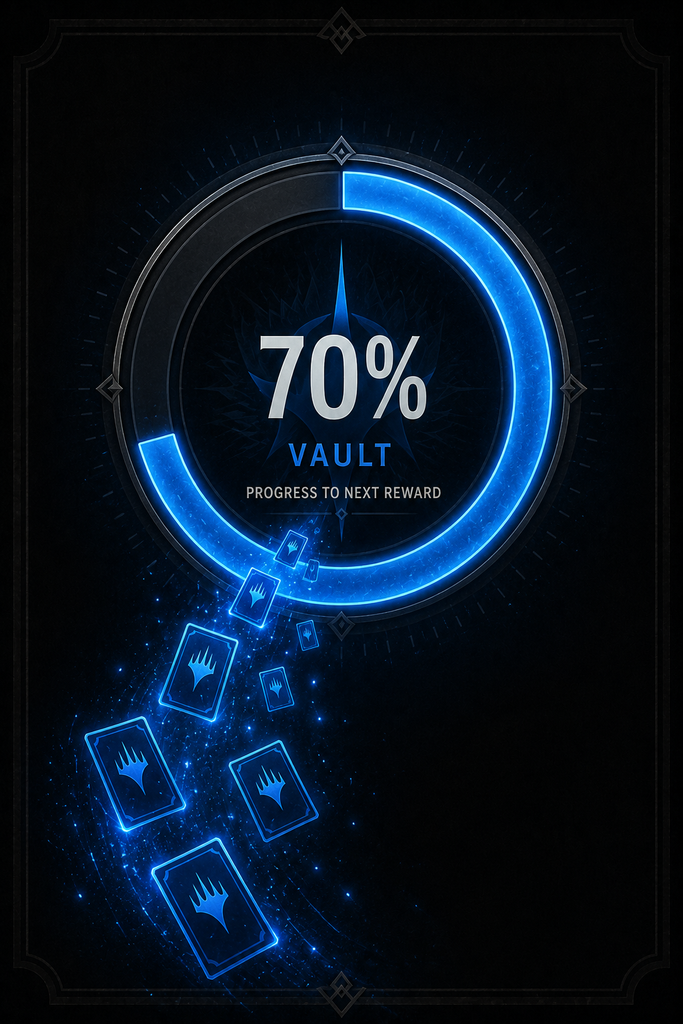
This matters because it means duplicates you can’t use are never fully wasted. If you crack a lot of packs early on, expect the Vault to fill reasonably often at first, then slow down as your collection matures and fewer of your pulls are dupes.
There’s also a Gem conversion layer working alongside it: once you own four copies of every rare or mythic in a given set, opening more packs from that set converts extra rares and mythics into a small Gem refund instead of useless cards. It’s a small trickle, but it means nothing is ever a complete loss once your collection for a set is truly finished.
🗓️ Timing Wildcard Spend Around Standard Rotation
Standard rotates on a yearly cycle, dropping the oldest sets and keeping roughly the two most recent years of cards legal. Spending your best Wildcards on a card from a set that’s about to rotate out is one of the fastest ways to feel buyer’s remorse, so it pays to know roughly where you are in that cycle before committing Rares to a new deck.
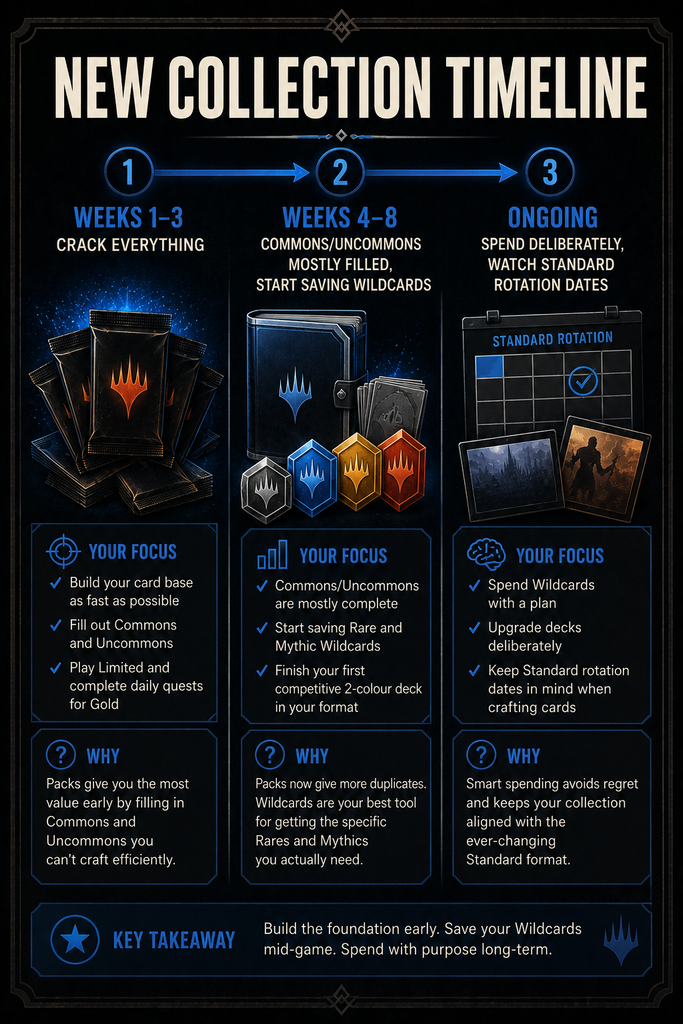
If a new set just released, cards from it are safe bets for a long while yet. If you’re crafting toward the tail end of a set’s legal window, weigh whether that card has a home in Historic, Explorer, or another non-rotating format too, so the Wildcard keeps paying off even after Standard moves on. Watching which decks are actually winning right now is a faster way to judge staying power than guessing from spoilers alone.
🎯 The Short Version
Gold funds your everyday grind, Gems are the premium layer you only need for extras, and Wildcards are the one true equaliser between “I opened the right pack” and “I can build the deck I actually want.” Crack packs early, save Wildcards once your collection matures, and let the Vault quietly clean up whatever falls through the cracks.
You’ll make a few suboptimal calls along the way. Everyone does. The system is forgiving enough that a wasted Rare here or there won’t set you back for long, especially once you’re deliberate about spending toward one format instead of scattering Wildcards across everything at once.