
As an Amazon Associate I earn from qualifying purchases and sometimes recommend products from other sellers at no extra cost you. For more details see my disclosure policy and privacy policy.
You can play thousands of games of Magic on Arena and never once swap a card between games. That is not a flaw in you. It is simply how the most popular queue works, and it leaves a gap that only shows up the first time you sit down at a paper table and a judge says, “Sideboards in, please.”
Sideboarding is a skill, and skills can be trained. This guide shows you how to sideboard in MTG with a simple repeatable process, which mistakes cost the most games, and how to practise on Arena before it matters in paper.
🎯 Why Bo1 Leaves a Skill Gap
In a single-game match, you pick a deck, shuffle up and play the same 60 cards from start to finish. There is no second game to adjust for, so there is nothing to learn from. Your deck either handles the matchup or it does not.
Wizards of the Coast’s own State of the Formats 2026 post says 93% of ranked Standard games on Arena are Best-of-One. If that describes you, you are in the overwhelming majority, and you have had very little reason to think about your sideboard at all.
Paper play is different. Tournaments, Friday Night Magic and most local events run matches as best-of-three, with a 15-card sideboard sitting beside you. If you have never built that mindset, the extra games feel like extra work rather than extra opportunity.
If you want the full picture of how the two formats differ, our guide to Bo1 vs Bo3 on MTG Arena covers it. This post assumes you already know the difference and want to get good at the part Bo1 skips.
📦 What a Sideboard Is Actually For
A sideboard is a pool of up to 15 cards that sits outside your main deck. Between games of a match, you can swap cards from your sideboard into your deck and vice versa, as long as the main deck stays at its minimum size. In practice, most players keep it at exactly 60.
Think of it as plan A and plan B. Your main deck is plan A: the configuration that performs best against a typical field. Your sideboard holds the tools for plan B, the configuration that performs best against the specific opponent across the table.
That framing matters because it changes how you build. A good sideboard is not a dumping ground for cards that nearly made the cut. Each slot answers a question: what do I do against fast aggression, against a deck full of artifacts, against a slow deck that wins with one big threat?
If you cannot name the matchup a sideboard card is there for, it probably should not be there.
🔍 A Repeatable Process for Sideboarding
You do not need to memorise swap guides. You need a process you can run on any matchup, including ones you have never seen. Here it is in three questions.
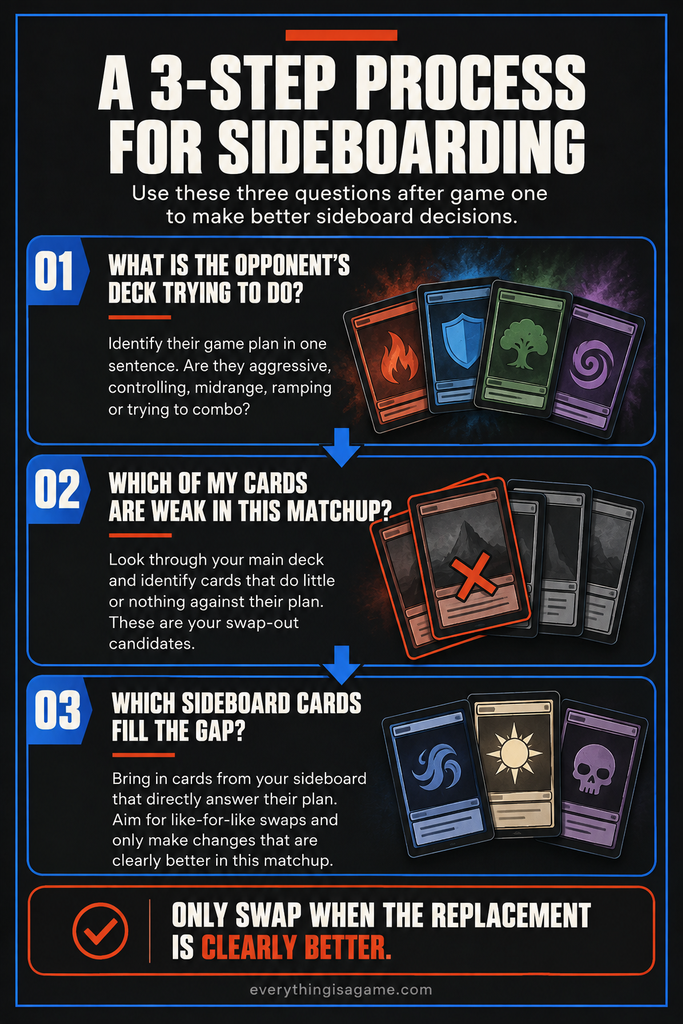
Step 1: What is the opponent’s deck trying to do?
Before you touch a card, name their game plan in one sentence. “They want to curve out and kill me by turn six.” “They want to survive, then land a few powerful threats.” “They want to assemble a combination of cards and win on the spot.”
Everything else follows from that sentence. If you cannot write it after game one, pay more attention in game two. Game one is your free scouting report.
Step 2: Which of my cards are weak in this matchup?
Go through your main deck and flag anything that does little against their plan. A removal spell that only hits large creatures is a blank card against a swarm of small ones. A slow, expensive threat may be too late against a fast deck.
Look for cards that are not just worse but close to dead. Those are your swap-out candidates, and you want a small, honest list.
Step 3: Which sideboard cards fill the gap?
Now match the weak slots to what your sideboard offers. You are looking for like-for-like swaps: cheap interaction for cheap interaction, a threat for a threat, a card that answers their key plan for one that does not.
Only swap when the replacement is clearly better in this matchup. If the answer is “marginally”, leave it alone.
⚖️ The Archetype Lens
You can run that process more quickly if you know what each type of deck usually wants from you. These are rules of thumb, not decklists, and they hold regardless of which cards are currently popular.
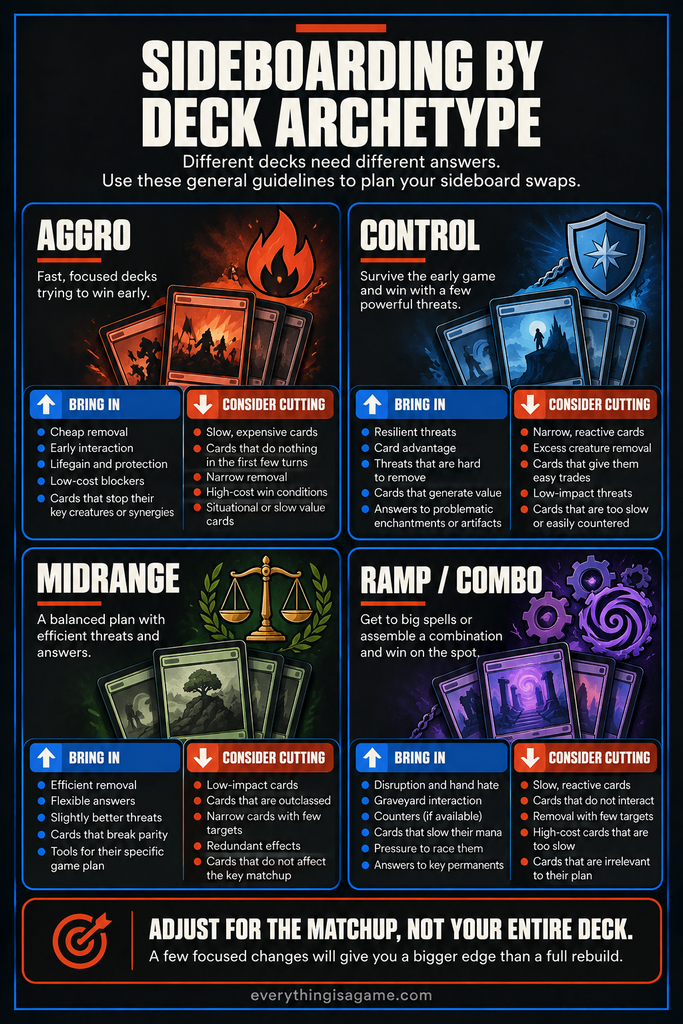
Against aggressive decks, you generally want to lower your curve, add cheap interaction and trim expensive cards that do nothing in the first few turns. Our look at aggro on MTG Arena explains what those decks are trying to do and why speed matters so much.
Against control decks, you often want the opposite. Cut narrow, reactive cards, add resilient threats and cards that generate value, and avoid giving them easy trades. If you are the control player yourself, our guide to winning with control on MTG Arena is a good companion read.
Against midrange decks, you are usually in a fair fight, so the edge comes from slightly better answers and slightly better threats. Our piece on how to play midrange on MTG Arena covers the thinking behind those decks.
Against ramp and combo, the question is whether you can disrupt them or race them. Check out ramp decks on MTG Arena and combo on MTG Arena to see what they are trying to pull off, so you know which of your cards actually interferes.
🚫 Common Sideboarding Mistakes
Most sideboarding errors fall into a handful of patterns. Learning to spot them will save you more games than any clever swap.
- Overboarding. Swapping six or seven cards because you can. Every swap pulls your deck further from the configuration you built and tested, so each one needs a real reason.
- Breaking the mana curve. Swapping three cheap cards for three expensive ones leaves you stuck with clunky draws. Swap like for like on cost wherever you can.
- Cutting your win conditions. It is tempting to take out threats that look slow. If you remove every way to actually win, you have built a deck that cannot close the game.
- Ignoring the mana. If you move many cards of one colour in or out, your land count and colour balance may need to move too.
- Reacting to one game. One strange draw does not tell you what the opponent’s deck does. Sideboard for their plan, not for the unlucky topdeck that beat you.
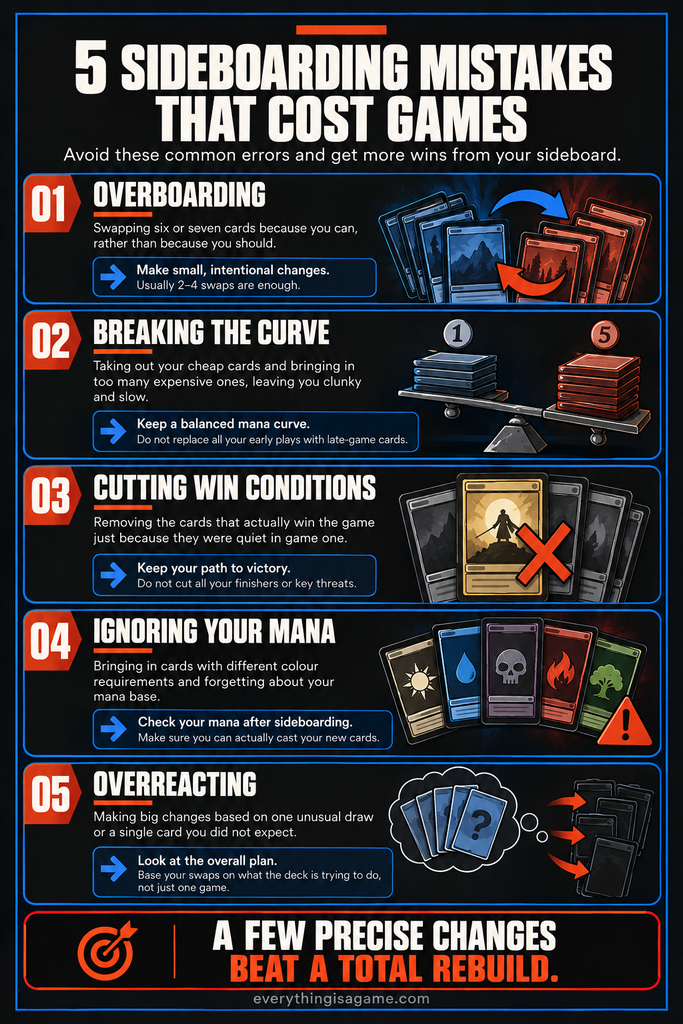
If you remember one thing, make it this: a good sideboard plan is small. A few precise changes beat a total rebuild almost every time.
🧠 Playing on the Play or the Draw
In paper, the loser of the previous game normally chooses whether to play or draw, and that choice interacts with your sideboard plan. Fast decks often want to be on the play. Slower decks that need time may be comfortable drawing.
Your sideboarding should account for it. If you expect to be on the draw, you have an extra card, so you can afford a slightly higher curve. If you expect to be on the play, tight and efficient usually wins.
This is the sort of decision Bo1 never asks you to make. It is worth thinking about before your first paper match, not during it.
🖥️ How to Practise Sideboarding on Arena
Here is the good news. Arena does let you train this skill. You just have to choose the right queues.
Play the Bo3 queues
Arena offers Best-of-Three play for Constructed. According to MTG Arena Zone’s formats and queues guide, Traditional Play is an unranked best-of-three queue with sideboarding, and there is also a Traditional Ranked option on the Constructed ladder.
The Play queue is the gentle place to start, since there is no ladder pressure. Treat each match as a lab: scout in game one, apply the three-question process, and see whether your changes help.
Expect matches to run longer. The same State of the Formats post notes that Best-of-Three has stayed niche on Arena because matches take longer, so queues can feel quieter than Bo1.
Try Traditional Draft
If you also enjoy limited formats, Traditional Draft is built for exactly this. Draftsim describes it as best-of-three with a sideboard, and unranked, which makes it a low-stakes place to practise.
Limited sideboarding is a different flavour. You have your whole draft pool to draw from, so you get to think about which spare cards answer which opponents. Our breakdown of Traditional Draft vs Quick Draft vs Premier Draft will help you pick the right event.
The State of the Formats post also says Traditional Draft plays a role for people who want to practise matches the way they would play in person. That is exactly our goal here.
Find the sideboard in the client
Arena’s sideboarding screen appears between games in a best-of-three match, and it lets you swap cards between your main deck and sideboard. Draftsim’s sideboard guide shows the layouts. Layouts and interface details can change with client updates, so look at the screen on your own client the first time you play a Bo3 match rather than trusting any screenshot.
Build your deck with a full 15-card sideboard before you queue. An empty sideboard gives you nothing to practise with.
Review your own games
The most effective habit is the simplest. After each Bo3 match, ask yourself what you swapped, why, and whether it helped. Write it down if you can.
You will quickly see patterns. Maybe you consistently over-swap, or you keep forgetting to adjust your land count. Those are exactly the habits you want to find on Arena, where a mistake costs you nothing but a few minutes.
It also helps to practise your own deck’s weak matchups. If you keep losing to one archetype, build a plan for it deliberately and test it across several matches.
🃏 Carrying the Skill Into Paper
When you move to a paper table, the process stays the same. What changes is the logistics, and a few things are worth preparing.
You need to physically separate your sideboard and keep track of what you swap. Many players write a short sideboard plan on a slip of paper for each major matchup, so they do not have to improvise under pressure. A deck box with a divider for the sideboard keeps it tidy, and our piece on sleeves, storage and deck boxes covers how to look after your paper collection.
For a low-pressure first event, our guide to playing your first FNM is a good place to start. Prerelease events are friendlier still, and drafting at a paper prerelease explains what first-timers get wrong.
Remember to put your sideboard back into the deck before the next match begins. Paper has no client to reset it for you, and forgetting is a surprisingly common mistake.
🏁 Final Thoughts
Bo1 is a fine way to play, and for plenty of Arena regulars it is the right choice. But if you ever plan to sit down at a paper table, sideboarding is worth learning, and you do not need to wait for paper to learn it.
Pick one Bo3 queue this week. Play a handful of matches, run the three questions, and review what you changed. Within a few sessions, the plan A and plan B habit will start to feel automatic.