
As an Amazon Associate I earn from qualifying purchases and sometimes recommend products from other sellers at no extra cost you. For more details see my disclosure policy and privacy policy.
You have built the deck. You have sleeved it, shuffled it and carried it to the local game store, and now four people are looking at you across a table asking, “So, how strong is it?”
In Arena, matchmaking answers that question before you ever sit down. In paper Commander, nobody answers it for you. If you get it wrong, one mismatched deck can flatten a whole evening for four people.
This post picks up where Commander Deckbuilding 101: Your First 100-Card Singleton Deck leaves off. That guide helps you build the deck. This one helps you talk about it.
🎲 Why Commander Needs a Conversation First
Most Magic formats come with a built-in referee. Arena’s ladder pairs you with someone at a similar rank, and a paper Friday Night Magic event puts you against opponents who all chose the same format that night.
Commander has no such filter. Four players show up with decks built to four different ideas of fun, and the format itself does nothing to line them up.
That is why the community leans so heavily on a pre-game chat. It is the paper-side skill that MTG Paper vs Arena: Why Your Deck Plays Differently hints at: on Arena the client handles a lot for you, and in paper the table handles it.
A mismatch hurts more in multiplayer than in a one-on-one duel. In a two-player game, the weaker deck loses and you shuffle up again. In a pod, a very strong deck can end the game before three of the four players have done anything, and a very weak deck can leave its owner watching.
📏 What “Power Level” Actually Measures
Most of us grew up describing decks as a number out of ten. It feels natural, and it breaks down quickly.
A “7” at one table is a “5” at another, because nobody agrees on what a 10 looks like. Two decks can share a number and play nothing alike.
A single score hides the things that actually matter at the table. Here are the four that tend to decide how a game feels:
- Speed: how many turns before the deck can win if left alone.
- Consistency: how reliably it does its thing, and how well it recovers when something goes wrong.
- Interaction: how much it can answer other people’s plans, and how often it chooses to.
- How it wins: a slow combat grind, a pile of value, or a sudden combo.
Two decks can both be fast, but one wins through damage everyone can see coming, and the other wins out of nowhere. Those feel very different to play against, even with the same number attached.
So treat power level as a description, not a grade. “It wins around turn eight, it can answer one or two threats, and it usually wins by attacking” tells a pod far more than “it’s a 6”.
🧭 The Official Brackets: A Shared Vocabulary
Wizards of the Coast’s Commander Format Panel now offers a common language called Commander Brackets. Check the current wording at the official Commander format page, because the system has been adjusted a few times.
At the time of writing, the brackets are still labelled as a beta. The panel’s own update says the brackets are “a tool to guide pregame conversations”, not a rule about who may play whom.
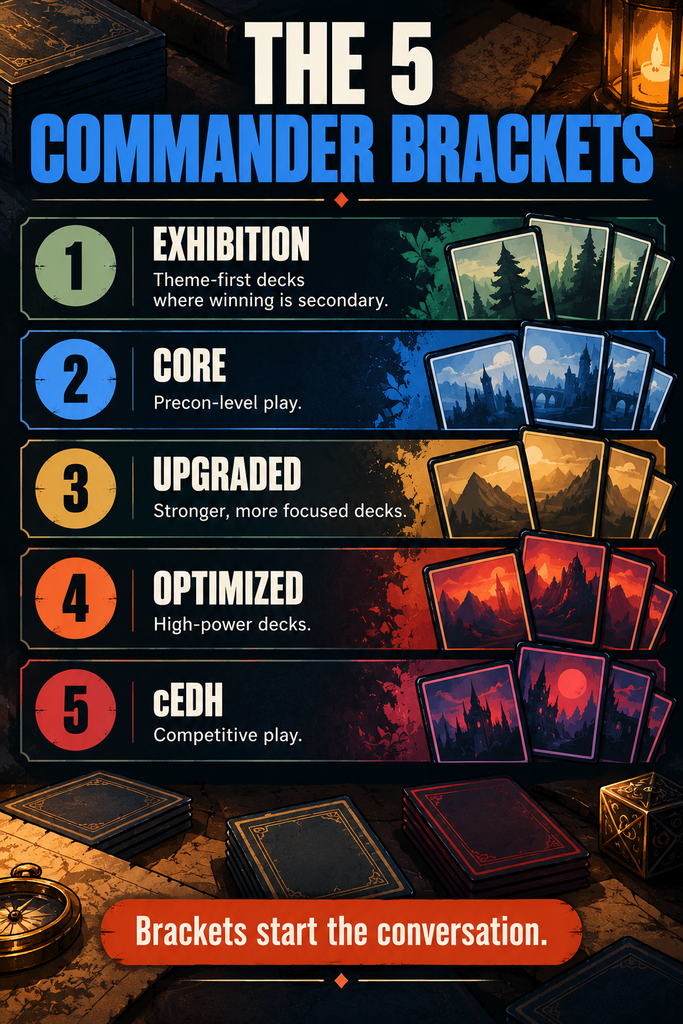
In my own words, the five brackets look like this:
- Bracket 1, Exhibition: theme-first decks where winning is secondary. No Game Changers, no mass land destruction, no extra-turn chains and no intentional two-card combos.
- Bracket 2, Core: roughly the strength of an average modern preconstructed deck. Same restrictions as Bracket 1, though a few extra turns are fine if they are not chained or looped.
- Bracket 3, Upgraded: stronger than a precon but not fully optimised. Up to three Game Changers, no mass land denial, and no two-card combos early in the game.
- Bracket 4, Optimized: the strongest decks short of a metagame mindset. Only the banned list limits you.
- Bracket 5, cEDH: high power and a competitive, metagame-focused approach, also limited only by the banned list.
Game Changers are a list of individual cards that Wizards flags as much stronger than they look on the page. Because the list has been revised since launch, always read it fresh on Wizards’ Commander page rather than trusting a memory or an old article.
Wizards’ October 2025 update also added a rough expectation of how long a game lasts in each bracket, from around nine turns in Bracket 1 down to around four in Bracket 4. Treat that as a guideline, not a rule. Your pod’s real games will vary with the draw.
Brackets are a starting point for the conversation, not the end of it. Saying “Bracket 3” is useful, and saying “Bracket 3, but I run a lot of removal and I win slowly” is better.
🗣️ What Rule 0 Is, and What to Cover
Rule 0 is the community’s name for the pre-game agreement: before you shuffle, the table decides together how this game should go. Wizards’ own bracket announcement confirms the idea is alive and well, noting that “Rule Zero still exists” and that having that conversation is great.
It does not need to take long. A good chat takes two minutes and saves two hours of grumbling.
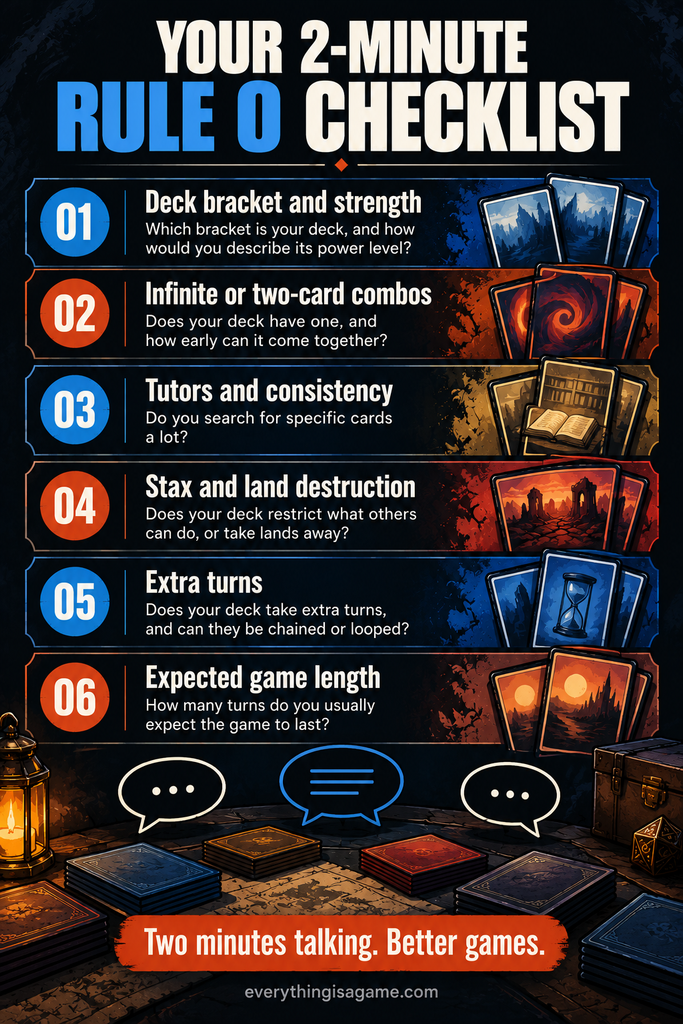
Here is a checklist of what is worth raising:
- Bracket or rough strength: where each deck sits, in plain terms.
- Infinite or two-card combos: does your deck have one, and how early can it come together?
- Tutors: do you search for specific cards a lot?
- Stax and land destruction: decks that restrict what others can do, or take lands away, are a common cause of frustration.
- Extra turns: a few are fine for many tables, but chains tend to annoy people.
- Expected game length: do you want a quick game or a long, politicking one?
Not every table wants every item. The point is that nobody is surprised halfway through the second turn cycle.
🪞 Describing Your Own Deck Honestly
Most of us are bad at rating our own decks. We remember the one glorious game where it won on turn five and forget the dozen games where it sat on a hand full of lands.
Try running through this short self-check instead:
- When does it usually do its main thing? Be honest, and use what actually happens, not the best case.
- What does it do when it is stopped? A deck that has no plan B is weaker than one with options.
- Could it win before anyone else has done much? If the answer is yes, say so.
- Does it have combos you would not enjoy facing? Mention them even if you rarely assemble them.
- How many cards are real power, and how many are filler? Be honest about the ratio.
The aim is to land close to the truth. Under-selling a deck to look modest and over-selling it to look impressive both cause the same problem: someone walks away disappointed.
Descriptions work best when they include a reason. “Mid-power, because it has good card draw but not much protection” is a sentence a pod can use.
A goodstuff pile of strong individual cards and a tight synergy deck can sit in the same bracket and feel completely different. Say which one you brought.
If your deck is a precon with a few swaps, say that too. It gives people a reliable reference point, since most players have seen the original.
🎤 Scripts You Can Steal
Plenty of people stay quiet because they do not know how to start. Here are a few lines to borrow and adapt.
Pitching your deck:
“This is my Bracket 2 deck. It wants to attack with a lot of small creatures, it has a couple of board wipes, and it usually wins around turn eight or nine.”
Asking others about theirs:
“What are you all playing tonight? I’d like to check we’re on a similar page before we start.”
Asking about something specific:
“Does anyone mind if I play something with a two-card combo? It’s not the main plan, but I’d rather ask.”
Flagging a tweak:
“This one is mostly Bracket 2, apart from one card that’s a bit stronger. Is that okay?”
That last one echoes the example in Wizards’ own announcement, which is a good sign that a tidy, honest “Bracket 2, except for this” has official blessing.
None of these need to be formal. You are a person talking to other people about a game, not filing a form.
🔧 When the Table Turns Out Mismatched
Sometimes the chat happens and it still goes sideways. Maybe someone under-described a deck, or maybe nobody realised how different the decks were until turn three.
You have a few options, and none of them are rude:
- Dial it down: the stronger deck can hold back, skip a combo line or play the long game.
- Swap decks: a second deck in your bag is a great way to rescue a game. Keep one low-power backup if you can.
- Play it out for fun: if everyone is happy to carry on, there is no need to stop.
- Call it early and reset: a friendly “should we start over with different decks?” is better than four people grinding through something no one is enjoying.
Afterwards, a bit of friendly feedback helps. “Your deck was great, but it felt faster than the others” is useful and kind. It gives the owner something to adjust without making them feel judged.
It also helps to remember kingmaking, the habit of a player who cannot win picking who does. A mismatched pod creates a lot of it, so setting expectations early protects everyone’s night.
Neither high-power nor casual decks are the problem. Both are valid when the table agrees on what it is playing. The trouble starts only when people expect different things.
🃏 Practice Before You Sit Down
You can prepare for this conversation away from the table. Playing your list against friends is the quickest way to find out how it actually performs.
If you are not sure whether a card list is worth buying, Testing Your Paper Deck on MTG Arena Before You Buy is a handy way to get a feel for it first. For a digital cousin of the format, Historic Brawl on Arena lets you try a Commander-style deck without a pod.
Your local store is a good place to practise the conversation itself. Playing Your First FNM covers what a store night feels like if you are new to it.
It is also worth knowing how reputation works in a small community. Trading Cards in Paper Magic explains how word travels in local playgroups, and it applies to Commander, too: players who describe their decks honestly get invited back.
If you want to understand how your deck wins, Combo on MTG Arena and Control on MTG Arena break down two of the archetypes that most often need a heads-up at the table.
✅ Take It to the Table
A power level is not a score you earn. It is a conversation you have.
Next time you sit down, describe your deck in plain words, ask what the others brought, and agree on how you want the game to feel. That small effort turns a gamble into a good night.
What is the best thing a stranger has said to you before a Commander game? Let us know in the comments below.